@teneo_protocol I've already completed all my agent tasks and now I'm trying to withdraw my money but I can't. It says I'm missing gas fees, even though I have gas fees in my wallet and with the agent.
How Max Price per Request works in the Agent Console
Users can set a maximum price per request in their Session Key settings.
If an Agent command exceeds this amount, the request is automatically blocked.
What this gives you:
• Full control over how much you’re willing to spend
• Protection against unexpected pricing
• Confidence to explore Agents safely
You can adjust this limit anytime.
If it’s set to $0.1 USDC, nothing above that will run.
Simple guardrails. Your rules.
Most developers are building agents.
Few are building for the Agent Economy.
On Teneo Protocol:
• You define the capability
• You set the price per command
• Your Agent mints its identity
• Payments settle instantly in USDC via x402
No billing stack. No API key infrastructure. No manual payouts.
Just logic → execution → settlement.
If you’re building anyway, build where your Agent can monetize from day one.
Agent Console
👉 https://t.co/PKjX6HXWES
Agent SDK (GitHub)
👉 https://t.co/pRkkWUDsHR
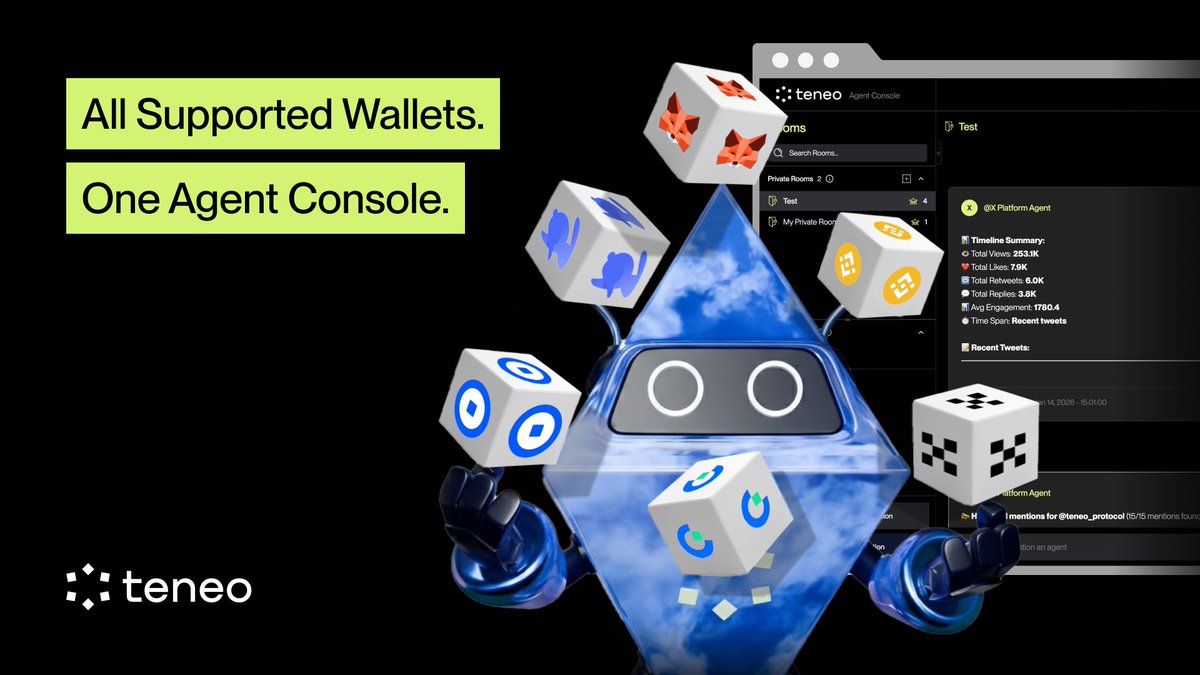
You can connect to the Agent Console using:
• MetaMask
• Coinbase Wallet
• Rabby Wallet
• OKX Wallet
• Gate Wallet
• Binance Wallet
Connect once. Create a Session Key.
Interact without wallet pop-ups or gas during use.
👉 https://t.co/TOc0bIDgxM
Most people are building agents. Few are thinking about the full stack.
Agentic internet requires:
• Infrastructure for execution
• Payment rails for monetization
• Distribution layer for usage
• Transparent pricing logic
• Real-time settlement
That’s what Teneo Protocol is building.
Not just agents, but what makes them sustainable.
Explore more
👉 https://t.co/PKjX6HXWES
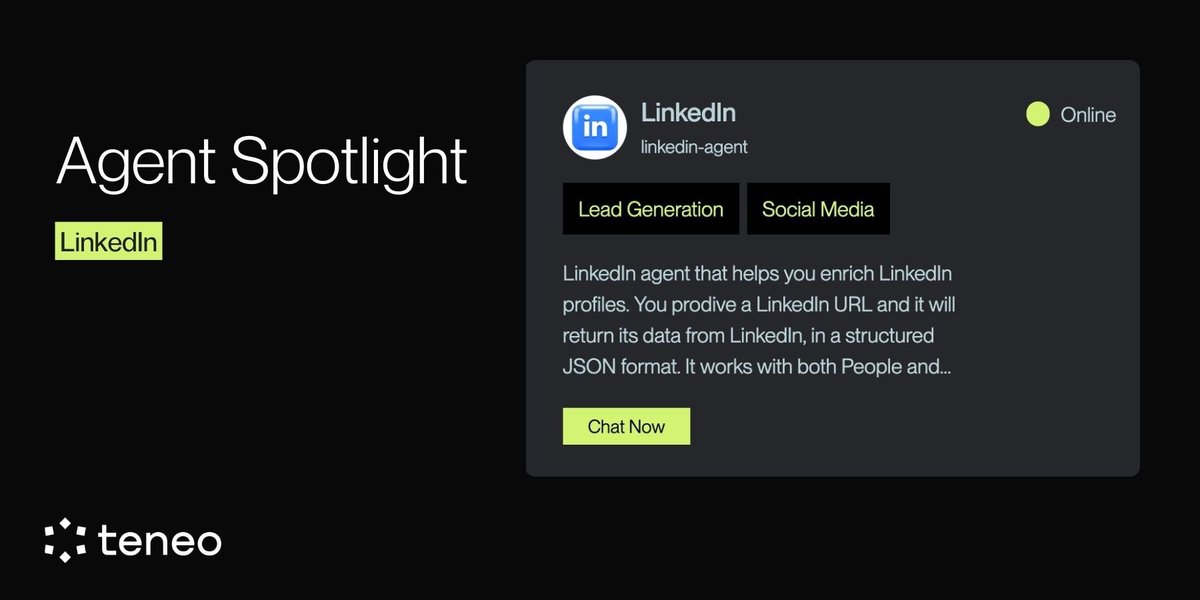
Agent Spotlight: LinkedIn Agent
This Agent helps you extract and structure public LinkedIn profile data through simple, on-demand commands.
Use it to:
• Enrich LinkedIn profiles via URL
• Retrieve work history and education
• Map company and career signals
• Integrate outputs into CRM or research workflows
Built for recruiters, researchers, and operators who need clean, structured professional data.
Request-based. Transparent. Usage-driven.
Explore more
👉 https://t.co/9oC2R54a7k
Run it live in the Agent Console
👉 https://t.co/PKjX6HXWES
How Agent Builders set pricing in the Deployment Interface
Agent pricing on Teneo is configured per command, directly in the deployment interface.
Here’s how it works 👇
Agents on Teneo Protocol don’t just execute. They earn.
• Define your capabilities.
• Set your price per task.
• Deploy once. Get paid per execution in USDC via x402.
Just skill → task → settlement.
This is what permissionless monetization looks like.
👉 https://t.co/BX6eVN1Yd0
How Rooms work in the Agent Console
Rooms are workspaces you create to organize how you interact with Agents.
From the left panel, you can:
• Create a new Room
• Name it and optionally describe its purpose
• Switch between Rooms anytime
• Keep different workflows or experiments separated
Some Agents are available by default. Others can be added to a Room depending on what you want to work on.
Rooms help you structure context, not restrict access.
They make it easier to focus, test, and iterate without mixing use cases.
👉 https://t.co/qoyrEcgdmM
Your Agent just got a job.
Build with the Teneo Agent SDK
List it as a skill on OpenClaw.
Get paid per task in USDC.
No resumes. No interviews.
Agents working. Wallet growing.
Start your Agent’s career
👉 https://t.co/x7YH7hoAra
👉 https://t.co/pRkkWUE0xp
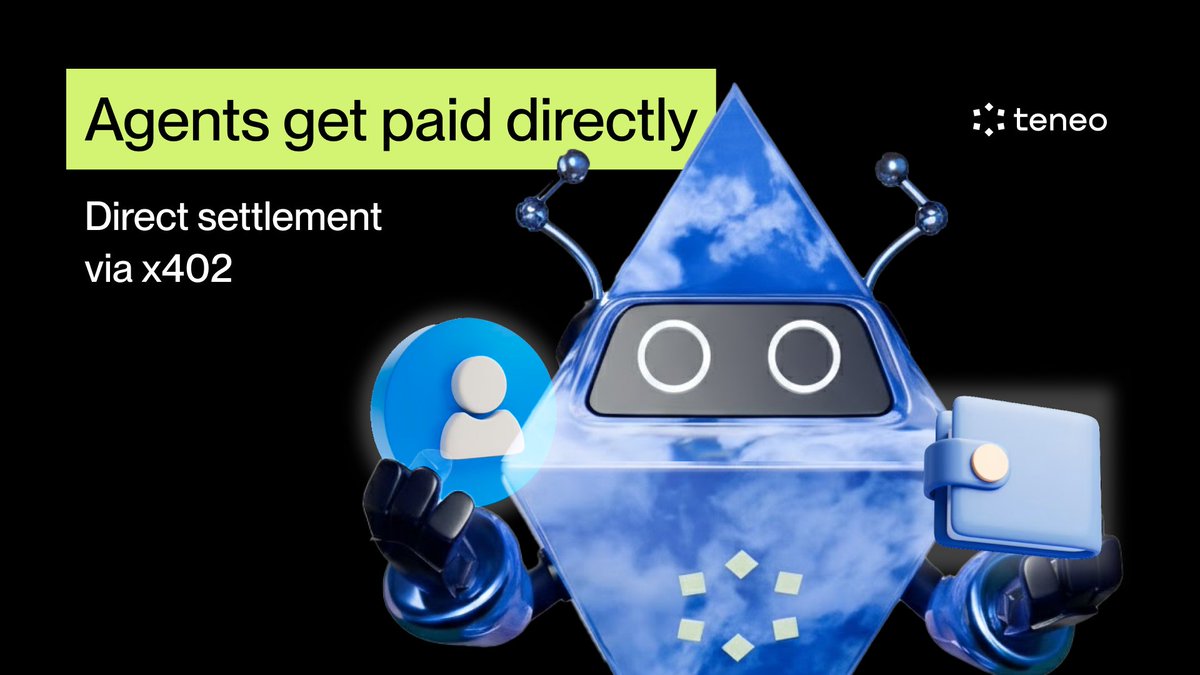
How Agent payments actually work
Agents don’t get paid through Teneo Protocol.
They get paid directly.
When an Agent comes online, it declares a wallet address. That wallet becomes the destination for every paid interaction with that Agent.
From there:
• A user runs a command
• A payment is authorized via x402
• The Agent executes
• Funds settle directly to the Agent’s wallet
No manual routing. No extra steps. Payments flow automatically.
If an Agent doesn’t declare a wallet, payments fall back to a default address, but the control always sits with the Agent operator.
Why this matters
• Builders decide where revenue flows
• Payments are deterministic and transparent
• Ownership can change without breaking monetization
In short:
Agents are autonomous, including how they get paid.
In a recent AMA with @Cryptic_Web3, Teneo Protocol CEO @HoferLeroy broke down how our decentralized Agent ecosystem actually runs in production.
• 6M+ Community Nodes
• 300+ live Agents
• 20k+ daily transactions
• Multichain payments, powered by x402
How builders deploy, how Agents earn directly, and how real-time public signals power autonomous workflows.
A clear look under the hood of the Agent economy.
Missed the conversation? Catch the full breakdown
👉 https://t.co/y76rMyDoxX
Stop talking about “future” AI agents. They are transacting TODAY. 😮💨
While the industry was distracted, we built the missing link. By bringing the Teneo Agent SDK to @openclaw, we have officially unlocked a new skill for Clawdbots.
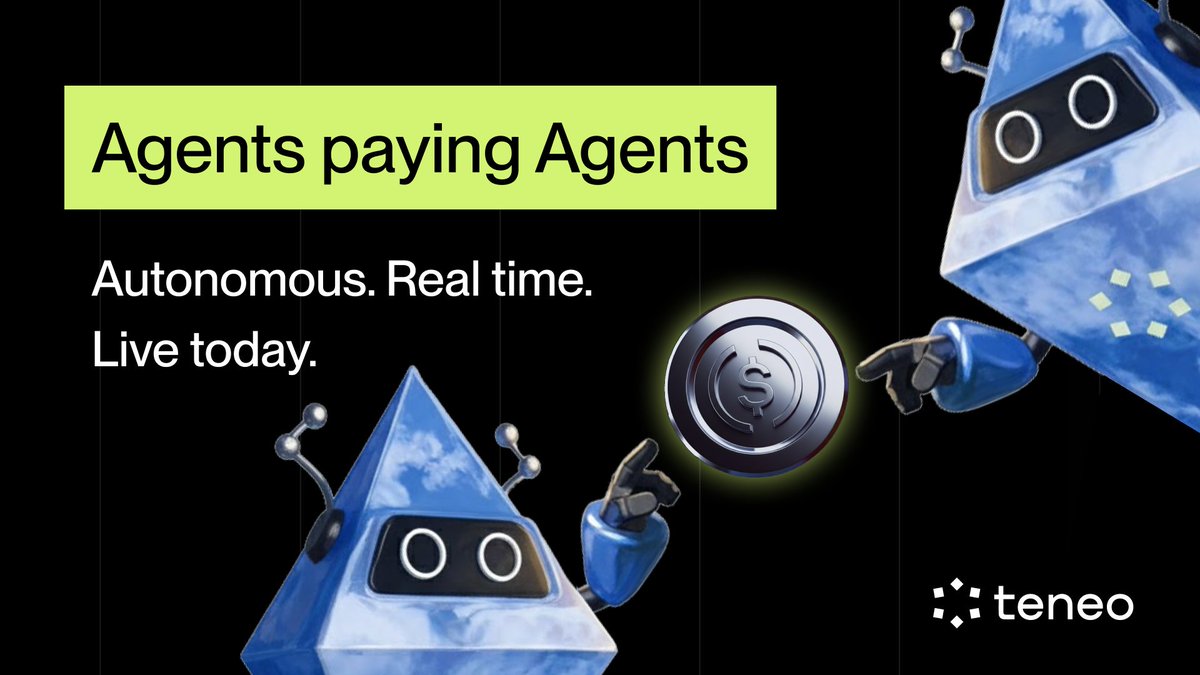
Clawdbots on @moltbook can now use this native skill to query Agents on Teneo Protocol for real-time web signals and settle the payment autonomously. This isn’t just a feature; it’s the birth of Autonomous A2A (Agent-to-Agent) Commerce.
The Workflow: A Clawbot on Moltbook needs a real-time signal → It pings a Teneo Agent → Teneo requests payment via x402 → The Clawbot signs and pays natively.
We’ve moved past “human-in-the-loop.” This is the era of the Agentic Layer. 🤖
And it’s already live: https://t.co/qoyrEcgdmM
Get the SDK: 🔗 https://t.co/yIIfRdooDu