Huawei Publishes V2 of "Tao's Law" Paper, Laying Out a New Path for the Post-Moore Era
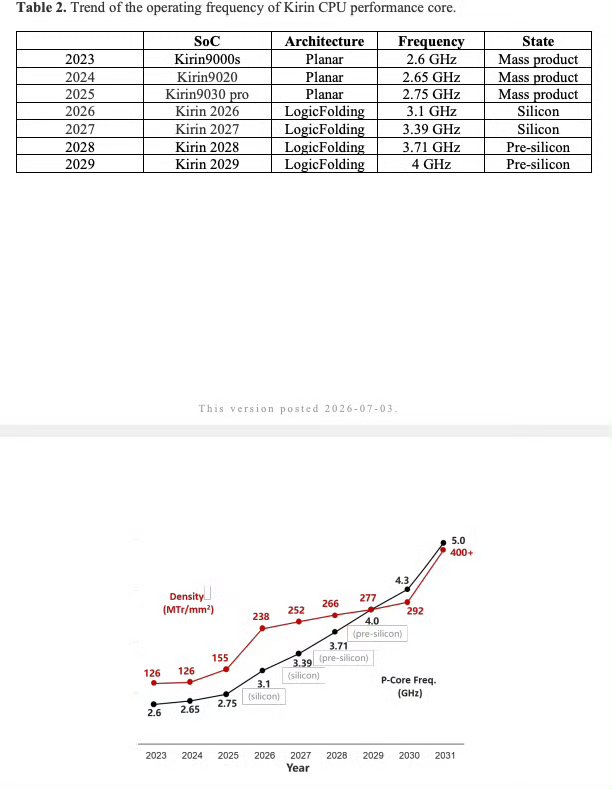
On July 3, Huawei’s He Tingbo officially released Version 2 of the paper "A Time-Scale Miniaturization Theory for Multi-Level Electronic Systems" on the ChinaXiv platform. This update moves the theory from an initial concept to a closed-loop framework backed by real engineering data — offering a homegrown, top-level theoretical foundation for the semiconductor industry beyond Moore’s Law.
Compared to the V1 release in May, the new version expands into a full eight-chapter academic structure, adding practical engineering details such as the LogicFolding fold ratio model, unit-level optimization for 3D hybrid bonding, and a unified interconnect bus architecture. It breaks through the traditional limitation of 3D stacking, which previously only worked at the macro-block level.
For the first time, the paper includes production test data from the Kirin 2026 series, with head-to-head comparisons against previous flagship chips. Using concrete metrics like voltage, frequency, power density, and die area, it demonstrates real-world performance gains from the time-scale miniaturization paradigm.
Rather than following Moore’s Law’s single-minded focus on geometric scaling, Tao’s Law centers on a system-level metric — the time constant τ — to reduce signal transmission delays across devices, circuits, chips, and entire systems. The result: steady gains in computing density without relying on extreme ultraviolet lithography or ever-shrinking process nodes.
This marks a milestone for China’s semiconductor industry — proposing a globally applicable new roadmap for industry evolution, on its own terms.
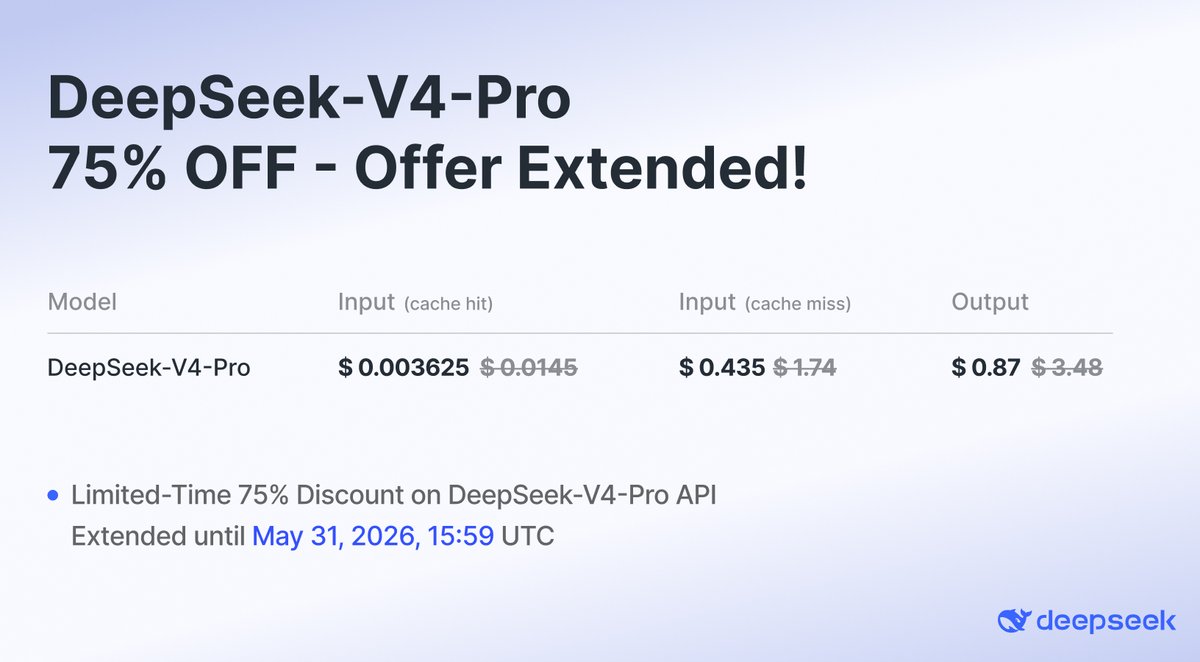
🔥DeepSeek Input Cache Price Drop!
Effective immediately, the price for input cache hits across the ENTIRE DeepSeek API series is reduced to just 1/10th of the original price! Build more efficiently for less.
📌Reminder: The DeepSeek-V4-Pro 75% OFF promotion is still active until May 5th, 2026, 15:59 (UTC Time).
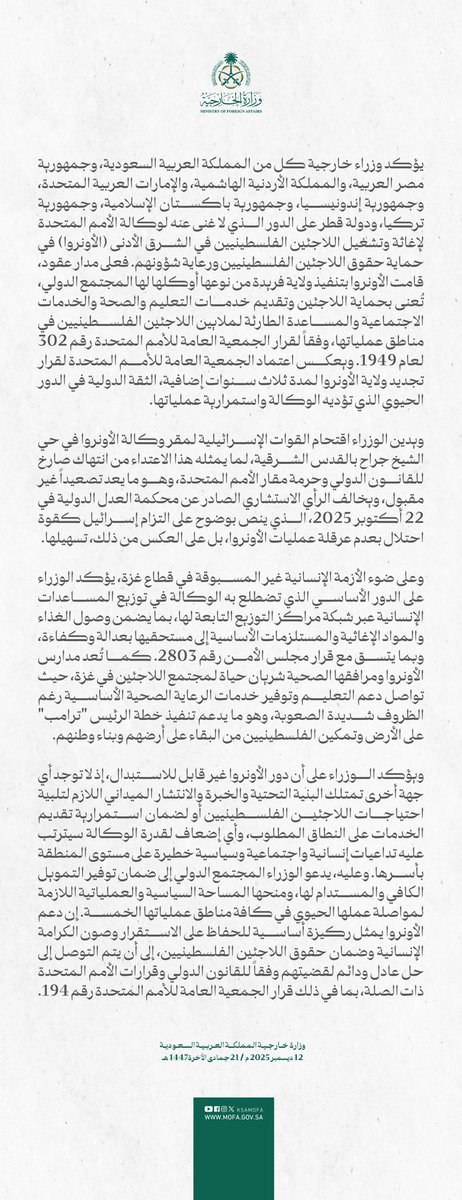
#بيان | يؤكد وزراء خارجية كل من المملكة العربية السعودية، وجمهورية مصر العربية، والمملكة الأردنية الهاشمية، والإمارات العربية المتحدة، وجمهورية إندونيسيا، وجمهورية باكستان الإسلامية، وجمهورية تركيا، ودولة قطر على الدور الذي لا غنى عنه لوكالة الأمم المتحدة لإغاثة وتشغيل اللاجئين الفلسطينيين في الشرق الأدنى (الأونروا) في حماية حقوق اللاجئين الفلسطينيين ورعاية شؤونهم.