Agents on Rails: We ran 8 models against 21 atomic tasks to see which were best at writing Rails code. 3 runs each: a bug report, a security finding, a feature request.
The first benchmark report with findings is now live. So: what did we discover?
As of August 2026:
- Most accurate: @claudeai Opus 5 by @AnthropicAI (by a hair). Solved 92% of runs (58 of 63). (But for a little more than half the cost, you get almost the same accuracy with @Kimi_Moonshot.)
- Cheapest: @OpenAI GPT-5.6 Luna. 73% of runs solved at default medium reasoning effort, and all 63 of its runs cost 90 cents combined.
- Fastest: Luna again, at a median of 3.3 minutes per run task.
- Best combination of all three: @OpenAI GPT-5.6 Sol. 84% accuracy, costing $0.52 and 5 minutes per run.
Read all the findings in the first full benchmark report from @evilmartians here: https://t.co/SxyPPUwDJw
Just Speak
FDA Maharashtra has launched grievance redressal portal for citizens. It is AI enabled platform, having auto assignment, auto escalation and built in accountability with traceability features .
https://t.co/597si71Z6E
#TukaramMundhe#FDA
>Behind Zohran Mamdani's historic mayoral primary win was a decision-making system that coordinated 13,000 members with zero paid staff.
And this system, Loomio, is built in Ruby on @rails and it's open source: https://t.co/if3Dio2sOH
This guy lives near SFO. He built a system that projects every plane flying over his house onto his ceiling in real-time. 🤯
Built it with Claude Code. Open-sourced the whole thing.
→ A tiny radio picks up every aircraft signal overhead
→ A Raspberry Pi decodes it and a projector maps it to your ceiling
→ Airliners, helicopters, Cessnas all live, not a loop
→ Also tracks the sun, moon, stars, and the ISS
→ No internet, no subscription, fully local
→ Total hardware: one radio, one Pi, any 1080p projector
It's called Skylight. Fully open-source on GitHub right now.
Ready-made kit coming to crowdfunding soon for anyone who doesn't want to DIY.
This is the most beautiful thing someone has built with Claude Code.
India's courts produce more data than most SaaS companies.
It's public and Free. Still, nobody is using it.
Every district court publishes cause lists daily. Every High Court puts orders online. Case status, hearing dates, adjournments, judge assignments. All public. All free. eCourts alone has data on over 20 crore cases.
And what are funded legal tech startups doing? Building contract review tools for the 200 large firms that already have budgets. Classic.
Meanwhile the most valuable dataset in Indian legal is sitting on government servers. Updated daily. Ignored completely.
Every judge has patterns. I have seen judges in Saket who dispose of cheque bounce matters in 4 hearings flat. And judges two courtrooms away who take 14 for the same case type. Some adjourn freely on first ask. Some will chew you out for wasting court time.
When a lawyer faces an unfamiliar judge, they call a senior. Ask the clerk. Walk in and hope for the best.
But that judge's last 500 orders are on eCourts. How many NI Act cases did he dispose of last year? Average time to disposal? Does he grant interim relief without hearing the other side? All answerable. Nobody is answering.
A client asks: how long will my case take? Every lawyer makes something up.
Not because they are dishonest. Because they genuinely do not know.
But 5 years of data from that court, that case type, under that judge, gives you a real answer. "14-18 months. Under Judge Sharma, closer to 12."
Now here is the part that changes everything.
You do not need a SaaS company to build this anymore. You do not need funding or a tech team.
A single lawyer with a laptop can scrape a judge's last 200 orders, feed them into an AI, and build a personality model of that judge. How does he reason?
What arguments does he find persuasive? What makes him dismiss an application on the first hearing?
Then do the same for opposing counsel. Do they seek adjournments early?
File bulky replies? Bluff on interim applications or actually follow through?
Now your draft is not generic. Your arguments are written for the specific judge who will read them. Structured to counter the specific lawyer on the other side.
Do this for an arbitrator before your statement of claim. For a tribunal member before your next hearing. Even for your own senior, so the draft you hand them already matches how they think and argue.
At LawSikho, we are now teaching our learners to build exactly this. Not a product. A personal tool on their own laptop for the matters they are actually working on.
The lawyer who walks into court with a personality model of the judge and a pattern analysis of opposing counsel is not just better prepared.
They are playing a different game.
The data is public. The tools are free. The skill takes weeks, not years.
The only question is whether you learn it before the lawyer on the other side does.
Would you like us to make a youtube video and put out on our channel?
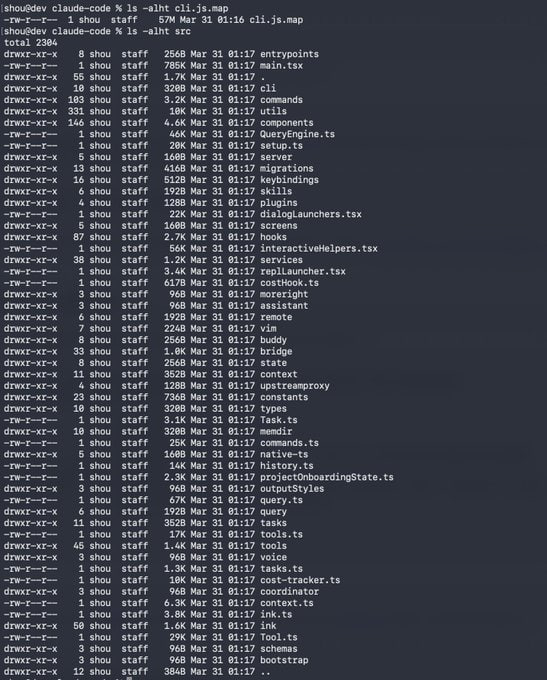
Anthropic accidentally leaked their entire source code yesterday. What happened next is one of the most insane stories in tech history.
> Anthropic pushed a software update for Claude Code at 4AM.
> A debugging file was accidentally bundled inside it.
> That file contained 512,000 lines of their proprietary source code.
> A researcher named Chaofan Shou spotted it within minutes and posted the download link on X.
> 21 million people have seen the thread.
> The entire codebase was downloaded, copied and mirrored across GitHub before Anthropic's team had even woken up.
> Anthropic pulled the package and started firing DMCA takedowns at every repo hosting it.
> That's when a Korean developer named Sigrid Jin woke up at 4AM to his phone blowing up.
> He is the most active Claude Code user in the world with the Wall Street Journal reporting he personally used 25 billion tokens last year.
> His girlfriend was worried he'd get sued just for having the code on his machine.
> So he did what any engineer would do.
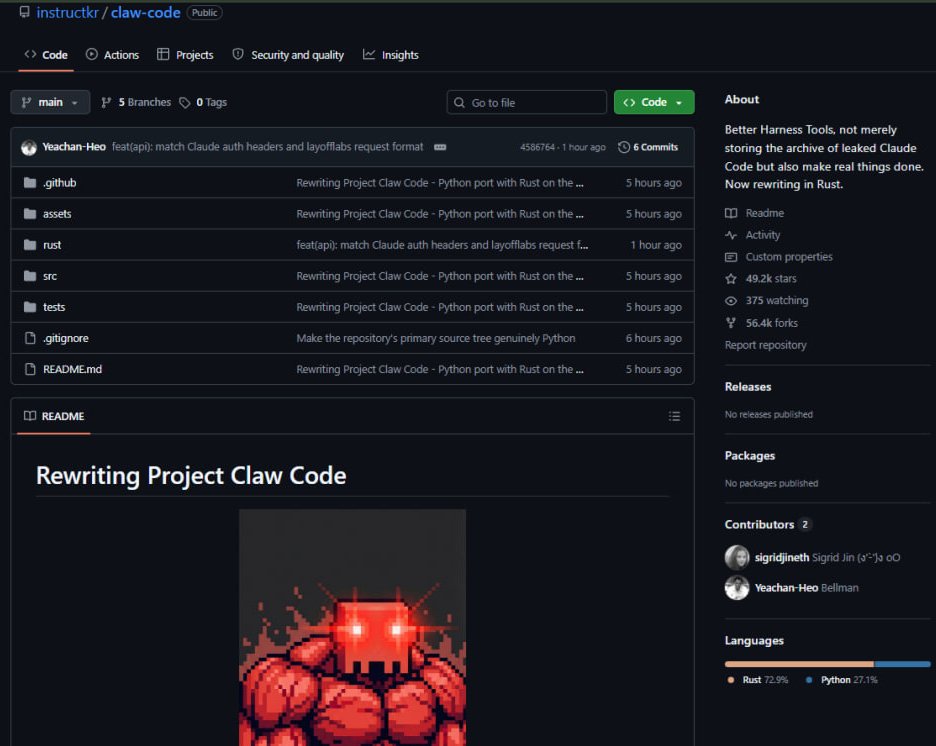
> He rewrote the entire thing in Python from scratch before sunrise.
> Called it claw-code and Pushed it to GitHub.
> A Python rewrite is a new creative work. DMCA can't touch it.
> The repo hit 30,000 stars faster than any repository in GitHub history.
> He wasn't satisfied. He started rewriting it again in Rust.
> It now has 49,000 stars and 56,000 forks.
> Someone mirrored the original to a decentralised platform with one message, "will never be taken down."
> The code is now permanent. Anthropic cannot get it back.
Anthropic built a system called Undercover Mode specifically to stop Claude from leaking internal secrets. Then they leaked their own source code themselves. You cannot make this up.
🚨 Screen Studio charges $89 for this. Someone open sourced the entire thing for free.
It's called OpenScreen. 8,400+ GitHub stars.
You record your screen. It automatically transforms it into a polished, professional demo video.
Auto-zoom into clicks. Smooth cursor animations. Motion blur. Custom backgrounds with wallpapers, gradients, and shadows. Webcam overlays. Annotations. Timeline editing. Export in any aspect ratio.
The exact workflow that Screen Studio sells for $89 and Loom sells as a subscription. Free. No watermarks. No accounts. No subscriptions.
Here's what you get out of the box:
→ Full screen or window capture with system audio and mic
→ Automatic zoom that follows your cursor and clicks
→ Manual zoom with customizable depth and timing
→ Smooth motion blur on pan and zoom transitions
→ Animated cursor rendering with motion effects
→ Webcam bubble overlay with drag-and-drop positioning
→ Wallpapers, solid colors, gradients, or custom backgrounds
→ Text and arrow annotations layered over recordings
→ Timeline trimming and variable speed segments
→ Crop, resize, and export in any resolution or aspect ratio
→ Save and reopen projects anytime
Here's the wildest part:
A developer forked it and built an even more advanced version called Recordly. Full cursor animation pipeline. Native macOS and Windows recording. Zoom behavior that mirrors Screen Studio frame-for-frame. Audio tracks. Webcam overlays with zoom-reactive scaling.
Both are free. Both are MIT licensed. Both work on Windows, macOS, and Linux.
Download. Record. Export. Done.
100% Open Source. MIT License.
(Link in the comments)
H!ndutva t€rrorists went to h@rass an old muslim baba & asked to change the name of 30 years old shop in Uttarakhand.
Only two guys kicked them out. One of them was "Mohammed Deepak"
Mad respect for these guys who stood for old muslim shopkeeper🙏🙏