Iceland has now killed at least 11 fin whales this summer, the second-largest animal on Earth, for meat almost no one eats.
After two years without a hunt, commercial whaling resumed in June. The season’s quota is up to 150 fin whales, a vulnerable species that has still not recovered from a century of commercial whaling.
One of the whales killed was a pregnant mother, along with her unborn calf.
The deaths are rarely quick. Iceland’s Food and Veterinary Authority (MAST) documented one whale taking 31 minutes to die after being struck by four exploding harpoons. Previous investigations have also found whales taking up to two hours to die.
And it’s for almost nothing. Icelanders rarely eat fin whale. Most of the meat is exported to Japan, where much of it remains frozen and unsold. Whale watching generates far more value for Iceland’s economy than whaling ever has.
The Icelandic government has pledged to introduce legislation to end commercial whaling, but this season’s hunt is still going ahead.
[Source: Whale and Dolphin Conservation / Oceanographic (June 30, 2026).]
Swiss farmers planted flowers between their crops and watched pest damage drop by over half. The UK is now running the same trial across 15 farms. The reason this works is embarrassingly simple.
A Swiss study on winter wheat found that fields with wildflower strips had 40 to 53% fewer leaf beetle pests than fields without. Crop damage dropped 61%.
The mechanism is simple. Wildflowers feed hoverflies, lacewings, parasitic wasps, ladybugs, and ground beetles. Those insects eat the aphids, beetle larvae, and caterpillars that farmers would otherwise spray for. A few meters of wildflowers hosts an unpaid pest control crew that would jump at the chance to whoop some aphid ass.
In apple orchards where no insecticides had been used for five years, plots with wildflower alleyways had 9.2% damaged fruit. Control plots without flowers had 32.5%.
The UK is now running a five-year trial across 15 farms placing 6-meter flower strips through the middle of fields, not just at the edges, because the beneficial insects can't reach the center of a large field otherwise.
This works the same way in a backyard vegetable garden as it does on a commercial farm. Plant native flowering species near your tomatoes, beans, and squash. The pests still show up, but the predators show up too.
Study doi: 20151369
Human population is expected to cap at 10.3 billion.
A vegan world would reduce agricultural land by 75%.
The land freed up would be more than enough to cover an extra 2 million people.
Madagascar has been isolated for about 88 million years and is home to an abundance of plants and animals found nowhere else on Earth: 90% them are found only there.
It literally looks like another world.
🌏
The extraordinary courage of the elephant, facing down this loud, terrifying machine in defense of their territory.
How will it end? Asian elephants are already endangered and declining—hundreds are killed on purpose every year.
1/2
The global collapse of pollinators is estimated to kill 427,000 people a year. It sounds absurd until you follow the data.
A 2022 study led by Harvard modeled what happens when wild pollinators decline. Bees, moths, flies, hoverflies, beetles, and other animal pollinators help produce the fruits, vegetables, and nuts that reduce the risk of heart disease, stroke, diabetes, and certain cancers.
When pollination falls short, those crops yield less. People eat fewer of them. That gap in healthy food consumption accumulates into disease risk.
The estimate: 427,000 excess deaths a year, mostly from chronic diseases tied to lower fruit, vegetable, and nut intake. That is larger than the global annual death toll from prostate cancer.
This isn't really about managed honeybees. Their numbers have actually grown globally, even though beekeepers still face serious losses in some regions. This is about wild pollinators: the thousands of bee species, flies, moths, beetles, butterflies, and other insects that most of us have never heard of, but all of us rely on.
Their habitat is what keeps disappearing: meadows converted, hedgerows removed, roadsides mowed flat, lawns replacing native plants, and pesticides spread across landscapes they used to forage in safely.
Every wildflower strip, every unmowed edge, every native plant replacing a patch of lawn is working against that loss. Not as a cute gesture. As actual habitat restoration for the animals our food system depends on.
The chain from the flowers in your yard to cardiovascular mortality is longer than most people picture. But it is real.
Australia's most important Bee? 🐝
At only 3mm long, there are thousands of tiny Euryglossinae Bee's pollinating Eucalyptus trees across Australia right now! 🌳
They are specialised only for Myrtaceae flowers and actually swallow the pollen to transport it back to their nest! 🌼
This endangered tapir (Tapirus indicus), once known as “the gardener of the forests,' can no longer be called that because the forest in Mesuji, Lampung, Sumatra, has almost vanished. Now, it rests on the asphalt road, breathing in traffic fumes and fleeing from a man with a stick.
Think.
https://t.co/Bc3DcNlpvF
The greatest trick coffee pod companies ever pulled was convincing people to pay more for cheap coffee wrapped in trash.
Tens of billions of single-use coffee pods and capsules are used every year. Many are made from mixed plastic, foil, aluminum, filters, lids, and wet coffee grounds, which makes them annoying or impossible to recycle through normal curbside systems. Even the 'recyclable' ones often require special collection programs most people don't have easy access to.
The pod gives you one cup of coffee, then leaves behind a tiny piece of manufactured garbage that may outlive you.
A French press, drip maker, moka pot, pour-over, percolator, or reusable pod can make coffee every morning without throwing away a plastic capsule every time you wake up. The grounds can go in your compost.
This is one of those environmental swaps that is not complicated. You don't need a lifestyle overhaul. You don't need to become a coffee snob. You just need to make the switch.
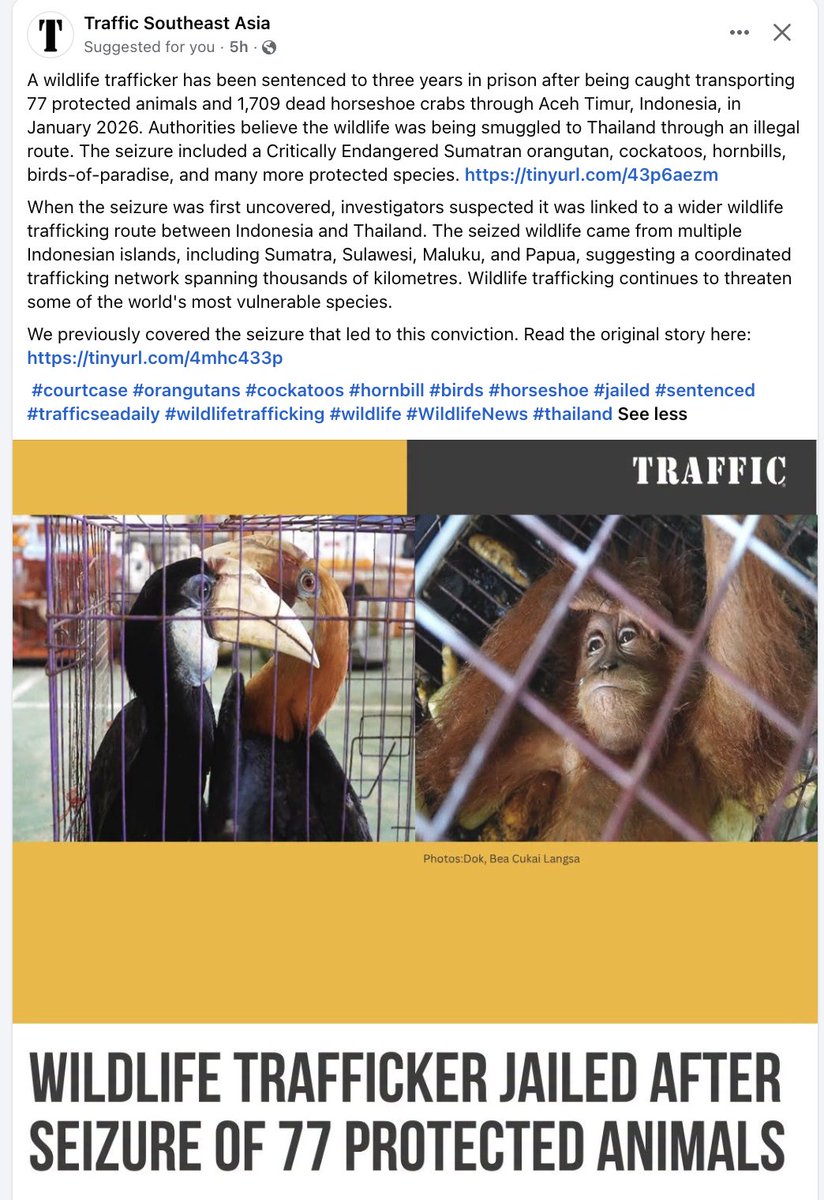
THREE YEARS!? 😤
Find everyone involved and give them LIFE!
Indonesia's wildlife are all on the edge of EXTINCTION from deforestation, this needs to be taken SO much more seriously by the WHOLE WORLD! 🦧😭
Britain turned all its beavers into hats, then spent the next 400 years fighting against dysfunctional rivers.
Beavers were once native across Britain. They built wetlands, slowed floods, stored water, trapped sediment, raised water tables, created fish habitat, and turned simple streams into messy, living systems. Then we wiped them out.
By around the 16th century, beavers had been hunted to extinction for their fur, meat, and castoreum, a scent gland secretion used in perfume and medicine.
The rivers they left behind became poorer, faster, straighter, and less alive. That loss cost a great deal of money.
The UK spends billions on flood defenses because water now rushes through landscapes that used to be full of natural speed bumps: ponds, wetlands, woody dams, side channels, boggy ground, and beaver-built chaos.
When beavers returned to trial sites, they started rebuilding that missing infrastructure with sticks and mud.
Research has found beaver dams can reduce flood peaks by up to about 60%. In Devon, monitored beaver dams slowed stormwater, stored extra water, and delayed flood flows moving downstream. The same wetlands that slow floodwater can also hold water on the land longer during dry periods.
The wildlife response is just as dramatic. Beaver wetlands create habitat for dragonflies, frogs, fish, bats, birds, otters, water voles, plants, fungi, and insects. Recent UK research found beaver-created wetlands held more species than other wetland types.
A beaver isn't just a big-toothed critter, it's a watershed worker. It shows up every night, builds flood control, repairs drought resilience, digs wildlife habitat, filters water, and doesn't invoice the taxpayer for it.
Obviously, they need management in order to coexist with human habitation. Beavers can flood the wrong field, block the wrong culvert, or chew the wrong tree. Nobody serious is saying 'release them everywhere and walk away.' But pretending rivers are healthier without them is absurd.
Britain spent 400 years missing one of its best engineers. I'm glad to see them welcomed back.
Fewer than 2,000 yellow-crested cockatoos are left in the wild.
Decades of trapping for the illegal pet trade pushed this species to the brink across Indonesia and Timor-Leste.
But about 200 now live freely in Hong Kong, descended from escaped pets. That’s roughly 10% of the remaining wild population.
Scientists recently sequenced their DNA and discovered something remarkable: this small urban population holds exceptionally high genetic diversity, including lineages from every recognized subspecies, one of which may already be extinct in the wild.
The cages that emptied the forests accidentally built an ark. It shouldn’t take a lucky accident to save a species.
But this time, we’ll take it.
[Source: Mongabay (2026); Evolutionary Applications.]
Costa Rica has successfully doubled its rainforest cover in just a few decades, becoming the first tropical country to completely reverse deforestation.
A team working off Vancouver Island just caught something no one had ever seen clearly before: a slab of ocean floor in the act of dying. The plate that slides under North America is tearing apart about 75 kilometers down, roughly 47 miles below the seabed, and along one tear a section has dropped close to five kilometers, taller than Mount Whitney.
A subduction zone is the seam where one tectonic plate dives beneath another. Off the coast there, two plates, the Juan de Fuca and the smaller Explorer, slowly slide under the continent. To see what was happening, a crew aboard the research ship Marcus G. Langseth spent 41 days dragging a 15-kilometer line of underwater microphones, sending sound waves down into the seabed and listening to the echoes that came back. It works like an ultrasound for the planet. Nobody has a photograph of the crack. What they have is a sound map, and it shows the plate splitting along a fault line called the Nootka into smaller pieces.
For a long time scientists assumed one of these zones shuts off all at once, either jammed by a thick block of rock or cut off by an underwater ridge. Brandon Shuck at Louisiana State, who led the study published in Science Advances, found that it ends slowly instead. The plate rips one fragment at a time, leaving behind microplates, which are just small leftover pieces of the plate, until the whole thing winds down. He compared it to watching a train derail one car at a time rather than in a single wreck. That process runs over millions of years.
When the news first spread, some people heard shutting down and hoped the famous Cascadia earthquake risk was dropping. The researchers say it does not work that way. The tear does not change the danger on any timescale a person would actually notice, and a more broken, shifting plate may even make the next quake harder to predict.
Cascadia still runs about 700 miles from northern California to British Columbia, and it can produce a magnitude 9 quake, the same size as the one that hit Japan in 2011. The last time the whole fault broke was in January 1700. These quakes tend to come every few hundred years, and it has now been about 325. FEMA estimates a full break could kill around 14,000 people across Oregon and Washington.
So the plate really is splitting open. It is just dying on a clock that runs in millions of years, while the quake it could still set off runs on a clock measured in centuries, and that one is nearly out of time.
Erin Brockovich is now tracking more than 5,000 community concerns about AI data centers across the United States.
The renowned environmental activist has created a nationwide map that tracks AI data centers that are operating, under construction, proposed, or facing local opposition.
Reports have surged in recent weeks. On June 2, the tracker showed just over 3,000 community submissions. By June 9, that number had climbed past 5,000.
The worries are very real. Residents are raising alarms about skyrocketing electricity demand, massive water consumption, constant noise, strain on local infrastructure, electronic waste, flooding risks, and the overall burden these industrial-scale facilities place on small towns and rural areas.
Data centers serve as the physical foundation of artificial intelligence, powering everything from chatbots and image generators to cloud services and video models. But keeping the servers running 24/7 requires enormous resources.
A single large data center can consume up to 5 million gallons of water per day, equivalent to the daily water usage of a town of 10,000 to 50,000 people. They also used about 4.4% of total U.S. electricity in 2023, a figure the Department of Energy projects could rise to 6.7–12% by 2028.
This rapid growth has sparked growing local backlash. Several cities and counties have already imposed moratoriums or restrictions on new data centers to assess their impact on water supplies, power grids, and household utility bills. Seattle, for example, approved a one-year pause, with similar measures taken in parts of Kentucky, California, and Georgia.
Hundreds of thousands of poultry have died in France during the current extreme heat wave.
Temperatures above 40°C have overwhelmed poultry farms across western France. Farmers report losing hundreds of birds per day, with some losing half their flocks in just a few days.
Unlike humans, chickens have no sweat glands. They rely on panting to cool themselves, and in extreme heat that mechanism can fail.
This is one of the hidden costs of extreme heat. Modern livestock systems are highly vulnerable to prolonged high temperatures, leading to mass animal deaths, economic losses, and welfare concerns.
The same heat wave has also been linked to dozens of human deaths, school closures, and major strain on power grids across parts of Europe.
When the climate changes faster than infrastructure and farming systems can adapt, the consequences become increasingly severe.
Extreme heat is becoming increasingly deadly for both people and animals.
[Source: Mongabay, “Extreme heat wave in France kills hundreds of thousands of poultry” (June 2026).]


![Oxygen_Token's tweet photo. Iceland has now killed at least 11 fin whales this summer, the second-largest animal on Earth, for meat almost no one eats.
After two years without a hunt, commercial whaling resumed in June. The season’s quota is up to 150 fin whales, a vulnerable species that has still not recovered from a century of commercial whaling.
One of the whales killed was a pregnant mother, along with her unborn calf.
The deaths are rarely quick. Iceland’s Food and Veterinary Authority (MAST) documented one whale taking 31 minutes to die after being struck by four exploding harpoons. Previous investigations have also found whales taking up to two hours to die.
And it’s for almost nothing. Icelanders rarely eat fin whale. Most of the meat is exported to Japan, where much of it remains frozen and unsold. Whale watching generates far more value for Iceland’s economy than whaling ever has.
The Icelandic government has pledged to introduce legislation to end commercial whaling, but this season’s hunt is still going ahead.
[Source: Whale and Dolphin Conservation / Oceanographic (June 30, 2026).]](https://pbs.twimg.com/media/HMQoTAwWcAAlq3f.jpg)


![Oxygen_Token's tweet photo. Fewer than 2,000 yellow-crested cockatoos are left in the wild.
Decades of trapping for the illegal pet trade pushed this species to the brink across Indonesia and Timor-Leste.
But about 200 now live freely in Hong Kong, descended from escaped pets. That’s roughly 10% of the remaining wild population.
Scientists recently sequenced their DNA and discovered something remarkable: this small urban population holds exceptionally high genetic diversity, including lineages from every recognized subspecies, one of which may already be extinct in the wild.
The cages that emptied the forests accidentally built an ark. It shouldn’t take a lucky accident to save a species.
But this time, we’ll take it.
[Source: Mongabay (2026); Evolutionary Applications.]](https://pbs.twimg.com/media/HMGY-HIW4AAhY_L.jpg)
![Oxygen_Token's tweet photo. Fewer than 2,000 yellow-crested cockatoos are left in the wild.
Decades of trapping for the illegal pet trade pushed this species to the brink across Indonesia and Timor-Leste.
But about 200 now live freely in Hong Kong, descended from escaped pets. That’s roughly 10% of the remaining wild population.
Scientists recently sequenced their DNA and discovered something remarkable: this small urban population holds exceptionally high genetic diversity, including lineages from every recognized subspecies, one of which may already be extinct in the wild.
The cages that emptied the forests accidentally built an ark. It shouldn’t take a lucky accident to save a species.
But this time, we’ll take it.
[Source: Mongabay (2026); Evolutionary Applications.]](https://pbs.twimg.com/media/HMGY-HFXwAA8idy.jpg)




![Oxygen_Token's tweet photo. Iceland has now killed at least 11 fin whales this summer, the second-largest animal on Earth, for meat almost no one eats.
After two years without a hunt, commercial whaling resumed in June. The season’s quota is up to 150 fin whales, a vulnerable species that has still not recovered from a century of commercial whaling.
One of the whales killed was a pregnant mother, along with her unborn calf.
The deaths are rarely quick. Iceland’s Food and Veterinary Authority (MAST) documented one whale taking 31 minutes to die after being struck by four exploding harpoons. Previous investigations have also found whales taking up to two hours to die.
And it’s for almost nothing. Icelanders rarely eat fin whale. Most of the meat is exported to Japan, where much of it remains frozen and unsold. Whale watching generates far more value for Iceland’s economy than whaling ever has.
The Icelandic government has pledged to introduce legislation to end commercial whaling, but this season’s hunt is still going ahead.
[Source: Whale and Dolphin Conservation / Oceanographic (June 30, 2026).]](https://pbs.twimg.com/media/HMQoTAwXsAA59qQ.jpg)



![Oxygen_Token's tweet photo. Fewer than 2,000 yellow-crested cockatoos are left in the wild.
Decades of trapping for the illegal pet trade pushed this species to the brink across Indonesia and Timor-Leste.
But about 200 now live freely in Hong Kong, descended from escaped pets. That’s roughly 10% of the remaining wild population.
Scientists recently sequenced their DNA and discovered something remarkable: this small urban population holds exceptionally high genetic diversity, including lineages from every recognized subspecies, one of which may already be extinct in the wild.
The cages that emptied the forests accidentally built an ark. It shouldn’t take a lucky accident to save a species.
But this time, we’ll take it.
[Source: Mongabay (2026); Evolutionary Applications.]](https://pbs.twimg.com/media/HMGY-HNW0AAFtfV.jpg)


![Oxygen_Token's tweet photo. Hundreds of thousands of poultry have died in France during the current extreme heat wave.
Temperatures above 40°C have overwhelmed poultry farms across western France. Farmers report losing hundreds of birds per day, with some losing half their flocks in just a few days.
Unlike humans, chickens have no sweat glands. They rely on panting to cool themselves, and in extreme heat that mechanism can fail.
This is one of the hidden costs of extreme heat. Modern livestock systems are highly vulnerable to prolonged high temperatures, leading to mass animal deaths, economic losses, and welfare concerns.
The same heat wave has also been linked to dozens of human deaths, school closures, and major strain on power grids across parts of Europe.
When the climate changes faster than infrastructure and farming systems can adapt, the consequences become increasingly severe.
Extreme heat is becoming increasingly deadly for both people and animals.
[Source: Mongabay, “Extreme heat wave in France kills hundreds of thousands of poultry” (June 2026).]](https://pbs.twimg.com/media/HL2pcjLXsAAUmif.jpg)


