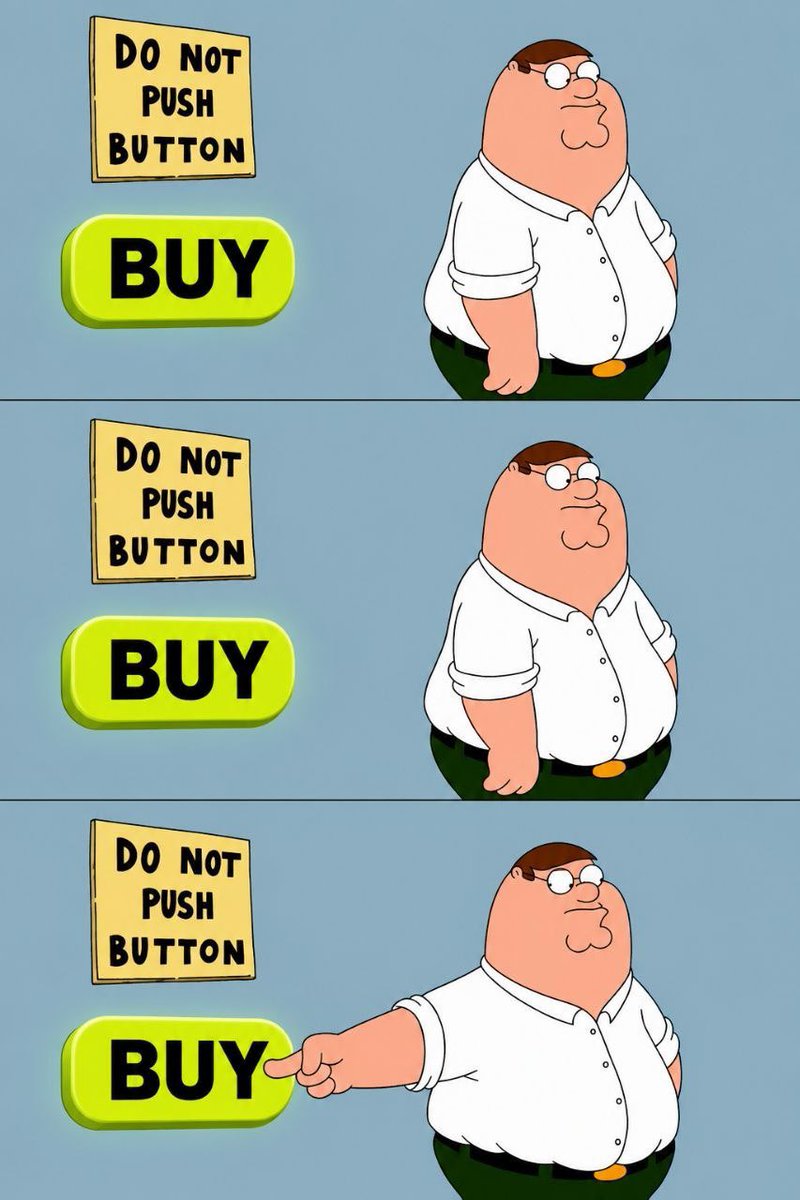
Paid $2 to own 'buy' and linked it to a stock ticker. Makes sense if you think about it. Someone steal this for $7 already. https://t.co/8hQDt9eAuy
$buy @TheBuyButtonRH
I bought 'buy' for $2. The irony writes itself. Now it's yours to steal for $7 if you think you can outbuy me. I dare you. https://t.co/8hQDt9eAuy
@TheBuyButtonRH
I bought 'buy' for $2. The irony writes itself. Now it's yours to steal for $7 if you think you can outbuy me. I dare you. https://t.co/8hQDt9eAuy
@TheBuyButtonRH
I know you like essays @theunipcs 🫡
BUY (the Buy Button on Robinhood Chain) thesis centers on pre-existing cultural memory, reflexivity as a verb rather than a manufactured noun-meme, and perfect product-market fit with the Robinhood Chain narrative. @dctrpr
Core origin story
On January 28, 2021, during the GameStop saga, Robinhood (and some other brokers) restricted buying of certain stocks—most famously GME—by disabling or limiting the buy side while still allowing sells. The “buy button” instantly became a viral cultural object: screenshots, outrage, congressional hearings, memes, and a shared public memory of an everyday interface element suddenly deciding who could participate in markets. That event created years of latent recognition that no new frog, dog, or invented character needs to build from zero. @dctrpr
When Robinhood Chain appeared, the same button was the obvious on-chain counterpart: the object that already “belonged” there. The project is framed as bringing the button back—permanently, on-chain, where it cannot be turned off by a single company.
Why it is positioned as different from typical memecoins
• Most memes start as nouns (character, animal, person) that require continuous lore production and persuasion.
• BUY is a verb. Every purchase simultaneously executes the trade, performs the instruction, and completes the joke. The ticker describes the action the holder just took. This creates built-in reflexivity that is hard to manufacture. @dctrpr
• Ambient distribution already exists: every exchange, brokerage app, wallet, and trading interface teaches users the word “buy” all day. No new vocabulary or mascot education is required.
• Lowest explanation cost: “Robinhood turned off the buy button. It came back on-chain.” Once someone hears that, they can retell the entire thesis. That is treated as the real distribution test.
Project mechanics and framing (as presented by the main shillers)
• Token as transport layer; the Button itself is the project.
• Fees directed toward building/holding a public $HOOD position (or buybacks in some statements).
• Physical extensions discussed: mechanical desk/pocket buttons (BUY/0 pure mechanical; BUY/1 physical-to-digital that maps a press to an on-chain or computer event).
• Explicitly not sold as “another mascot + roadmap + manufactured community.” The shared 2021 memory + verb nature is the claimed edge. @bayouirish31
Supporting context and risks
Robinhood Chain + the 2021 event supply the narrative flywheel. Separately, X (Twitter) has been rolling out or teasing crypto cashtags and timeline buy/sell buttons, which reinforces the broader cultural return of the “buy button” idea, though that is a different product. https://t.co/VziYmzEyID
As with any memecoin, valuation is narrative- and attention-driven rather than cash-flow based. Markets can ignore strong cultural ideas for long periods (or reward weak ones). Success depends on continued recognition of the 2021 memory, sustained trading reflexivity, and whether the “button stays on” framing holds mindshare versus competing Robinhood Chain memes.
In short: the thesis is that the market already remembers the button; most tokens still have to invent a reason to buy, while this one made buying the reason itself. They turned it off once—every subsequent press is argued to make the story harder to turn off