We're looking for 2026 summer interns to tackle exciting aspects of AI climate model development (generalization across climates, impacts modeling capabilities like fire and water resources) and to be a part of our dynamic team.
https://t.co/Eyq1EbbOve
Last year, we developed ACE, a boundary-breaking climate emulator. Now, we introduce ACE2, which addresses stability and accuracy across a range of climates, broadening the scope of how AI can help us deal with climate change.
In another, we show that when ACE2 is coupled to a slab ocean model, it can replicate the equilibrium response of the atmosphere to increased CO2 concentrations https://t.co/iQt2fiJtRp
We partnered with researchers @UCSanDiego and @ucsd_cse to supercharge climate modeling, speeding up predictions and enhancing accuracy.🌍 Check out the blog post below and come find us at #NeurIPS this week!
Finally at #NeurIPS2024, former @ai2_climate intern Salva Ruhling Cachay @salvaRC7 will present a spotlight poster on climate model emulation using Spherical DYffusion, Thursday 11am-2pm PST: https://t.co/g0IGziSMHp
Oli Watt-Meyer @oliwm will present on ACE's variability and forced response to sea surface temperatures, tomorrow at 9:35am EST in session GC21C-07: https://t.co/eUuB9ssRF8
We are now seeking applicants for a full-time research scientist position on the climate modeling team at Ai2! Come work with an excellent team at the frontier of using AI for climate modeling. 🌎🌦
Hybrid in Seattle, app review begins Oct 15.
Details 👉https://t.co/XAHuhAvjyA
We are delighted to announce the #ICML2024 ML4ESM Best Paper Award winner:
[2406.14798] Probabilistic Emulation of a Global Climate Model with Spherical DYffusion (https://t.co/zEuA5qC3Vu)
Congrats to @salvaRC7 and co-authors @ai2_climate@yuqirose for their amazing work!
🌍We've developed the first conditional generative model for accurate & efficient ensemble climate simulations!
📄Read the full paper: https://t.co/a47yL2uC6f
🎉Excited to share that a preliminary version was accepted as an oral presentation @ml4esmworkshop at #ICML2024!
🧵
And finally, we have a preprint paper led by a former intern, James Duncan, where we ACE’d another major atmospheric model, DOE’s EAMv2.
https://t.co/MklA9Ei09m
We have a new ACE preprint led by our former intern, James Duncan, where we’ve successfully emulated a second major atmospheric model, DOE’s EAMv2! 🌎💻
https://t.co/jbjPRb2Py8
Spring is here, so check out a fresh slate of articles from our team on ML for climate modeling! A little something for everyone here with direct ML on 3-km model physics 🌡️🌧️, ML of a subgrid cloud scheme for correcting radiative flux biases🌤️ , and some full model emulation 🌎
@BrianMHenn1 led a paper on an ML model for predicting subgrid cloud properties (learned from 3-km resolution) for unbiased radiative flux in our 200-km model.
https://t.co/lBV49RHD3H
See another newly published article, led by @brianmhenn1, where we machine-learn cloud properties (from a 3 km reference simulation) needed for unbiased radiative fluxes in coarse-resolution FV3GFS (200 km). ⛅
https://t.co/NmVOT8Ystk
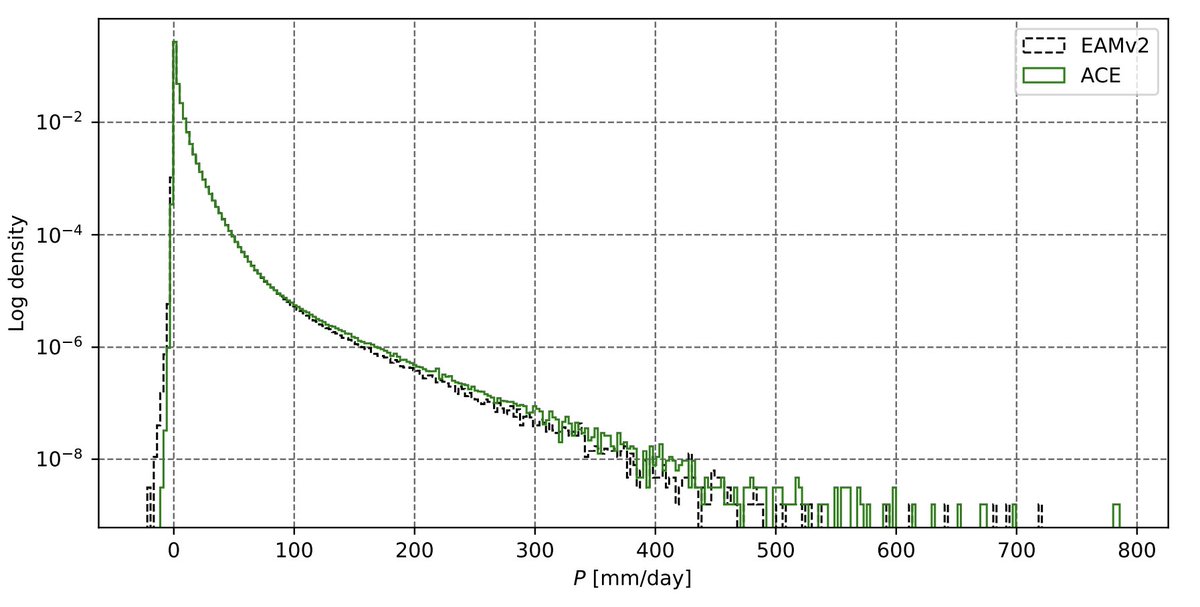
We found that ACE could be trained without modification on EAMv2 data, producing stable simulations for at least 10 years with similarly small climate biases. Impressively, ACE accurately reproduced many of EAMv2's precipitation characteristics, including the MJO!
We have a new ACE preprint led by our former intern, James Duncan, where we’ve successfully emulated a second major atmospheric model, DOE’s EAMv2! 🌎💻
https://t.co/jbjPRb2Py8