When you combine accelerating utility and infrastructure development with a network that already has 16.5M of its 21M hard-capped supply in circulation... that’s not a manufactured pump. That is the setup for a fundamental repricing. 🚀🛡️ $ZEC #Zcash#Privacy#ZODL
$ZEC market took a full 16 hours to process the "Constructive Discharge" news. Classic delayed reaction.
The initial read was "Bullish: Talent is free."
The reality setting in now is "Bearish: Civil War."
ECC team (talent) walked out, but the Bootstrap Board (Zaki et al.) still holds the keys to the treasury and brand.
We are entering a "Legitimacy Crisis." The code is open source, but the funding is not. Until the community picks a winner between the New Co and the Old Board, uncertainty is the only certainty.
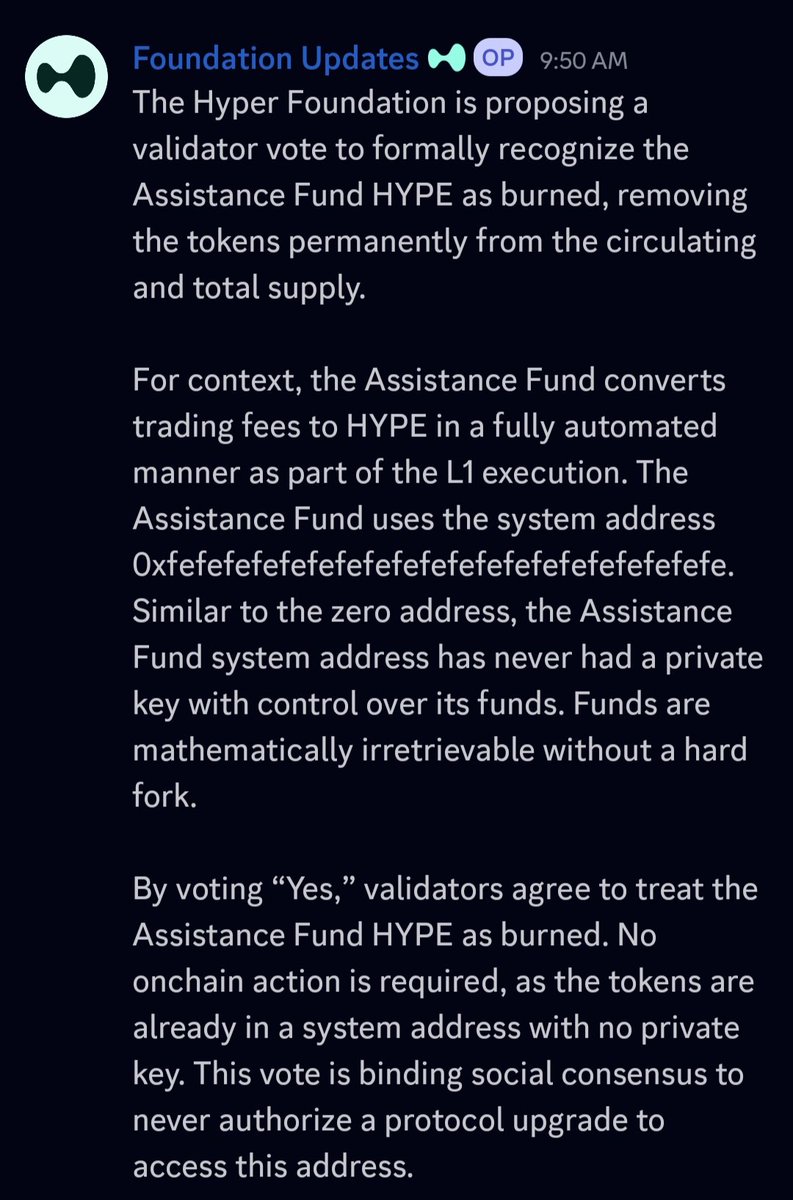
Huge bullish signal for $HYPE! 🚀 Hyperliquid's proposal to burn the Assistance Fund—over 10% of circulating supply—locks away tokens forever. FDV overstated, supply deflation incoming with more AF activity. This is massive for holders! #HYPE#CryptoBurn
New $HYPE proposal to burn the supply bought back by the AF
This would equate for 4% of the total supply and 10% of circulating supply currently.
Hyperliquid.
Hyperliquid just announced Portfolio Margining
But I don't think most people understand how important this is
When it was introduced in TradFi it added $7,200,000,000,000 to the derivatives market in just a few years
The Historical Context:
This used to be illegal. In 1934 the government mandated margin minimums (downstream of people getting insanely levered during the 1929 crash).
Like with many regulations, this was well intentioned but it was oversimplified and ultimately choked liquidity causing even more volatility in the future.
Why?
Because you can't run delta neutral strategies in a capital efficient manner. It doesn't matter if you're hedged, you need a huge lump of margin for each leg.
Eventually the CME introduced Portfolio Margining in 1988 which substantially lowered margin requirements based on an actual analysis of the total risk of one's combined positions (so hedged positions net one another out risk wise).
The messed up part? This was gate kept only to broker-dealers and market makers with exchange seats for nearly 30 years until finally in 2006 retail customers got access.
So what does all this mean for Hyperliquid?
The impact on liquidity growth:
They key thing here to understand is simple: you get far more Open Interest and Volume per $ of margin in the system.
Basically with this live, we get a substantial liquidity multiplier for every new $ of margin entering Hyperliquid.
But even more importantly:
Portfolio margining is an essential tool used by any large scale liquidity provider in traditional finance.
Without this, it simply would be uneconomical for larger scale TradFi players to provide liquidity on Hyperliquid because the returns per $ of margin would be so much lower than alternative traditional exchanges that allowed portfolio margining.
Basically all I've done for the past 6 months at @Nomina is hop on calls with people who are interested in using perp DEXs for user research and when I've talked with larger TradFi funds one of the most obvious roadblocks was inefficient margining systems.
There is more work to be done, but with this rollout one of the biggest issues I repeatedly heard cited will no longer be a blocker.
Higherliquid
Now on X, it's really polarized.
One group sees the market as miserable and thinks it's over.
Another group thinks it's a good opportunity to buy the dip and prepare to go all in.
What do you think?
#web3#btc#crypto