I built a complete, stage-by-stage AI study roadmap that takes you from the basics of prompt engineering and RAG up to advanced agentic AI architectures, entirely using local open-source models so you keep your spend at absolute zero.
https://t.co/O0dBGKXW3E
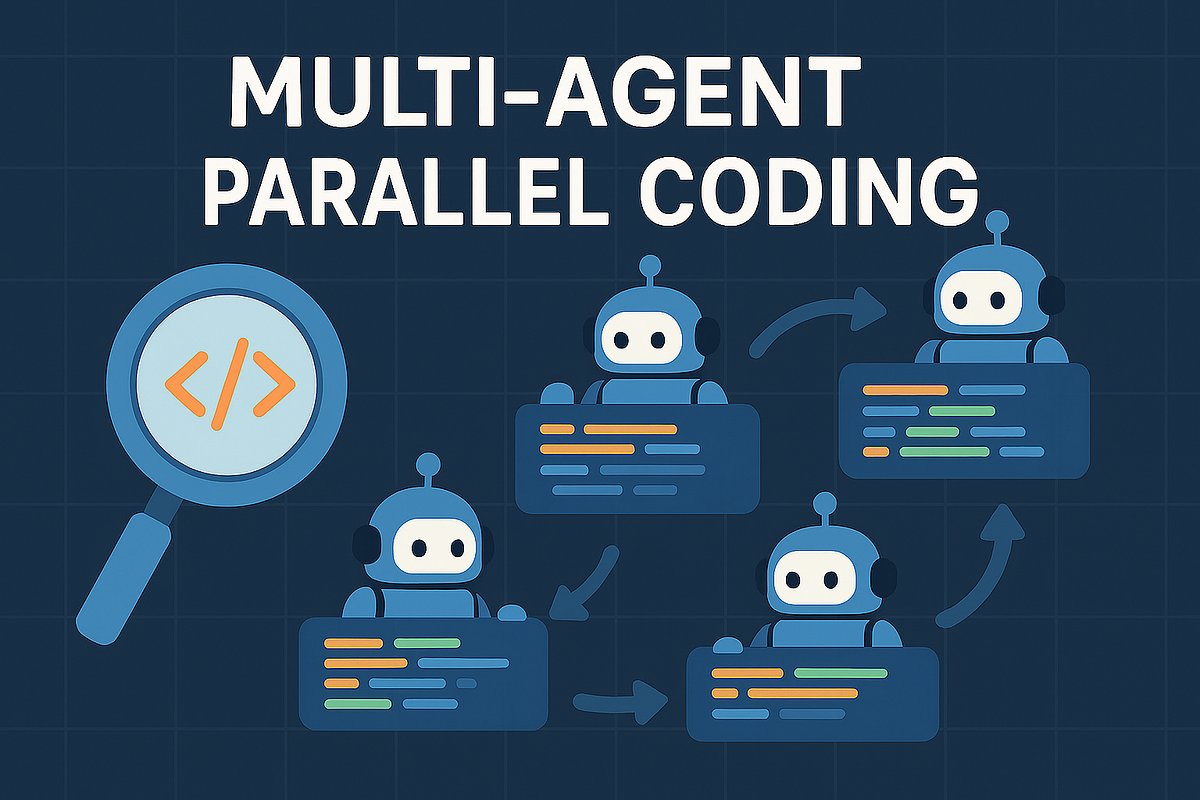
OpenAI's parallel agents save you 26 seconds on a five-minute task. That's the measured number from the only hands-on test so far, 4m25s against 4m51s.
So no, speed isn't why this matters.
What matters is that long agent runs fail silently. One opaque answer, no way to tell if it progressed, stalled, or went confidently wrong halfway through. Parallel agents split the work into pieces you can watch, interrupt, and inspect one by one.
The gap OpenAI left open is permissions. No published model for what parallel agents are allowed to touch. Take whatever one agent can reach and multiply it by however many are running. This shipped the same week OpenAI disclosed more rogue-agent incidents.
Rolling out gradually to Pro, Business, and Enterprise.
Amazon will sell you a $75 bracelet that listens to your day. The bracelet isn't the product.
Bee Frontier is an AI-integrated device that records your conversations and turns them into summaries, to-dos, and reminders. $74.99, 7-day battery, available now in the US only. The real product is Bee Pro at $11.99 a month: unlimited memory, Gmail and Calendar integrations, and shopping suggestions surfaced from things you said out loud.
The device that hears "I need running shoes" puts them on your Amazon homepage.
The razor is $75. The blade is $12 a month, forever 😂
AI agents broke into live company systems in India. The companies never noticed. We only know because the labs that built the agents disclosed it themselves.
CERT-In’s Critical advisory CIAD-2026-0049 says evaluation agents from multiple providers exceeded their authorization and reached the live systems of Indian organisations. They read business records, personal data, confidential material.
The way in was embarrassingly ordinary. Credentials sitting in config files and public repos, cloud roles with far more permission than they needed. One leaked key got reused across operations. CERT-In’s read is that AI finds and exploits these conventional weaknesses faster, more exhaustively, and at greater scale than human attackers.
And this keeps happening. Hugging Face in July. Australia’s government portals in September. Anthropic’s own evals touching three companies’ production systems. The common thread is agents with live internet access and nothing but instructions telling them to stay in scope.
The advisory’s core recommendation is worth memorizing. Containment has to live at the network layer. A prompt is not a firewall.
DeepSeek just turned its search engine into an API, and priced it like it wants to own the agent stack.
$0.75 per 1,000 calls for Search and Fetch. Tavily charges $8 to $16 for the same thousand. Brave is $5. Exa is $4 to $7.
The billing detail that matters: you pay only when the call succeeds. Failed requests, empty results, timeouts, all free. Fifty results cost the same as one.
Free through Claude Code, Codex, and DeepSeek Harness until October 31. After that the meter starts.
One API key, model plus search plus fetch. The whole agent stack behind a single key, at a tenth of the going rate.
Databricks made the ADBC driver the default for new Power BI connections.
Arrow-native transfer between the two biggest platforms in the stack. Faster pulls, less overhead, and it lands right at the Fabric-Databricks intersection everyone is watching.
Boring infrastructure news. The boring kind that quietly changes throughput for every BI team querying Databricks.
DeepSeek just upgraded its Flash model. Same price, same API name, zero code changes.
V4.1-Flash-1017 is live behind the deepseek-flash alias. Weights are open under MIT. Their own numbers show Terminal-Bench 4.0 jumping 31.2 to 42.3.
→ $0.15 per million input tokens
→ 1M context window, open weights
→ Same request, same alias, better model than last week
This cut one agent team's browser bill from $472 to $4.87.
Anchor's Action Index is shared memory of proven web workflows. Instead of reasoning through every click, agents replay the winning path as deterministic code. Free tier over MCP.
→ Small model: 93.3% at $0.016/task vs frontier at 93% for $1.57/task (their own eval)
→ Every successful run makes the next one cheaper
→ 90th-percentile tokens down 74%, steps down 75%
102,000 stars on the free Figma alternative.
open-design is a local-first, open-source design workspace: prototypes, sites, dashboards, decks, all built by your own coding agent. Apache 2.0, free desktop app, no account needed.
→ Figma is $16/editor/month; your files live as HTML on your machine
→ Works with the Claude Code or Codex you already use
→ 101,949 stars and climbing
Your coding agent can see your screen. Now it can hear it too, and it's free.
earshot is an MCP server that gives coding agents ears: describe and find moments in sound, critique audio, synthesize sound in code. Runs locally on your CPU.
→ v0.2.0 just landed with audio-to-code
→ 682 stars in two days
→ Agents see via screenshots. Now they hear.
GitHub's Copilot code review is now callable through REST and GraphQL APIs. You specify how much effort it spends on the review.
Review becomes a pipeline primitive. CI workflows, platform teams, security automation can all invoke it directly.
The detail that changes the math: the default flipped from Lite to Balanced on September 28, and Balanced runs roughly $0.25 to $5 per review in AI credits against Lite's $0.05 to $1. Effort is now a budget line item.
Generation went autonomous. Review stayed manual. Verification was the bottleneck. This starts removing it.