Our current best prompt for the film above, exactly as it went in. Three attempts to get here, and it is still not where we want it.
Photorealistic live-action cinematography: real skin and materials, motivated lighting, subtle film grain, anamorphic lensing, realistic depth of field and colour grade. Heavy night rain, bright stadium floodlights, graded like a sports drama. Camera at the dog's eye level, low to the ground. The advertising hoardings around the pitch are plain blank panels in flat solid colour, completely empty, with no writing or symbols on them.
THE DOG, identical in every shot: a small scruffy stray terrier, sandy brown and white, wiry damp coat, one ear folded over, dark button eyes, soaked through. THE BALL: a white-and-black match ball.
0-3s. Real time, brightly floodlit, rain sparkling in the floodlights. The small sandy-and-white scruffy terrier with one folded ear wriggles out from under a plain blank hoarding onto the bright green grass and nips the ball away from a player's feet.
CUT TO - 3-9s. Real time, low camera running alongside him at grass level. The small sandy-and-white scruffy terrier with the one folded ear drives the ball forward with his nose, sprinting. A defender in blue reaches a boot in for the ball; the terrier flicks the ball sideways with his nose and cuts around him, and the defender slides past on the wet grass on his backside, laughing, arms in the air. A second defender comes across and the terrier veers between him and a team-mate, ball still glued to his nose. Every player is going for the ball only, never for the dog, and nobody touches the dog.
CUT TO - 9-15s. Real time, low camera. A tall defender in blue plants himself in front of the small sandy-and-white scruffy terrier with the one folded ear, legs apart. The terrier nudges the ball straight between the defender's legs, darts around him, collects the ball on the other side and keeps running. The defender spins round with his hands on his head, laughing in disbelief. Every player is going for the ball only, never for the dog, and nobody touches the dog. The crowd is roaring with laughter and delight.
CUT TO - 15-21s. SLOW MOTION, and only here. The small sandy-and-white scruffy terrier with the one folded ear plants his paws and butts the ball hard with his forehead. The ball lifts off his head and flies low and fast toward the goal for about two seconds only. Cut for a beat to the terrier standing on the grass, ears up, watching it go. The goalkeeper dives full length, fingertips grazing it. The ball clips the inside of the post, drops onto the goal line and spins slowly over it into the back of the net.
CUT TO - 21-30s. SNAP BACK TO FULL REAL-TIME SPEED, and the sound explodes from near silence into a deafening roar in an instant. The stadium erupts - confetti, camera flashes, floodlight flare through the rain. Two laughing players lift the same small sandy-and-white scruffy terrier with the one folded ear high above their heads like a trophy, fast and joyful. The dog is loving it, tail going, mouth open in a happy pant, and he barks up at the sky.
AUDIO: rain on turf and studs on wet grass, the crowd building through the dribble into waves of laughter and a roar, everything dropping away to a muffled distant rumble through the slow motion, then the full stadium roar hitting at once and at maximum volume on the cut back to real time, with one bright bark on top.
No on-screen text, no subtitles, no watermark.
Take it, swap the animal, run it — nothing above is specific to a dog. If you get a better result out of it, post what you changed.
We film every day at 👉 https://t.co/Ul24IOq9VB — the thirty-second one-take version is not in the product yet, and whether it should be is this week's argument.
ByteDance shipped Seedance 2.5 this week. We have been testing what it can actually hold, and this is the furthest we have got so far.
A stray dog gets under the hoardings at a cup final, takes the ball off a defender and scores the winner. Thirty seconds, five shots, one generation — nothing was edited together, the cuts are written into the prompt. That is the part that is new: the models we film with today stop at fifteen seconds, so anything longer has to be shot in pieces and joined.
Third attempt, rendered at 480p because that is what we test at. A probe, not a finished piece of work.
What we have learned so far, and the whole prompt, are in the replies. If you are getting better out of it, we want to hear how.
Thirty seconds in one pass is a different writing problem to fifteen. It holds several cuts, so the prompt has to hold the film together on its own. Six things that have worked for us so far. None of it is settled — we are still probing the model.
Describe what you want, never what you don't. "No logos" puts a logo in the model's head and you get one. "Plain blank panels in flat solid colour, completely empty" gets you blank panels.
Repeat the character in full at every beat. Not "the terrier" but the whole description every time: "the small sandy-and-white scruffy terrier with the one folded ear". A cut is where a character quietly turns into a different animal, and this is what stops it.
Give anything that must not vanish its own line at the top, then make it the subject of the verbs. The ball is declared before the action starts, and after that it is the ball being nipped, flicked and headed. Whatever the model is not actively tracking will quietly leave the scene.
Put a clock on slow motion. "Flies toward the goal for about two seconds only." Left open-ended it eats the whole beat and you watch an empty sky.
Write the physical action, not the word for it. "Dribbles past the defenders" gets you a dog jogging. "Nudges the ball between the defender's legs, darts around him and collects it on the other side" gets you a nutmeg.
Change speed and sound in the same sentence, so the roar lands exactly on the cut back to real time.
And one that is not craft: a small dog among tackling adults reads badly to a safety filter. "Every player is going for the ball only, never for the dog" keeps the scene comic and keeps it generating.
Worth knowing before you plan around it: roughly double the price per second, and no 1080p or 4K yet.
If you have found rules that beat these, post them. We will test them against ours.
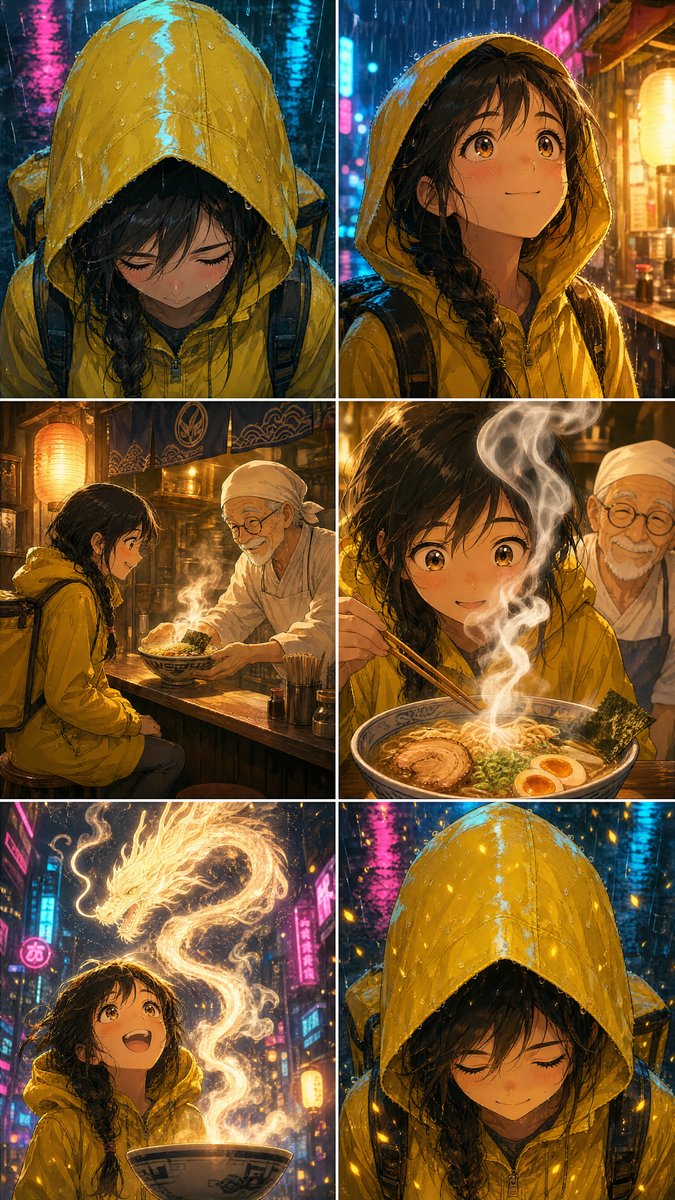
Then each pair of neighbouring pictures becomes a moving shot — picture one, picture two, and the machine fills in what happens between them. Five shots, glued end to end. The rain, the sizzling broth and her little gasp come out of the same step as the picture.
Now watch it again: the last frame is the first frame. It loops.
No camera, no editor, no studio. Somebody typed what they wanted to see 👉 https://t.co/Ul24IOq9VB
We build AI video tools, and we film with them every day.
Movie Maker — describe a film in plain words, get a finished multi-shot short with script, shots and soundtrack.
Hero Theater — describe a matchup, add a photo, watch it get filmed.
Presets — one photo, one click, a share-ready clip from $1.
The film below is 40 seconds. It started as a typed description — no shot list, no editing.
Everything lives here 👉 https://t.co/orQFqDN8aO
How this was made 👇
Before a single second of video existed, the entire film was drawn as one page.
Six pictures, in order, the whole story. That is why she is the same girl in every shot — she was drawn once, not six times.
One paragraph in. A finished movie out.
First snow. A cup of cocoa. Then a fox walked out of the white.
Describe a film in plain words, add photos if you want, and Movie Maker turns it into a multi-shot film with script, shots, and soundtrack.
Try it 👉 https://t.co/Ask3GACEW1