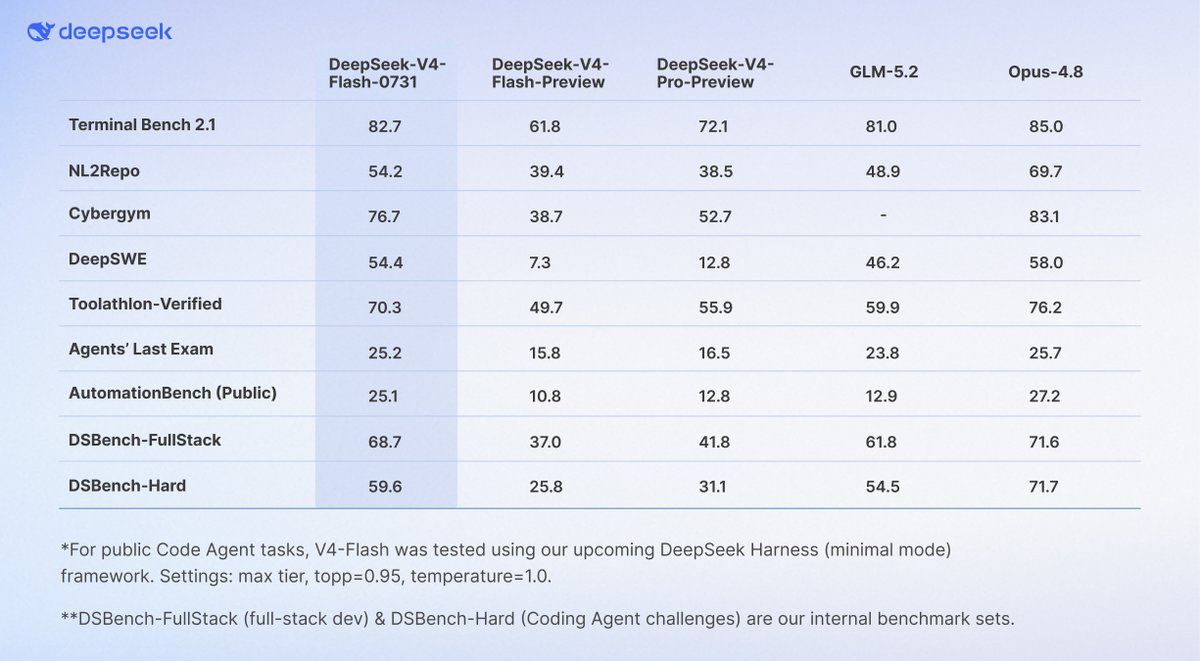
🚀 DeepSeek-V4-Flash Official API is now LIVE in public beta!
🔷 We’ve massively upgraded its Agent capabilities—benchmark scores are now far surpassing the V4-Pro-Preview. Check out the massive performance leap below! 👇
🔷 The official V4-Flash now natively supports the Responses API format and is fully adapted for Codex!
Check out the configuration details in our official API docs: https://t.co/smCwQZMeiq
The most valuable asset in go-to-market is the one nobody can access
Every company is sitting on a second product it never shipped: everything it has learned about how to sell the first one.
The positioning that actually converts. The objection that surfaces in every lost deal. The phrases customers reach for when they’re frustrated, and the ones they use when they’re about to buy. Which campaign worked, which quietly didn’t, and why. This is institutional knowledge, and in most GTM organizations it is the single most valuable asset on the books that appears nowhere on the books.
It’s also, functionally, inaccessible.
It lives in support tickets nobody reads twice, call recordings nobody revisits, docs with six conflicting versions, dashboards that report what happened but never why. The result is a quiet tax on every team: smart people re-answering questions the company already answered, briefs written from memory, campaigns launched on messaging that was deprecated two quarters ago. The newest hire knows the least at precisely the moment they need to know the most.
Then AI arrived, and most teams bolted it onto this mess. The output was predictable: fast, confident, and generic. The tools have read the internet. They haven’t read you. A model with no access to what your company actually knows can only produce what any company could produce, and audiences can smell it.
The industry’s answer has been more data. The well-funded platforms in this space are racing to assemble ever-larger graphs of consumer information, on the theory that whoever knows the most about your customers wins. I think that’s the wrong half of the problem. Customer data is abundant and increasingly commoditized. The scarce asset is the knowledge your company has already created and cannot retrieve. Whoever structures that context wins, because context is the one input your competitors cannot buy.
So what does it look like when that asset becomes usable?
It looks like asking any question about your own business and getting an answer grounded in your actual sources, with receipts attached. It looks like campaign briefs where every number traces to your real performance data, and copy built from your approved messaging rather than statistical vibes. It looks like the work your team ships sounding like your company because, for the first time, it’s actually built from your company.
But making institutional knowledge usable turns out to be a trust problem before it’s a technology problem, and trust imposes design constraints that most AI products skip:
The system can’t hoard. It has to collect what serves the work and ignore the rest, because indexing everything and trusting nothing is how knowledge tools die.
It has to know which source wins. When the old sales deck and the new pricing sheet disagree, something has to know the difference, and when two trustworthy sources genuinely conflict, the honest move is to say so rather than guess.
It has to respect who is allowed to see what, by design rather than by promise.
And it can’t ship anything on its own. The system drafts; a human decides. Anything less is asking organizations to outsource their judgment, and the good ones never will.
Get those constraints right and something interesting happens: the asset starts compounding. Every correction, every approved draft, every piece of feedback makes the layer sharper. Month three outperforms month one. By month twelve, a competitor adopting the same tools starts from zero while you’re working with a year of accumulated, structured judgment. That’s not a feature. That’s a moat made of time.
The companies that win the next decade of go-to-market won’t be the ones with the most data. They’ll be the ones whose accumulated knowledge finally shows up in the work, every day, compounding.
HARVEST NOW, DECRYPT LATER is a real threat that nobody's pricing in
everything you store today is already being harvested, waiting to be cracked
@WalrusProtocol is probably the only decentralized storage actually working on post-quantum
and we intend to be the first
Crypto GTM is broken because founders keep marketing to other founders.
The actual buyer isn't on CT debating tokenomics.
They're on LinkedIn wondering if this solves their problem.
AI agents don't replace your marketing team.
They replace your excuses for not testing. Every hypothesis you've been "too busy" to run — an agent runs it while you sleep.
The marketers who'll be irreplaceable in three years aren't the ones who can write the best prompts.
They're the ones who understand which model to use, why, and what the output is actually optimized for — then build systems around that.
The question is: are you learning the tools, or just using them?
I constantly see most marketers treating LLMs like a faster copywriter.
It's like getting a jet engine and using it to power a ceiling fan.
Their bottleneck isn't writing speed. Use @WisprFlow if that's that case. Ask yourself, what's the actual constraint in your marketing org right now?
The practical stack, simplified:
> Reasoning tasks (positioning, messaging architecture): GPT-4o or Claude Opus
> High-volume production (emails, ads, social): GPT-4o mini, Haiku, or Gemini Flash
> Retrieval over your own data (brand voice, past campaigns): any model + RAG
Stop picking one model for everything. That's not how the tools work.