From me to the world: The Faint Signal is launching soon.
An interactive lesson on EEG and brain-computer interfaces, built on a real brain recording.
Watch a blink drown the signal, clean it 8 ways, then argue it out in the forum.
BCIs are coming. Learn how they work.
#Bci
From me to the world: The Faint Signal is launching soon.
An interactive lesson on EEG and brain-computer interfaces, built on a real brain recording.
Watch a blink drown the signal, clean it 8 ways, then argue it out in the forum.
BCIs are coming. Learn how they work.
#Bci
How crazy that Chinese brain computer interface firms raised billions of yuan in 2026, often with state-backed investors BrainCo secured about 2 billion and StairMed RMB 1.4 billion since July. Four firms pursue listings, including Neuracle and BrainCo.
Bci is next biggest thing
Agree on the headline, but the cutoff isn't physics. Tissue conductivity is frequency-independent, and scalp EEG has caught 83–101 Hz high gamma (Darvas 2010) and ~600 Hz evoked bursts with low-noise amps. The real limit is SNR + muscle noise, not a 70 Hz wall.
Ok y’all, EEG can’t measure the same brain signals as implanted BCIs. It doesn’t matter how much AI you throw at it.
Spatial averaging filters out high-frequency neural activity by the time it reaches the scalp. Anything higher than ~70 Hz for research-grade systems or ~20 Hz for consumer systems is below the noise floor.
Implanted electrodes are much closer to the brain and can resolve brain activity up to ~200 Hz (epidural), ~600 Hz (ECoG), and ~2 kHz (penetrating).
Saying you can infer high-frequency brain signals from EEG is like saying you can infer the lyrics to a song you’ve never heard by listening to the bassline. Sure, you can guess some lyrics, but they certainly won't be accurate.
That doesn’t mean that EEG can’t be useful. But we shouldn’t pretend that EEG can do the same thing as an implant. It can’t because: Physics.
The best BCI news this week isn’t the “94% mind-typing” headline.
It’s the electrode: clean EEG for 8 hours of walking, eating and sleeping, while gel electrodes were nearly unusable after 4–5.
Non-invasive BCI will be won at the scalp, not the model.
https://t.co/QYA5dtMIri
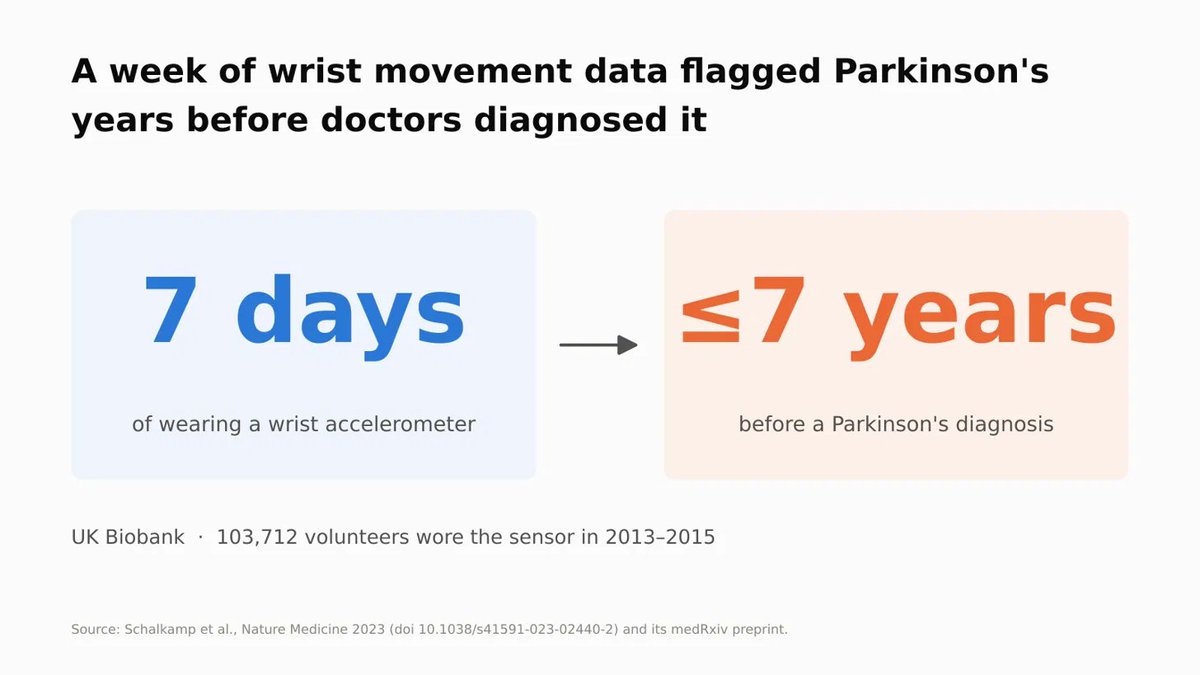
A research wristband, worn for just 7 days, picked up signs of Parkinson’s years before doctors diagnosed it.
Here’s what the Nature Medicine study actually found, and the one number most people will misread 🧵
#Parkinsons#Wearables#DigitalHealth
My take as a wearables engineer: it’s not a diagnosis. At AUPRC 0.07, most people it flags won’t develop Parkinson’s.
But as a cheap first filter to find people for prevention trials, a week on the wrist beat blood tests here.
A research wristband, worn for just 7 days, picked up signs of Parkinson’s years before doctors diagnosed it.
Here’s what the Nature Medicine study actually found, and the one number most people will misread 🧵
#Parkinsons#Wearables#DigitalHealth
Is it just “sick people move less”? They checked.
Across Alzheimer’s, dementia, dystonia, osteoarthritis and depression, only Parkinson’s showed lower movement both before and after diagnosis. In depression, the drop came only after.
Last Diwali, I was at Samsung, fixing my resume and applying on Naukri and LinkedIn.
This Diwali, I'm home from Bangalore, 6 months into Google.
Same family. Same aloo paratha from mom. Very different year.
If you're applying this Diwali, keep going. A lot can change in a year.
Happy Diwali 🪔
Neurotech is having a moment, and EEG is the consumer-friendly frontrunner. But what can its signals actually do?
I built an interactive site that walks through the physics, from a single neuron to robot arms to telling “focus” from “calm”, to show what EEG can and can’t do.