idk why it took me so long to do this, but if you're asking an agent to explain something to you, have it grill you first (e.g. @mattpocockuk's grilling skill) to find out what you know and where your knowledge gaps are. its explanations are 100x more effective this way.
bonus, use @backnotprop's html skills if you want to see visual explanations instead of walls of markdown :P
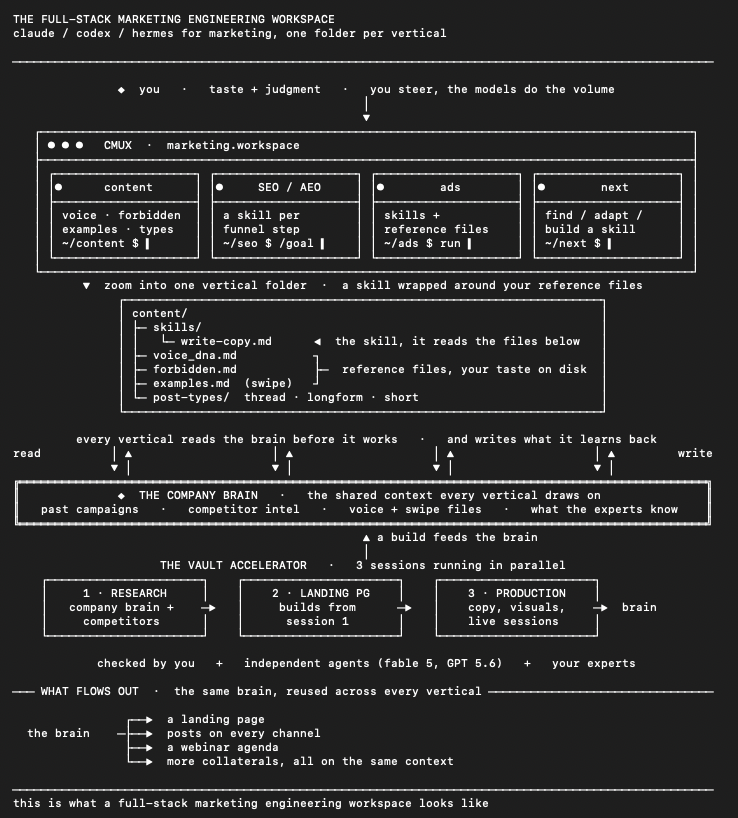
claude/codex/hermes for marketing
one folder per marketing vertical, find, adapt or create new skills to give you leverage within that vertical
easy - intermediate to set up, scales fast and produces quality (avoid slop)
example 1, content:
have a voice DNA, a forbidden, and an examples file for each channel you write for. the skill is crafted around these files and can write copy for you on whatever channel you'd like. pair that with reference files like post-types (thread, longform, short) and you get another layer to it
a swipe file library of good marketing has never been as powerful as now
example 2, SEO / AEO:
you create skills and reference for each step in the funnel. first the research and audit of your own rankings and competitors, find holes and opportunities. then a skill for the next step, edit current ranking articles or draft a new one, internal linking. then a skill to publish into your CMS. then the next step is backlinks to those articles, and it goes on
you start by building a foundation, you don't reinvent the wheel, there are already a bunch of great marketing skills out there
these examples teach you the fundamental framework to get started, just start within a folder and get the models to guide you when you don't know, and you bring your taste and judgment to avoid sloppy outputs
how I work with this is within CMUX, multiple terminals open at the same time targeting different verticals and projects, so I can juggle more but also deep dive one topic or campaign whenever I want
I recently prepared a vault accelerator for our agency, running three sessions:
1. one researches internally in our company brain to find learnings from past campaigns, and externally to look at competitors and other campaigns, gathering context to build as good a cohort as possible
2. one built the landing page, taking the context and learnings the first session synthesized
3. one creates the sessions, it takes info from the first two (and reads my input over the course of them) and creates the copy, illustrations, and everything that goes into the sessions we run
how I ensure the quality is by verifying myself, with independent agents along the way like fable 5 and GPT 5.6, but most importantly the experts I work with. its like bringing all the knowledge and experience into one place and letting ai synthesize and create learnings from it
that context I can then bring to my other open agents within each vertical to create more collaterals, posts on every channel, a webinar agenda to go with it
the whole thing starts being more like a full-stack marketing engineering workspace, and that's how it operates
Germany has launched one of the world's best open-source AI models.
Soofi S, made by the Soofi consortium, is a 30B parameter model fully trained in Europe and tops the ranking for open-source AI.
Huge moment for Europe, and finally some competition for Chinese open-source AI.
Family Trip Command Center is an open-source dashboard that manages group travel logistics through a command-center interface. The tool replaces standard planning methods by tracking convoy routes, simulating arrival times, and coordinating meals and activities for multiple families traveling together.
https://t.co/iU28zCJotH
i prompt my agents from my Mac notch
plans, todos, usage, transcripts, tools, everything
Claude, Codex, Cursor, Hermes, OpenCode, Grok, Pi, Antigravity
direct prompting currently works with Claude and Codex
No me quiero imaginar lo que va a ser esta red social el domingo 19 de julio de 2026.
Se inventarán nuevos insultos y palabras que a día hoy no conocemos.
Paz y amor para todos.
It’s a bad day to be a notification… Notion Agent can now manage your Inbox.
From chat, it can catch you up on what’s important, then mark notifications read or archive them in bulk.
Personal Brain from OpenWiki connects directly to your Twitter account which allows it to ingest posts from your feed (yes this is an api they offer!) and bookmarks. Bookmark ingestion is especially useful since we instruct the agent to place extra emphasis on bookmarks during the memory process
i use this all the time to save interesting posts i see, which i want my memory agent to know about
try out OpenWiki and build your own personal brain 👇
herdr 0.7.4 is out!
many fixes, many additions, and structural work for multi-client 👀
but this one ships one of the two most wanted features:
customizable sidebar.
both agent and workspace rows: plugins, custom scripts, agent hooks, or just settings can put anything on them. claude's live task title, codex context usage, a pac-man eating pi's context window. your agents, your rows.
new skill: improve-ui
built to audit interfaces against their own design language, inspired by @shadcn's improve skill.
it reads your repo's design context: DESIGN.md, CSS, shared components, etc. then finds where the UI breaks its own rules and writes a plan to fix it
Something I have been thinking about: in the past, the best engineers I knew spent a lot of time automating their work in various ways. Better vim/emacs automations, writing lint rules to catch repeat code issues, building up a suite of e2e tests so they don't need to smoke test the app manually. These kinds of things were the highest leverage activities an engineer could do, because it multiplied their own output, which in turn meant they could build more things.
I think many of these automations have become even more important now. This is true for a number of reasons.
First, infra and DevX automation speeds you up. And if you are running an army of agents, each of those agents will be sped up also. More automation == more output per unit of time.
Second, moving things to code improves efficiency. Your agent could fix an issue every time it sees that issue happen, but that uses tokens and might miss cases. If Claude instead writes a lint rule, CI step, or routine, that class of issue can be fully automated forever. This is really what people are talking about when they talk about loops -- it's about automating entire types of busywork rather than solving them one off. This isn't a new idea at all. Engineers have been doing this for a long time!
Third and most importantly, automation makes it possible for others to contribute to the codebase more easily. Increasingly what I am seeing is engineers are contributing to codebases on day one because Claude can navigate the codebase for them, and that non-engineers are able to contribute to a codebase as effectively as engineers can. What gets in the way of both of these is domain knowledge that lives in peoples' heads rather than in automation -- the stuff you used to have to learn when ramping up. What has changed thanks to agents is the domain knowledge that can be encoded as infrastructure is no longer limited to what is expressible in lint rules and types and tests; it can now capture nearly all domain knowledge, encoded as code comments and skills and CLAUDE.md rules and memories. If I put up a PR for an iOS codebase I don't know and a code reviewer rejects it because it doesn't use the right framework, or if a designer builds a new feature and it gets rejected because it doesn't follow the right architectural patterns, these are failures of automation.
Every team should be writing the CLAUDE.md's, REVIEW.md's, skills, and docs that enable agents to productively work in their codebase with zero additional context from the prompter. This sounds crazy, and at the same time is a natural extension of the stuff engineers have always done: automate, and encode domain knowledge as infrastructure. As the model gets smarter and as the harness matures, this task becomes easier. In the meantime, it is on every team to look for ways to convert their domain knowledge to infra so that Claude can write code better, so that code review catches issues automatically, and so the next person working on your codebase can contribute more easily.
The code is the environment your agent runs in
Ignore it, and the world around your agent crumbles
If you still think ignoring the code - i.e. vibe coding - is the future, I'd love to hear a counter to this
Claude Code artifacts can now call MCP connectors, letting you build dashboards and apps that can fetch information and take actions for each viewer on demand.
Available on Pro, Max, Team, and Enterprise plans. Not available on publicly-shared artifacts.