Anthropic code review this, clanker review that ... why don't you shut up and review+annotate your own code.... (yes im a loser who still manually reviews code)
Originally inspired by a bunch of feature requests and then seeing @dillon_mulroy tweet a similar cool ux.
@plannotator for reviewing plans (primary focus) and code, fully oss.
OpenCode, @badlogicgames 's https://t.co/tc56yk4Uom, and Claude Code and other clankers
@The_Whole_Daisy ah thanks... has been a burden and couldnt find out how to get past those approval windows
mess of stuff still didnt work from github issues
I'm hiring founding research scientists and interns for @MorphLabs_ to build non-invasive brain interfaces.
Looking for exceptional researchers from any background to tackle SSL on thousands of hours of EEG, transfer learning across people, sessions and headsets, and causal decoders that adapt online while the user adapts back
This has become, and feels like, a local version of Claude Tag, and it has also become the best remote mobile UX I’ve used.
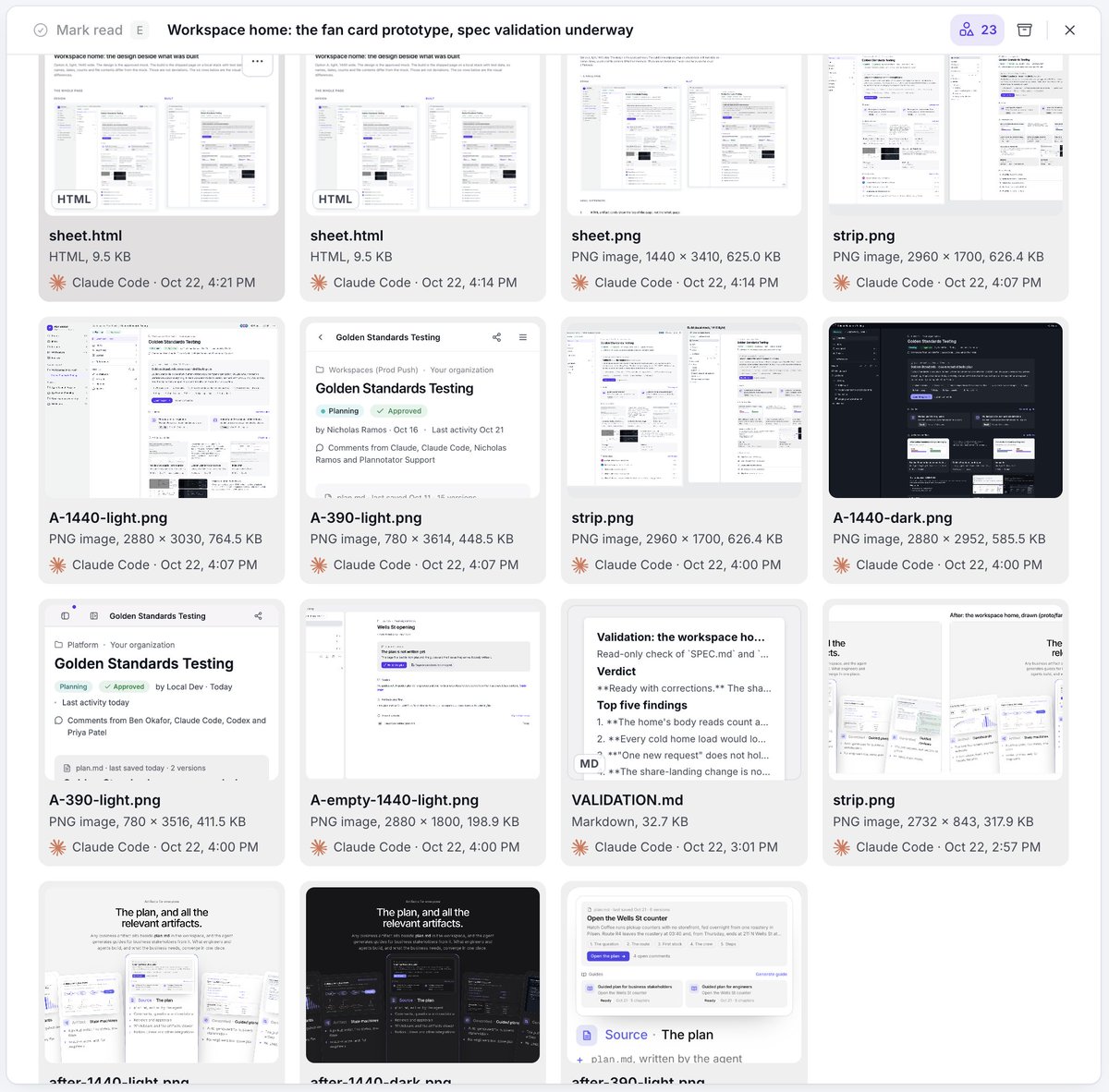
bc you are no longer operating in session threads and instead where decisions & images/html/video get surfaced right to you in an organized way.
Introducing Plannotator Inbox.
Making decisions is the new bottleneck, while your agents work on many things across many threads over longer periods of time.
Inbox is how you stay in-the-loop, organized, alongside the agent harnesses you already prefer to use.
Try today, free, local, open source.
@ArtemXTech Let me know if you think of UX improvements. Right now I really only the mark read/archive features but can see what you mean.
For me specifically each thread is always a high level focus area (like full feature). So it stays somewhat organized
@theplgeek Gotcha, guess ai is getting weird then. There are odd & subtle similarities that I didn’t specifically one-shot & instead iterated on.
It all convergences nevertheless.
https://t.co/wuDbDmKbcP
Introducing Plannotator Inbox.
Making decisions is the new bottleneck, while your agents work on many things across many threads over longer periods of time.
Inbox is how you stay in-the-loop, organized, alongside the agent harnesses you already prefer to use.
Try today, free, local, open source.
I think we are quickly evolving past needing surfaces to review intent/alignment and into needing better decision making "command centers."
As decision making across many contexts, which agents effortlessly own, is becoming the bottleneck.
This underscores the need for knowledgeable decision makers – and less so about a bottleneck of us not understanding; better models are able to derive aligned intent and produce tasteful+correct solutions without too much steering. This enables the experienced and things are just starting to get fun as we babysit less and do less of "wait bro wtf did you just do?"
UI/UX:
Similar to intent/alignment surfaces, and perhaps ironically bc better decision making surfaces need to provide adequate context per decision (that is easy for a human to consume/understand).
e.g. similar things, but different:
A tool feels behind when it focuses on a side bar of message thread activity and inline html rendering vs a tool that manages multiple contexts, surfaces relevant html artifacts per thread, and abstracts the exhaustive message threads away from you.
Introducing Plannotator Inbox.
Making decisions is the new bottleneck, while your agents work on many things across many threads over longer periods of time.
Inbox is how you stay in-the-loop, organized, alongside the agent harnesses you already prefer to use.
Try today, free, local, open source.
@ctatedev yea, where its all headed, I work in an async UX where most session tokens never surface to me.
Sitting in front of coding agent sessions is the next cursor tab. Next gen ux looks like Tag/Projects/Inboxes
https://t.co/wfWm8p0rVI
Introducing Plannotator Inbox.
Making decisions is the new bottleneck, while your agents work on many things across many threads over longer periods of time.
Inbox is how you stay in-the-loop, organized, alongside the agent harnesses you already prefer to use.
Try today, free, local, open source.
This isnt a full replacement for your local harness, this is like an extension view at this point. So if you already use claude or codex those browsers are still available to you.
Since you asked - I used to be a big user of the Codex browser annotation & things that captured the screen so i could draw on it, but now,
I no longer annotate on the screen or in the browser. It's a faster iteration loop (local dev) for the agent to just send you screenshots and you reply "i dont like how X looks, remove Y, add Z"
Half the time I don't even need screenshots. I'll just say, hey, I don't like how this looks on whatever page and it goes and changes it.
A good model can now infer your intent, without you having to draw circles or provide dom context.
pi-subagents just hit 4K stars on GitHub! 😇
Just shipped: it's now durable, so Pi no longer loses work when the session crashes. Interrupted subagents resume where they stopped, and finished ones show their results the next time Pi reopens the same session.
Also new: Rex support. Subagents can run in Rex terminal tabs, locally or over SSH.
pi install npm:pi-subagents
https://t.co/CbY36IKZ3z
This article applies to antiquated subagent pattern. Claude code itself embraces a strong subagent pattern with orchestrator on top. And subagents owning full work streams vs splitting it up. The full embrace is in their latest projects interface but the harness itself has a very strong setup on its own.