Welcome to Walrus Academy! 🎓
Think you know Walrus and its role in the Sui ecosystem? Now’s your chance to prove it and level up in the community!
Here’s how to seal your status as a Walrus expert 👇
https://t.co/xkPABCGESC
Honeypot Finance is excited to introduce our $4 Million incentive plan for Pot2Pump Meme Launchpad
Beras might wanna learn to read for this one 🔥
And furthermore, ooga booga 🐻⛓️
🔗 Mirror: https://t.co/OeHfk5KKR5
🔗 Zealy: https://t.co/UWwl1Lgh2V
🚨 Introducing Pot2Pump by Honeypot Finance 🚀
The next evolution in meme token launches, built for @Berachain and beyond 🌐
Tired of high-risk meme token launches? Honeypot has you covered 🧵👇
📰 Fjord Foundry Curator ✅
We are delighted to announce that we have become an official curator for launches on @FjordFoundry
Whether FTO, LBP or FPS, we'll support & help you achieve success together on @berachain - let's talk 🤙
Only the beginning. Beras support Beras 🐻 ⛓️
🚨 REVEALED: HoneyGenesis & Frens 🚨
After an epic meme war, slugging punches for weeks, we've buried the hatcher with our frens at @0xhoneyjar 🤝
Marking the occasion, we reveal to you the artwork for the first of our HoneyGenesis exclusive partner NFTs 🔥 🎨
HPOT X THJ 🐻 ⛓️
🚨 BERA FARM ALERT 🚨
Honeypot Finance is bringing the heat with BeraFarm 🚜
Co-developed with our partners at @0xAnimus - we introduce a game that’s levelling up the GameFi world on @BeraChain 🎮
Let’s break it down👇🧵
The HoneyGenesis NFT is more than just a Berachain pfp 🍯 🐻
It’s a gateway to a powerful set of utilities within Honeypot’s DeFi Hub.
Let’s dive into what makes this NFT a must-have in your collection 👇 🧵
Honeypot's BeraBatis Public Testnet is now open on @berachain testnet 🔔
💡 How to participate
💻 Brand new site & dApps
🪂 PotDrop incoming
🍯 HoneyGenesis Holder Prize
💰 Bumper Giveaway Bonanza
All details you need to know are below 👇
Professor Pot has been cooking up a Beducation series over the past 3 weeks, showcasing the Proof of Liquidity concept from the developers perspective and building it from the ground up.
Let's recap and bring the entire story together 🐻 ⛓️
🧵 1/8
Let’s Build the Tri-Token System
We return for the fifth and final tale on our journey to construct the mechanics of PoL from the ground up.
We've seen the rationale, the challenges, the foundations of the 2-token system. Now we extend this to the tri-token model to complete our quest and structure the ideal PoL mechanisms.
A quote from the Ooga Booga Founder
“Berachain's technical architecture operates under a "tri-token model". Some argue that the dubbing of this model is inaccurate, contending that the $HONEY stablecoin doesn't directly injunct itself with the Proof of Liquidity consensus model.”
Kevin made some good analysis to the use cases of $HONEY in this thread:
https://t.co/y1B3LxZTGk
Kudos for the good work @whoiskevin
I am going to present use cases for $HONEY and why they are important from an economic point of view.
Before I dive into this, let’s take a quick look at the US Dollar’s history.
Snapshot of Bretton Woods System
The Bretton Woods system was developed as an international monetary exchange arrangement. This system took currencies belonging to 44 countries and pegged them against the value of the US dollar.
The US dollar itself was pegged against the price of gold. This system was in use between 1945 and 1973.
In 1973, the US was short on gold. Gold reserves could not meet the value of dollars in circulation. Economists’ attempts to revitalize Bretton Woods failed.
In 1973, the Bretton Woods agreement collapsed - it ceased to exist.
From the Bretton Woods system, we can draw an important comparison to a blockchain:
The number of on-chain assets that can exist on a chain depends on how many native tokens (BERA + BGT) are reserved.
If on-chain assets issued are much greater than the native token, our previously designed 2-token system will collapse.
Let’s reinvent Fisher’s formula to solve this dilemma.
Previously, The Fisher Equation, MV = PT, is central to the Quantity Theory of Money, where
- M is Money Supply
- V is the Velocity of circulation
- P is the Price Level and
- T is Transactions
We introduced Proof of Liquidity to make smart uses of the Fisher’s formula by increasing V to increase overall on-chain economic scale.
Now, let’s reinvent M. Here is the formula that we come up with when we introduce another token (ideally stablecoin) - let’s call this token $HONEY
(M1 + M2)V = [P1 (M1/M1+M2) + P2 (M2/M1+M2)]*T
where
- M1 is the supply of $BERA + $BGT
- M2 is the supply of the $HONEY
- P1 is the price of the $BERA
- P2 is the price of $HONEY.
When $HONEY can be 1:1 converted to other stablecoins back and forth, the price is 1.
However we can’t just print stablecoins. If we do so, we are generating the token out of thin air.
$HONEY needs to have more use cases than USDT/USDC on Berachain so people would want to use it. In other words, $HONEY needs to be more “valuable” than the $USDT and $USDC and other types of stablecoins.
So, let’s build some use cases for $HONEY. We build the lending (Bend) and perps (Berps) engines to use $HONEY giving it real value tied up to the chain.
And there we have it, the architecture of tri-token model is constructed.
I hope you enjoyed this beducational journey and our quest to build the mechanics of the PoL system are complete.
Beras in control - Pot in control
Ooga Booga 🐻⛓️
Let’s Build the Initial Proof of Liquidity - Part 2
Effective Token Design in PoL
Having covered off in our last session, the challenges with building the PoL system, let's now address the issues and build it out effectively.
With the contrasting properties of a one-token system and the nature of PoS, we are forced to design a different, two token system with the following properties:
1 - This new token must have some relationship with the original $BERA token.
2- It must have potentially higher economic value than $BERA, so Validators are willing to hold the token and use it for circulation instead of converting it back to BERA.
Let's give this token a name. We'll call it $BGT. So now we have our two token systems for our blockchain. Let’s take the top-down approach to complete the rest of the design.
In order to incentivize Validators willing to assign the proportion of the $BGT to the rest of the parties, they need to compete with each other. So Validators competition is a key part of our design.
Here is the design work that makes them compete with each other:
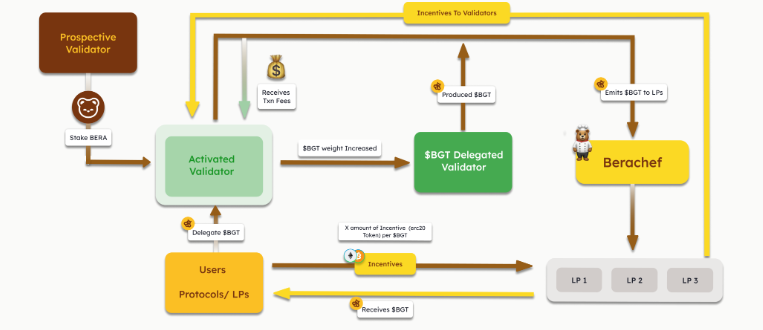
1 - We cook the Vault between the Validators and the Dapp. In this Vault, Dapps (producers) can allocate some of their governance tokens to the Vault. Dapps (producers) can freely choose a vault , and the amount of the governance token from the various Dapps is going to calculate the $BGT weight. So in this way, we make the Validators compete.
2 - We adopt Cosmos’ DPoS (Delegated Proof of Stake) so validators can delegate to other Validators (we validated the reason again in here why we go with the tendermint BFT).
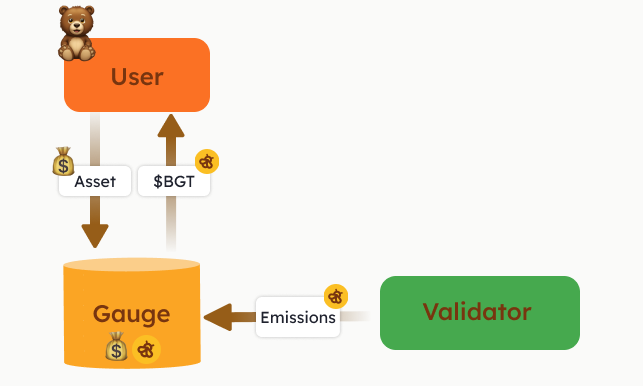
The last question is how do we get $BGT redistributed to the users, because the design that we come up with now “produced” some $BGT in the Vault. So we can use the vault as one of the gateways.
Users deposit some assets to the Vault and they can have some way directly or indirectly to receive the $BGT. They need to show the proof that they made the deposit to the vault.
How about the $BGT that protocols received, how can we make $BGT come down to the users from this path?
Naturally here is an easy solution that we can come up with. As a chain, we can build the Dex ourselves (fair play). So users can deposit the protocol’s governance token into the Dex’s LP pool and earn some $BGTs.
Now connecting everything that we build so far, here is what we have come up with:
Interpretation of $BGT in the real world.
Let’s review the properties of $BGT
1 - This $BGT must have some relationship with the original $BERA token
2 - $BGT must have potentially higher economic value than $BERA, so Validators are willing to hold $BGT and use it for circulation instead of converting it back to $BERA
Let’s finish the last part of the design work done: here is the relationship that we want to get between $BGT and $BERA. $BGT can be burned to $BERA with 1:1 ratio but anyone holding $BERA can’t use $BERA to buy $BGT. Putting this design into place will further accelerate the circulation of $BGT and reduce the stake centralization.
So let’s see what’s the definition of the $BGT ?
$BGT is the derivative of $BERA because holding $BGT has more economic value and it has zero risks. Such a thing can only be done in blockchain!
But let’s think from a real world perspective how we can make $BGT “legitimate”. Imagine that you are only allowed to issue one token, otherwise you are confusing the investors who invest you. So here is the way that you can do it.
You issue X amount of the $Bera and reserve ½ X amount of Bera in 100% “safety deposit box”.
“Safety deposit box” then issue you the receipt of the stBera to demonstrate that you made the deposit.
And then you show this receipt stBera to some magicBox and this magicBox will then burn ½ $BERA in “safety deposit boxes” and mint ½ $BGT. After finishing all steps, you issued ½ X amount of $BERA and ½ X amount of the derivatives of $BERA which is the $BGT.
Where to next you ask?
Stay tuned and we will build out the tri-token system. The journey continues 🐻⛓️
Let’s Build the Initial Proof of Liquidity - Part 1
Challenges in Building Proof of Liquidity (PoL)
Before I go through the right way of building PoL, I am going to show you the wrong way of building it so we understand better what the right elements are that we really need in order to build the real proof of liquidity.
Let’s start our exploration journey...
Validator Incentives and Governance Token Model
Without much thought, this is the initial model that jumps to mind. Let's say we are only issuing one token, $BERA, which is our governance token.
For any validator to successfully validate each transaction
- 60% of the $BERA reward goes to validators to reward them for successfully securing the chain
- 25% of the $BERA reward goes to dApps to reward them and keep them working to produce valuable services for the chain
- 15% of the $BERA reward goes to users to incentivize them to keep engaging with the chain
What does this model look like? This model looks exactly like Soviet-type economic planning. Even if we have some democratic procedures to have a DAO, what did I warn you about in the first thread?
Imagine that you are the validators; who would agree to let other parties take pieces of the pie from you when you could easily find more rewarding opportunities from other L1 chains? Validators are not incentivized to go with this model design.
The Condition:
Let’s rework on previous designs to improve them. This time, we're redesigning what conditions we need in order to keep all parties incentivized.
Let's list them all out and start to construct our structure:
1. Users (consumers) should be rewarded some reward token when they have the economic engagement with the chain’s dapps (producers), and the reward to Users (consumers) should come directly from the Dapp (producers) itself. Everything should be based on economic activities.
2. Users (consumers) can freely engage with Dapps (producers) based on the potential “APY”.
3. There should be some reward token coming from Validators to reward Dapps (Producers).
4. Dapps (Producers) can freely choose what economic relationship to have with Validators based on this reward token's "APY" from each validator.
5. Validators should receive returns from the Dapp / user engagement activities which they think are greater than the token that they allocated. This will incentivize them to allocate some reward tokens down the path.
6. Validators should compete with each others to earn more reward token
So now we get rid of the Soviet-type economic planning and embrace the free market.
We uncover the nature of this reward token - it needs to circulate within the ecosystem. Circulation is the essential property of this reward token.
However, herein lies the problem... its property contrast with the typical PoS design.
In PoS design, Validators want to stake tokens to earn and accumulate more tokens, and add their centralization power, not to circulate them.
On account of this, we must design a new token... coming thoon 🐻⛓️
In my second thread, we'll put the POL incentivization part aside and just explore the rest technical considerations and steps required to build a Proof of Liquidity (PoL) - let's Imagine we have already constructed the POL incentivization tech stack aims to ensure fair distribution of rewards among producers (dApps), consumers (users), and PoS validators, thereby incentivizing velocity (V) in the Fisher Equation (MV = PT).
We ask ourselves now, in what way should we build the rest of the technology stack?
This is the low IQ article among all series. Please gib an easy read!
Understanding the Current Setup
Here's a summary of what it take to build a blockchain
Network Module: Handles communication between nodes in the Ethereum network, including transaction and block propagation.
Consensus Module: Ensures all nodes agree on the blockchain's state.
Data Module: Contains the blockchain, a chain of blocks each holding a list of transactions.
Execution Module (Optional): Executes smart contracts via the Ethereum Virtual Machine (EVM), updating the blockchain's state accordingly.
Application Module (Optional): Where decentralized applications (dApps) run and interact with smart contracts.
Since we're building Layer 1, so that's not reinventing the wheel, it's easier to adopt a modular approach rather than a monolithic one. We can leverage the Cosmos SDK and select the components we need instead of forking Ethereum.
Choosing the Consensus Algorithm
PoL is built on top of PoS (Proof of Stake). But why choose PoS? Let's break it down:
Why PoS?
With a goal in mind to incentivize velocity of circulation, the chain's transactions per second (TPS) can't be too low. PoW (Proof of Work) requires heavy computational work, which slows transaction processing and isn't cost-effective for validators. This eliminates PoW from our options.
PoS and its variants are more efficient. one of stand out mechnism is Solana's PoH (Proof of History) uses a sequence of computations to create a historical record of events. Validators verify transactions by checking PoH timestamps. However, PoH increases centralization, which isn't ideal for PoL.
Selecting the Right PoS Model
There are two key considerations here in our decision making:
Modularity: We need a flexible and adaptable consensus mechanism.
Stake Flexibility: Unlike Ethereum, which requires a fixed 32 ETH stake to become a validator, we prefer a model with more flexible staking requirements.
Tendermint BFT, which uses a DPoS (Delegated Proof of Stake, which we’ll cover in more detail later on) model, fits these criteria. Validators are elected based on the amount of staked tokens and delegated tokens, offering both modularity and flexibility.
Building the Network module
Neither Ethereum nor Cosmos offers the perfect solution for our needs. Ethereum's network module is intertwined with other modules, while Cosmos Hub has a limited number of validators and slower transaction handling for entering the mempool.
Our approach:
Start with Tendermint Core.
Gradually modify the code to incorporate Ethereum-like features.
Comparing our Choices with Beaconkit (Berachain V2)
Here's a recap of our choices:
We opted for a modular approach, relying on the Cosmos tech stack.
We selected Tendermint BFT as it maximizes flexibility and compatibility with our incentivization module (the essence of PoL) that we constructed earlier.
We decided to rework the network module for modulairty and omtimal performance.
This approach mirrors Beaconkit's methodology.
Future Development
As parallel EVM becomes a more mature industry solution, PoL can adopt it to enhance performance during high traffic periods. This option is less centralized than PoH and can significantly improve TPS during periods of heavy traffic.
Beras in control
Introducing the Custom Hook 🪝
Honeypot Finance is all about flexibility and innovation, and our Dreampad custom hook features encapsulate this
Dive into how you can tailor your launches with us 🍯 🐻 ⛓️
🧵 (1/8)








![PotTheBera's tweet photo. Let’s Build the Tri-Token System
We return for the fifth and final tale on our journey to construct the mechanics of PoL from the ground up.
We've seen the rationale, the challenges, the foundations of the 2-token system. Now we extend this to the tri-token model to complete our quest and structure the ideal PoL mechanisms.
A quote from the Ooga Booga Founder
“Berachain's technical architecture operates under a "tri-token model". Some argue that the dubbing of this model is inaccurate, contending that the $HONEY stablecoin doesn't directly injunct itself with the Proof of Liquidity consensus model.”
Kevin made some good analysis to the use cases of $HONEY in this thread:
https://t.co/y1B3LxZTGk
Kudos for the good work @whoiskevin
I am going to present use cases for $HONEY and why they are important from an economic point of view.
Before I dive into this, let’s take a quick look at the US Dollar’s history.
Snapshot of Bretton Woods System
The Bretton Woods system was developed as an international monetary exchange arrangement. This system took currencies belonging to 44 countries and pegged them against the value of the US dollar.
The US dollar itself was pegged against the price of gold. This system was in use between 1945 and 1973.
In 1973, the US was short on gold. Gold reserves could not meet the value of dollars in circulation. Economists’ attempts to revitalize Bretton Woods failed.
In 1973, the Bretton Woods agreement collapsed - it ceased to exist.
From the Bretton Woods system, we can draw an important comparison to a blockchain:
The number of on-chain assets that can exist on a chain depends on how many native tokens (BERA + BGT) are reserved.
If on-chain assets issued are much greater than the native token, our previously designed 2-token system will collapse.
Let’s reinvent Fisher’s formula to solve this dilemma.
Previously, The Fisher Equation, MV = PT, is central to the Quantity Theory of Money, where
- M is Money Supply
- V is the Velocity of circulation
- P is the Price Level and
- T is Transactions
We introduced Proof of Liquidity to make smart uses of the Fisher’s formula by increasing V to increase overall on-chain economic scale.
Now, let’s reinvent M. Here is the formula that we come up with when we introduce another token (ideally stablecoin) - let’s call this token $HONEY
(M1 + M2)V = [P1 (M1/M1+M2) + P2 (M2/M1+M2)]*T
where
- M1 is the supply of $BERA + $BGT
- M2 is the supply of the $HONEY
- P1 is the price of the $BERA
- P2 is the price of $HONEY.
When $HONEY can be 1:1 converted to other stablecoins back and forth, the price is 1.
However we can’t just print stablecoins. If we do so, we are generating the token out of thin air.
$HONEY needs to have more use cases than USDT/USDC on Berachain so people would want to use it. In other words, $HONEY needs to be more “valuable” than the $USDT and $USDC and other types of stablecoins.
So, let’s build some use cases for $HONEY. We build the lending (Bend) and perps (Berps) engines to use $HONEY giving it real value tied up to the chain.
And there we have it, the architecture of tri-token model is constructed.
I hope you enjoyed this beducational journey and our quest to build the mechanics of the PoL system are complete.
Beras in control - Pot in control
Ooga Booga 🐻⛓️](https://pbs.twimg.com/media/GS8xDIeXcAE7DPP.jpg)


![EarthDeFIRE's tweet photo. [#Airdrop กำลังมา?!] Crypto Project ที่ได้รับเงินระดมทุนสูงสุด 30 อันดับแรกที่ยังไม่ได้เปิดตัว Token
ผมได้พยายามทำให้เนื้อหาเข้าใจง่ายและเป็นกันเองมากขึ้น โดยใช้การเปรียบเทียบและภาษาที่เป็นธรรมชาติ https://t.co/yX7oL1SCuk](https://pbs.twimg.com/media/GR3OyjxagAAdyPR.png)


