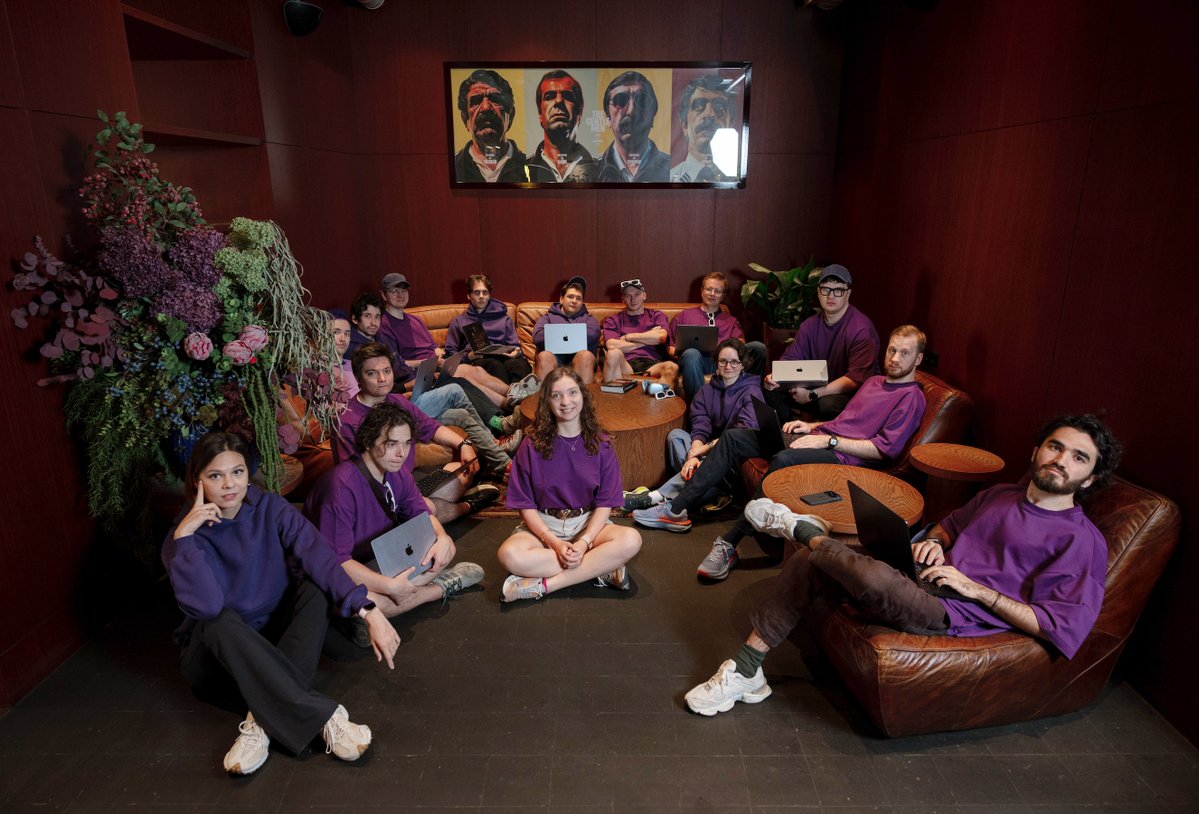
meet @mostik_ai!
what happens when you put 12 PhDs in one room for four months? first place on the ARC-AGI leaderboard, which I can't say much about while the competition is still running. and this, which I can.
everyone's arguing about whether open models will catch up to frontier models. we think it's the wrong question. here's the one we pose: why does a frontier model have to generate your answer at all, when the only thing you need from it is the reasoning?
we do this by enabling models to communicate in latent space. through our protocol, hidden states pass straight from a frontier model into a small one running on your infrastructure -- no text between them, and neither model is fine-tuned. two models from different families, sharing reasoning, both left untouched.
how do we know it works? we tested it on a setup where a 753B model reads the problem, and a 4B edge-class model writes the answer. with this approach, we get results 80% as accurate as the frontier model, but at 20x faster performance.
we're committed to preventing frontier model lock-in and are already partnering with inference providers to accelerate open-weight adoption. we've done this between 15 of us, in four months, 12 PhDs and a Fields medalist, backed by @generalcatalyst
WIRED has the first external account of the company and the work: https://t.co/tP8nItCsDl
full writeup, the setup, and all the numbers: https://t.co/C9NZ5vtV1V
And now it's happening! I am hosting San Francisco Shabbat on December 11th
Come join us for kosher food and wine, eight Hanukkah candles, old and new friends.
I came to SF in August, and the people here have been incredibly kind, inspiring, and supportive. So many of you have made me feel welcome, and I wanted to bring some of that warmth into one room.
A little time to slow down and feel at home together 💛
https://t.co/4O0BjqZ6Rg
a fair question about models talking in latents: how do you read what they send each other?
new paper from MATS, Arb and Anthropic trains a model that takes a direction from another model's hidden state and writes text that triggers it. every output can be checked with one forward pass. it pulled hidden backdoor payloads out of LoRA weights 85% of the time, corpus search ~2%
still misses ~11% of features (mostly lists, tables, number formats), but this is exactly the kind of tool latent channels need
https://t.co/CHIy6rTcIT
flying to Tel Aviv today, then London next week ✈️
if you’re working on multi-agent systems, inference infra or anything around latents, I’d love to grab a coffee! or if you know someone I should meet there, please send them my way 🫰
how do you know which model actually answered you? when you call an open model through a provider or a router, all you see is the model name in the API (and the same name can score anywhere from 67 to 99 depending on who served it, see more in the quoted post about it)
so this matters if you pay for a specific model through a router, if you publish benchmark numbers you got through an API, or if you’re a provider who wants to show you serve the real weights
there are two ways to check now:
1/ statistical: “One Token Is Enough” paper asks a model about a hundred trivial one-word questions like “name a random number between 1 and 100” and compares the answers with the model’s known fingerprint (one output token per question, tested on 165 models on OpenRouter, ~7% error rate)
https://t.co/uxgukHpPCF
2/ cryptographic: @AnthropicAI’s Frontier Red Team open-sourced FlashProve, a zero-knowledge proof that a response came from specific weights (on Llama 4 Maverick it costs 70-95x the GPU time of normal serving, ~19 MB of proof per 1,024 tokens and ~17 seconds to verify on a CPU, greedy decoding only for now)
https://t.co/1DLswcmXMN
my guess is routers will fingerprint every endpoint, since it costs almost nothing, and keep proofs for disputes (at 70-95x the compute, nobody runs those on every call yet)
does the inference provider change the answers? 👀
@ArtificialAnlys tested 103 endpoints serving open models against their own copy of the official weights, and 24 of them scored statistically below it!
the most extreme case is GLM-5.3: 10 out of 26 endpoints are below the reference (scores from 67 to 99, where 100 means the same as the official weights)
for comparison, DeepSeek V4.1 Flash 1017 had 22 endpoints and none below
so the GLM-5.3 on a leaderboard and the GLM-5.3 behind your API key can be noticeably different models
https://t.co/cV0gl1fHKt
open weights now come with a clause for the people who serve them
1/ Mistral Large 4: modified MIT, free to use and sell, except "businesses that operate a Model-as-a-Service offering must obtain a separate commercial license from Mistral"
2/ Kimi K3.1 Pro: hosting providers making over $20M in any 12 months need a separate agreement with Moonshot
3/ Meta's Muse Spark Open: companies over $20M in revenue have to notify Meta and sign an agreement before hosting it (internal use is exempt)
for comparison, DeepSeek V4.1 Flash 1017 is plain MIT and Reflection's Beam is Apache 2.0
I get why: open models are over 70% of paid tokens on @OpenRouter, and labs want a share of what providers make on them (however what Mistral's license doesn't define is where SaaS ends and model-as-a-service begins, if your product is a thin layer over the model...)
20 different models have been #1 on @OpenRouter since January.
The one at didn’t even have a name yet. Turned out to be MiniMax. Launch strategy: free and anonymous for two weeks, then the reveal.
Claude is WASTING 98% of your tokens on website edits
I changed ONE BUTTON and it cost me 150k tokens
We built a FREE skill to fix that
Click the element, ask for the change, and spend 5x fewer tokens
https://t.co/7jG3s0Ehag
does the inference provider change the answers? 👀
@ArtificialAnlys tested 103 endpoints serving open models against their own copy of the official weights, and 24 of them scored statistically below it!
the most extreme case is GLM-5.3: 10 out of 26 endpoints are below the reference (scores from 67 to 99, where 100 means the same as the official weights)
for comparison, DeepSeek V4.1 Flash 1017 had 22 endpoints and none below
so the GLM-5.3 on a leaderboard and the GLM-5.3 behind your API key can be noticeably different models
https://t.co/cV0gl1fHKt
swarm scale in 2026:
OpenAI, Navier-Stokes: ~10,000 agents for 88 hours Anthropic, Fermat in Lean: dozens of agents for 11 days Claude Code dynamic workflows: up to 1,000 per run
me: one agent, asking it for the third time to stop rewriting the tests 😄
words like “the”, “of” and “he” mean almost nothing on their own, and a recent paper looks at how transformers handle them
Vallisa et al. measure how many independent directions each word’s representation varies along (its intrinsic dimension), layer by layer, in two encoders and two decoders (Gemma-2-2B, Llama-3.2-3B): function words expand earlier and collapse sooner than nouns or verbs, and the collapse comes when their nearest neighbors change, as each one attaches to the phrase it belongs to
geometry alone is enough to tell function words from content words with 0.878 accuracy, without the classifier ever seeing which word it is
in the appendix they test what the collapse is for. averaged over a medical abstract, function words start far behind nouns at predicting its specialty, and around layer 19 they nearly catch up: “the” gets its meaning from the noun it attaches to
https://t.co/USFthY0SYr
this year three different teams used this nice and simple training idea: give the model a hint it won’t have later, let it solve the task with the hint, and then teach it to give the same answer without one (like a student working through the solutions manual, then closing it)
@jonashuebotter et al. (SDPO) used error messages and feedback as the hint: on a coding benchmark, a Qwen3-8B trained this way scored 48.8% vs 41.2% with standard RL, and caught up to standard RL’s final score with 4x less sampling
https://t.co/9wybQMK93e
@cursor_ai used it to train Composer 2.5: when the model makes a mistake mid-task, they insert a short hint right at that point. their post also lists what the model learned to cheat with, from digging through a leftover Python cache to decompiling Java code
https://t.co/lbSXZF7kIA
@perplexity_ai trained on real failures from production: in a live test with real users, tool errors dropped from 3.56% to 2.38% and the signs of unhappy users from 4.12% to 3.41% (they also published the test that showed no effect, which I respect a lot!)
https://t.co/gBS51MXXRU
then last month came the reality check: Zhong et al. ran 10 of these self-distillation methods against plain RL (GRPO) on 4 agent benchmarks with three Qwen3.5 sizes, 132 training runs and over 12,000 GPU-hours. only 2 of the 10 beat plain RL on average, the best one won in 6 of 12 settings, and spending more compute didn’t reliably help
https://t.co/TwmThsfera
so the idea is good, and how much it helps depends a lot on the task: the hint is where your knowledge about the task goes in, and that part seems to matter more than the method around it (sigh)
reading Minsky’s Society of Mind and so much of today’s multi-agent stuff is already there! his idea from 1986: the mind is a bunch of small (dumb) agents, and the intelligence is in how they talk to each other
in his version, however, they barely even talk: each part gets short signals from the others and figures out the rest on its own
and that’s kind of still where we are tho 😅 we connect really smart models and make them chat in text, which is pretty much the same narrow signal compared to what could be achieved in principal
that’s what we’re trying to change at @mostik_ai, so models can share what they actually computed instead of the narrow channel of words
Excited to launch Sprites 1.0 - the proactive agent that runs your ads end to end, fully autonomously.
1/ Trained on thousands of ads from the fastest-growing companies
2/ Builds a custom playbook for your brand, budget, and goals
3/ Autonomously creates on-brand video and image ads
4/ Full visibility across channels and funnels
5/ You stay in control with approvals
6/ Works in Slack, Claude, and wherever you work
Runs across Meta, Google, LinkedIn, TikTok, ChatGPT and all major ad platforms to find your buyers wherever they are.
Sprites has already been driving growth for a select group of customers, managing $30M in growth spend.
Today, we're opening it up to everyone with Sprites 1.0.
ugh @wandb! cross 10 seats and you’re officially “enterprise” (5x per seat, and the whole year paid upfront)
we’re a team of 15, and nothing about us changed between seat 10 and seat 11 except the bill haha 🥲
why is the jump so abrupt? a plan that grows with a small lab would be so much easier...
in Lisbon this week for @WebSummit 🇵🇹
if you’re around and working on multi-model systems, inference infra or anything where models need to talk to each other, let’s grab a coffee ☕
reading notes on Wittgenstein’s Tractatus this morning: his answer to why a sentence can describe the world at all is that the sentence and the fact share a logical form (e.g. one melody can live as sheet music, a MIDI file or a piano recording, and the relations between the notes stay the same)
it sounds very close to what we see in models: networks trained apart can (under the right training) end up with the same structure up to a rotation, and that shared structure is what makes a bridge between them possible
then comes his catch: some things can only be shown, never said! my read is that this is the gap between a model’s text and its hidden states, and why we’d rather pass the second one between models 👀
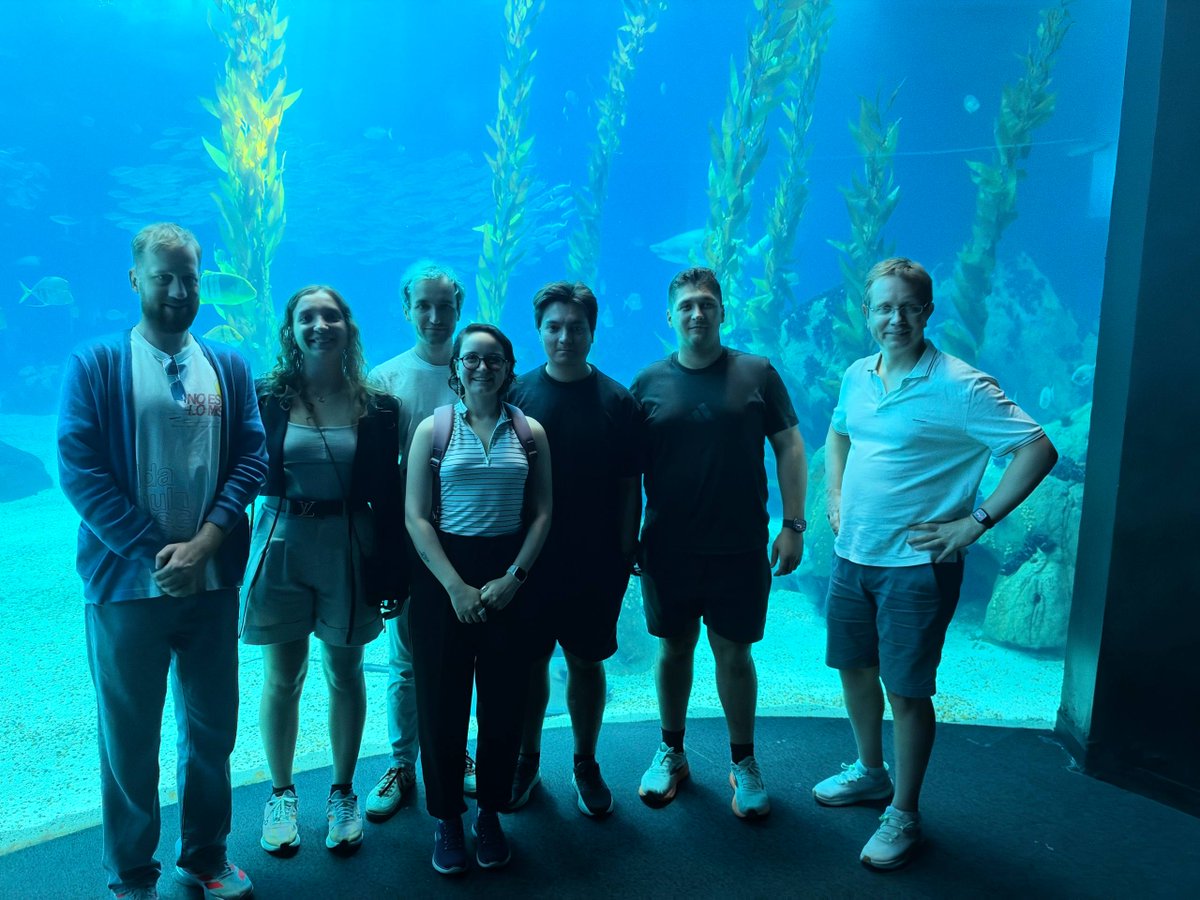
sunday brunch with the @mostik_ai team, then off to the oceanarium 🐠
at brunch the lady at the register asked what kind of group we were, and I said we live together and work together, and she asked “and you spend your weekends together too?” in a tone that clearly meant “don’t you get tired of each other” haha
honestly no! I’m blessed to have people who are my teammates, my housemates and the best company, all the time 💙
speculative decoding is one of the main tricks for making AI answer faster: a small model quickly drafts the next few words, and the big model checks them all at once
in papers however (below are few most interesting ones) these speedups are usually measured with a single user, while on a busy server the GPU has less spare capacity for drafting, so the gain shrinks
DFlash: 5.1x faster with 1 request at a time, 2.4-2.9x with 32
https://t.co/FF8ECCMqWM
P-EAGLE in @vllm_project: up to 1.69x over EAGLE-3 with 1 request, 1.05-1.25x with 64
https://t.co/9CPZZK7nZz
DeepSeek’s DSpark reports the number a provider actually needs: on live traffic, each user gets answers 60-85% faster while the server handles the same total load
https://t.co/Qp6UdFRTWS
so “5x faster” is true for one person in a chat window. for anyone serving many users, one needs to check out speed per user at the same load
every model keeps a memory of what it has already read, the KV cache: that memory only makes sense to the model that wrote it, so when a conversation moves from one model to another, the new model has to reread everything from scratch
Apple’s KV-Lingo translates one model’s cache into another’s with a simple linear map per layer, and the interesting part here is the training target: a translated cache can match the real one almost number by number and still leave the receiving model writing badly, so they tune the map until the receiving model predicts the same next words it would predict from its own cache
it works even between two model families, Qwen3-8B and Mistral-7B, and the result depends on which model does the writing:
(a) Qwen reading Mistral’s translated cache solves 85% of GSM8K math problems (Mistral alone 52%, Qwen alone 92%)
(b) Mistral reading Qwen’s cache gets better at knowledge questions (ARC-C 83% vs 73%) and worse at math (39% vs 52%)
and model switches get much faster: time to first token drops 9.6x on a short prompt and up to 29x on a 32K-token one
https://t.co/Nk5HxfketS