Kalshi's first Sequoia pitch was 18 slides, two headshots and a growth chart that looked too good to be true. Six years later, it's worth $40B.
In October, Sequoia and Wellington co-led its $1B Series G at that $40B valuation.
The climb:
$5B valuation in October 2025
$22B in May 2026
$40B in October 2026
30M+ accounts and over 75% of all prediction-market trading volume
Kalshi spent two years with the US regulator before launching as a regulated exchange. In the deck, that wait became the moat.
Fundraising comes down to 4 things: the story, the deck, the right investors and the timing of every round.
Product Market Fit has broken down all 4, with the decks, investor lists and templates included 👇
1️⃣ The Kalshi Series A deck Sequoia backed, slide by slide
https://t.co/yITWKhzlP9
2️⃣ The $1B fundraising playbook: every round of the 10 fastest-raising AI startups
https://t.co/IJmElSsF7d
3️⃣ The ultimate pitch deck directory (+70 decks)
https://t.co/SoBjqWW1g9
4️⃣ How to pitch without talking about your company, by Andreessen Horowitz
https://t.co/qXtG9msLGa
5️⃣ The ultimate capital directory (+5,000 investors, angels, funds and LPs)
https://t.co/PigWjr9QsD
6️⃣ The 120+ angels behind Cognition and 19 more breakout AI startups
https://t.co/thkyF6baai
7️⃣ The 10 fundraising templates and databases that matter
https://t.co/aa3UBEzN29
What's the hardest part of your fundraise right now?
The investor behind Spotify rides Lime bikes through red lights in Paris to meet founders.
Staffan Helgesson, founder of Creandum, calls venture "street fighting":
1. Creandum reached out first to Modal and to Black Forest Labs
2. It tracks interesting people and moves when something is about to happen
3. The investment team travels 3-4 days every week
4. It hosts small, curated dinners with the right people in the room
5. Founders are the customers, so you go where they work
Modal is now worth $4.65B, Black Forest Labs $3.25B.
A $750M fund still wins deals by showing up first.
Full breakdown here:
https://t.co/k87Td1vlcu
https://t.co/mK3FD9IihA
The investor behind Spotify rides Lime bikes through red lights in Paris to meet founders.
Staffan Helgesson, founder of Creandum, calls venture "street fighting":
1. Creandum reached out first to Modal and to Black Forest Labs
2. It tracks interesting people and moves when something is about to happen
3. The investment team travels 3-4 days every week
4. It hosts small, curated dinners with the right people in the room
5. Founders are the customers, so you go where they work
Modal is now worth $4.65B, Black Forest Labs $3.25B.
A $750M fund still wins deals by showing up first.
Full breakdown here:
https://t.co/GAy7Fs2cL1
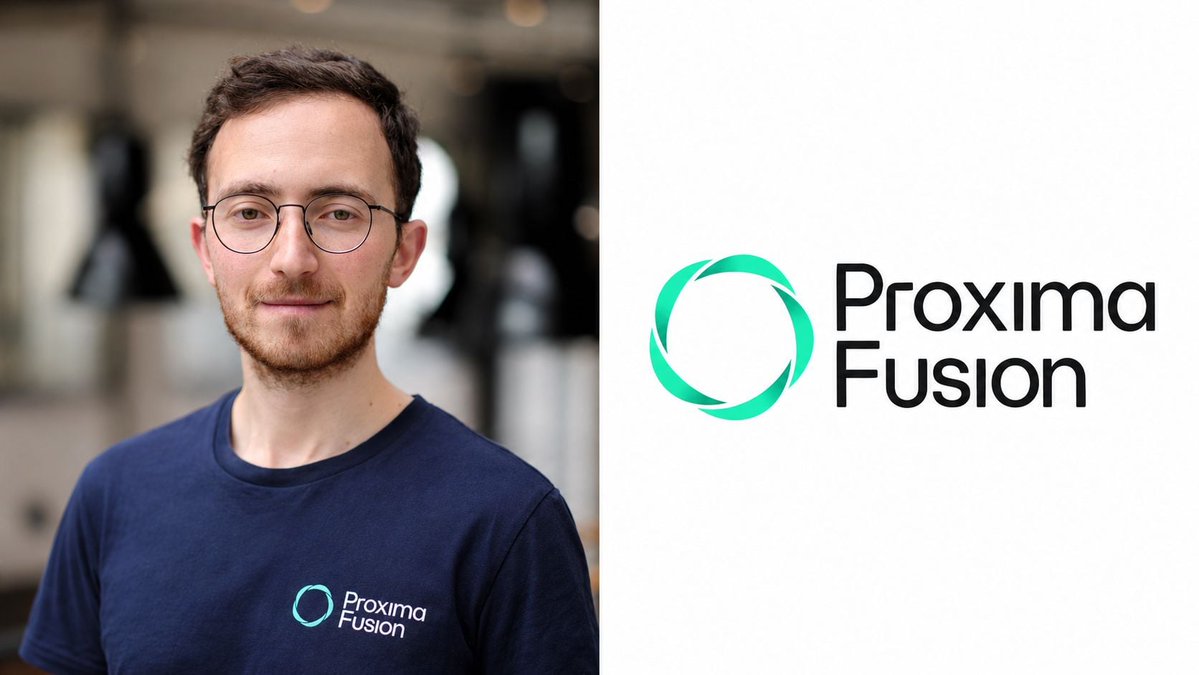
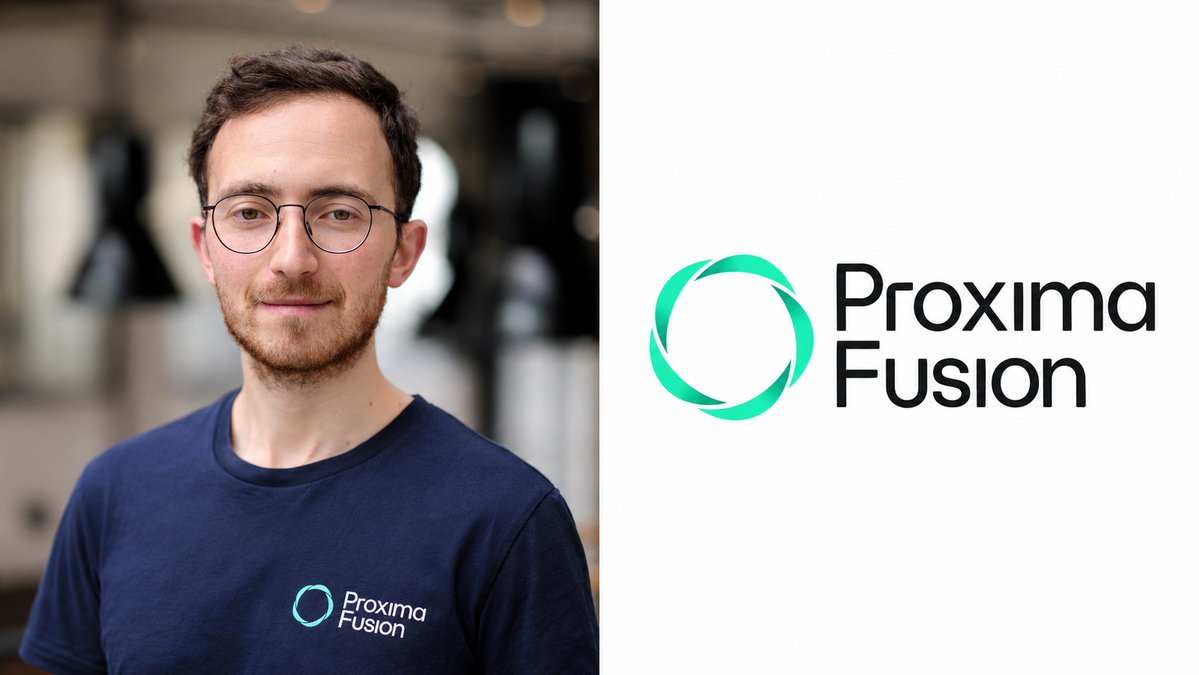
Germany's €1.3B fusion machine ended up too complex to build. Proxima Fusion is using AI to fix that.
Francesco Sciortino, CEO of Proxima Fusion, told us how:
1. A stellarator is a very complicated geometric object
2. Wendelstein 7-X got more expensive because nobody could see the integrated picture
3. Geometry is something AI captures very well
4. AI maps the integration, then the engineers weigh the trade-offs
5. The final call stays with his co-founder, because Claude isn't trained on manufacturing tolerances
He uses AI himself to summarize what the team produces.
That engineering judgment is what Europe's €2.4B fusion company is built on.
Full breakdown here:
https://t.co/03qBeHUI5U
https://t.co/CUHC5JwsgN
Sierra just raised $1.75B at a $30B valuation.
The Series F is led by Greenoaks and Lightspeed, and its valuation doubled in six months.
ARR passed $400M two and a half years after launch, and it doubled in just 5 months.
We broke down how Bret Taylor and Clay Bavor built it.
Inside you'll find:
1. Why Customer Service Was the Perfect First Job for AI Agents
2. How to Sell to the Fortune 50 From Day One
3. How Outcome-Based Pricing Turned Sierra Into a Partner
4. How Sierra Builds Agents the Biggest Brands Trust
5. From Answering Questions to Selling Mortgages
6. The Team Behind Sierra
7. The Road to $400M ARR
Full breakdown here:
https://t.co/8ZURygs3AP
https://t.co/4CeukaoXIp
Sierra just raised $1.75B at a $30B valuation.
The Series F is led by Greenoaks and Lightspeed, and its valuation doubled in six months.
ARR passed $400M two and a half years after launch, and it doubled in just 5 months.
I broke down how Bret Taylor and Clay Bavor built it.
Inside you'll find:
1. Why Customer Service Was the Perfect First Job for AI Agents
2. How to Sell to the Fortune 50 From Day One
3. How Outcome-Based Pricing Turned Sierra Into a Partner
4. How Sierra Builds Agents the Biggest Brands Trust
5. From Answering Questions to Selling Mortgages
6. The Team Behind Sierra
7. The Road to $400M ARR
Full breakdown here:
https://t.co/7VZ2M3TQYq
BREAKING: Minecraft creator Markus "Notch" Persson asked Anthropic for more unlimited tokens and more speed.
He sold Mojang to Microsoft for $2.5B in 2014. Now he says he has money to burn and is building something he's never seen before.
What do you think he's building?
Naval and Garry Tan on why inference could grow 90,000x, five orders of magnitude.
The thesis: intelligence is no longer the bottleneck. Cost is. And cost is collapsing.
One founder in the conversation drove per-user AI costs from $100 a month to $2.84. Categories that were uneconomical at $100 become obvious at $2.84.
The operating model shifts with it: several coding agents running in parallel as a personal leverage stack.
When inference is cheap, execution quality decides the winner. The tightest feedback loop on agent accuracy compounds fastest.
Full breakdown in Product Market Fit: Garry Tan: The AI Startup Playbook
https://t.co/8Pea9fCOmG
https://t.co/iYox3x0Ndc
Naval and Garry Tan on why inference could grow 90,000x, five orders of magnitude.
The thesis: intelligence is no longer the bottleneck. Cost is. And cost is collapsing.
One founder in the conversation drove per-user AI costs from $100 a month to $2.84. Categories that were uneconomical at $100 become obvious at $2.84.
The operating model shifts with it: several coding agents running in parallel as a personal leverage stack.
When inference is cheap, execution quality decides the winner. The tightest feedback loop on agent accuracy compounds fastest.
Full breakdown in Product Market Fit: Garry Tan: The AI Startup Playbook
https://t.co/26yKYNH9YL
Everyone knows the Catholic Monarchs backed Christopher Columbus, arguably the most successful venture bet in history.
Few know the Crown was nearly out of money in 1492 after years of war.
So Queen Isabella needed someone to finance the expedition.
That someone was Luis de Santángel, a Valencian financier who helped secure 1.14 million maravedís to make the voyage possible.
If the Catholic Monarchs were the first VCs, their first LP was a Valencian.
More founder lessons like this in Product Market Fit: https://t.co/UxsO8US1Yd
Who was the first LP behind a company you admire?
BREAKING: MCP turns two, and Anthropic just let MCP servers ship their own skills.
Shopify, HubSpot and Atlassian are first. Long-running Tasks are now GA.
Same day, Google made 8 Workspace MCP servers GA, Gmail and Drive included.
Is MCP the new default API for agents?
BREAKING: Three xAI founding members just launched Epochal.
Guodong Zhang, Zihang Dai and Manuel Kroiss. Zhang put in $100M of his own money (Bloomberg).
Built in 3 months: Time Portal, 30 years of web history so AI agents learn to forecast.
Would you trust an AI forecaster?
The fund behind Spotify runs on a sign it took from Stanford's athletes' gym.
"The price always increases."
Staffan Helgesson, founder of Creandum, told us what it means:
1. What you did last year won't be enough this year
2. The playbook that won a deal last year won't win one next year
3. Venture gets more competitive every year
4. The day you think you're somebody, you've never been closer to being no one
He still feels he has to prove himself every day.
The firms that keep winning are the ones that keep raising the bar.
Full breakdown here:
https://t.co/k87Td1vlcu
https://t.co/UpGmoftH8z
The fund behind Spotify runs on a sign it took from Stanford's athletes' gym.
"The price always increases."
Staffan Helgesson, founder of Creandum, told us what it means:
1. What you did last year won't be enough this year
2. The playbook that won a deal last year won't win one next year
3. Venture gets more competitive every year
4. The day you think you're somebody, you've never been closer to being no one
He still feels he has to prove himself every day.
The firms that keep winning are the ones that keep raising the bar.
Full breakdown here:
https://t.co/GAy7Fs2cL1
The CEO of a €2.4B fusion company spends 30% of his time on hiring.
Francesco Sciortino, CEO of Proxima Fusion, wishes it were more.
Why:
1. Recruiting is the single most important function of the company
2. A founder needs to augment himself
3. Eventually the team can do much more than you can
4. The first few hires multiplied the founding team and attracted everyone else
His early hires came from a Harvard physics PhD and from seven years at Tesla.
In a company building a power plant from scratch, the team is the product.
Full breakdown here:
https://t.co/03qBeHUI5U
https://t.co/6m23AvmY0H
The CEO of a €2.4B fusion company spends 30% of his time on hiring.
Francesco Sciortino, CEO of Proxima Fusion, wishes it were more.
Why:
1. Recruiting is the single most important function of the company
2. A founder needs to augment himself
3. Eventually the team can do much more than you can
4. The first few hires multiplied the founding team and attracted everyone else
His early hires came from a Harvard physics PhD and from seven years at Tesla.
In a company building a power plant from scratch, the team is the product.
Full breakdown here:
https://t.co/C3eZSGtVdl
Sierra just raised $1.75B at a $30B valuation.
ARR passed $400M two and a half years after launch, and it doubled in just 5 months.
I broke down how Bret Taylor and Clay Bavor built it.
Inside you'll find:
1. Why Customer Service Was the Perfect First Job for AI Agents
2. How to Sell to the Fortune 50 From Day One
3. How Outcome-Based Pricing Turned Sierra Into a Partner
4. How Sierra Builds Agents the Biggest Brands Trust
5. From Answering Questions to Selling Mortgages
6. The Team Behind Sierra
7. The Road to $400M ARR
Full breakdown here:
https://t.co/8ZURygs3AP
https://t.co/X9E6Q90lAa
Sierra just raised $1.75B at a $30B valuation.
ARR passed $400M two and a half years after launch, and it doubled in just 5 months.
I broke down how Bret Taylor and Clay Bavor built it.
Inside you'll find:
1. Why Customer Service Was the Perfect First Job for AI Agents
2. How to Sell to the Fortune 50 From Day One
3. How Outcome-Based Pricing Turned Sierra Into a Partner
4. How Sierra Builds Agents the Biggest Brands Trust
5. From Answering Questions to Selling Mortgages
6. The Team Behind Sierra
7. The Road to $400M ARR
Full breakdown here:
https://t.co/7VZ2M3TQYq
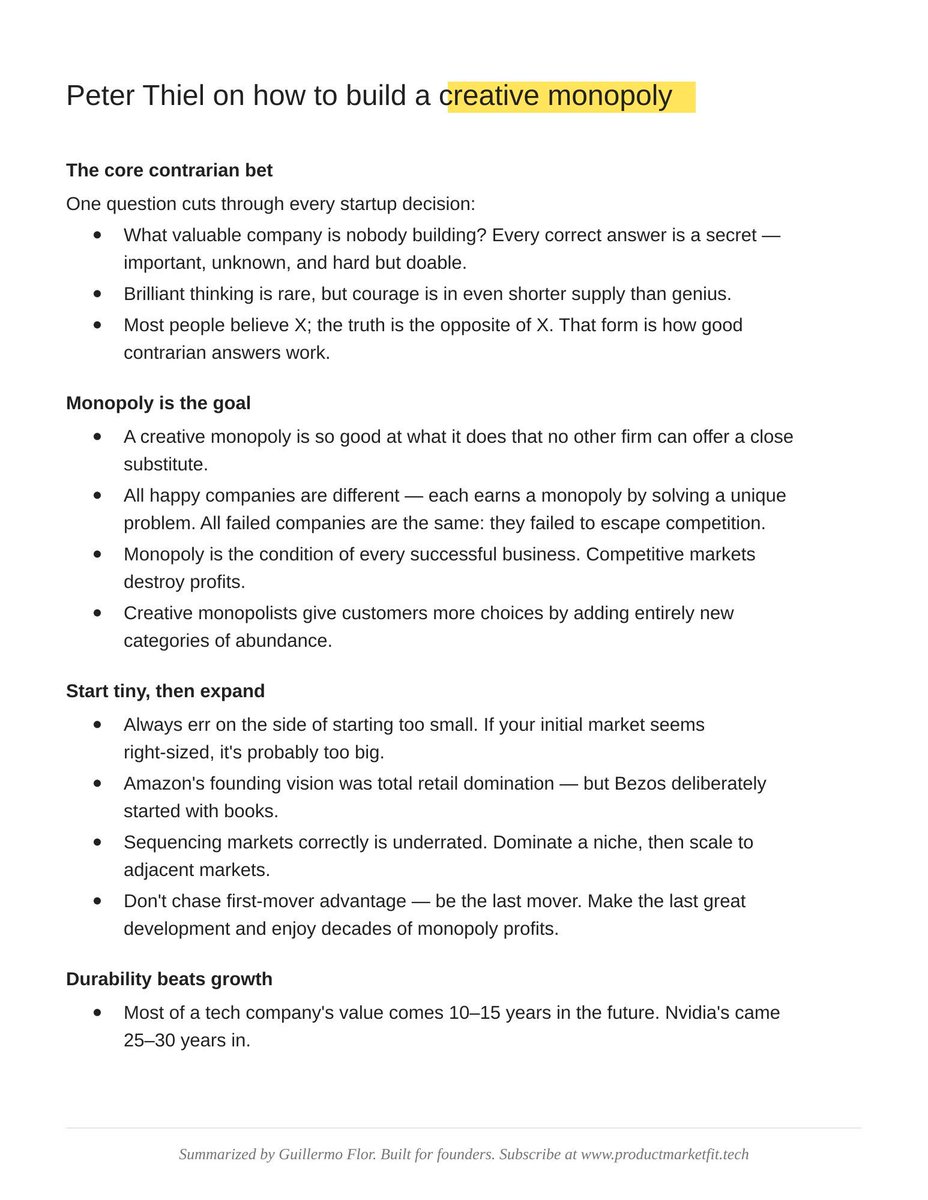
Peter Thiel's playbook for building a creative monopoly, saved in 2 pages.
Start tiny, own one niche, be the last mover, and treat distribution as part of the product design.
Which of these rules do you see founders break most often?
https://t.co/btA1FjCtMz
Peter Thiel's playbook for building a creative monopoly, saved in 2 pages.
Start tiny, own one niche, be the last mover, and treat distribution as part of the product design.
Which of these rules do you see founders break most often?
Every partner at Creandum, the fund behind Spotify and Lovable, is judged on 3 things.
Staffan Helgesson, its founder, told us:
1. Investments
2. Building the firm
3. Developing people
You can't be good at all three. You have to be pretty good at two.
His rules for adding a partner:
1. Pick someone you like
2. Pick someone who's good at what you're not
3. Accept that you're different
Like in football, the better team often beats the better roster.
Full breakdown here:
https://t.co/k87Td1vlcu
https://t.co/X8AHBdFtkb
Every partner at Creandum, the fund behind Spotify and Lovable, is judged on 3 things.
Staffan Helgesson, its founder, told us:
1. Investments
2. Building the firm
3. Developing people
You can't be good at all three. You have to be pretty good at two.
His rules for adding a partner:
1. Pick someone you like
2. Pick someone who's good at what you're not
3. Accept that you're different
Like in football, the better team often beats the better roster.
Full breakdown here:
https://t.co/GAy7Fs2cL1
Proxima Fusion won't hire lone wolves, however brilliant.
Francesco Sciortino, its CEO, told us why:
1. Engineering is all about communication
2. Keeping people aligned on one mission is how you go faster
3. Lone wolves are fascinating in academia
4. They don't do as well in a company building a power plant
So Proxima screens strictly for people who work in teams.
A €2.4B bet on fusion runs on 200 people pulling the same way.
Full breakdown here:
https://t.co/03qBeHUI5U
https://t.co/jZw1Sdv5mD
Proxima Fusion won't hire lone wolves, however brilliant.
Francesco Sciortino, its CEO, told us why:
1. Engineering is all about communication
2. Keeping people aligned on one mission is how you go faster
3. Lone wolves are fascinating in academia
4. They don't do as well in a company building a power plant
So Proxima screens strictly for people who work in teams.
A €2.4B bet on fusion runs on 200 people pulling the same way.
Full breakdown here:
https://t.co/C3eZSGtVdl
Chamath Palihapitiya's AI moat thesis has nothing to do with models, data or talent. It's electrons.
"I think power will be the moat. You're going to see people on the dry docks basically trying to hitchhike to get power."
Every SaaS and AI business plan assumes cloud capacity is effectively unlimited. If the hyperscalers can't secure enough power to grow, that assumption stops being true.
Owning land, power and the physical shell becomes the advantage. The companies that control the electrons control who gets to build.
Full breakdown: Compute Is the New Oil
https://t.co/lTZGEV1TEw
Is power the real AI moat, or will it get solved?
Sierra raised $1.75B at a $30B valuation, led by Greenoaks and Lightspeed. The valuation doubled in six months and ARR passed $400M.
We broke down how Bret Taylor and Clay Bavor built it:
https://t.co/ZREpU8NDlb
From Guillermo:
https://t.co/mJRbkoSO1V
Sierra just raised $1.75B at a $30B valuation, led by Greenoaks and Lightspeed.
Its CEO Bret Taylor is also the chairman of OpenAI. When Sam Altman was fired, the board and Sam agreed on one person to fix it: him.
What he found:
1. The board was down to three people, him included, so they rebuilt it almost from scratch
2. It was his first nonprofit board, with a duty to a mission: making AGI benefit humanity
3. He says you can't walk out of those board meetings uninspired
Sierra passed $400M ARR in under three years.
Full breakdown here:
https://t.co/7VZ2M3TQYq
Proxima Fusion is worth €2.4B three and a half years after spinning out of the Max Planck Institute, backed by Google and RWE.
We interviewed CEO Francesco Sciortino at Slush. No utility will build the first plant, so Proxima will build it itself.
https://t.co/03qBeHUI5U
From Guillermo:
https://t.co/5gQ8NpckzC
Proxima Fusion has raised about €650M in three and a half years.
It has no revenue yet, and its founder says a deep tech company can't have any, almost by definition.
What's behind it:
€411M raised in July at a €2.4B valuation, with Google and RWE joining as strategic investors
€400M more committed by Bavaria for the machine it's building
About 200 people in Munich, Zurich and Oxford
The first spin-out of the Max Planck Institute for Plasma Physics, founded in 2023
Proxima designs stellarators: machines that hold a gas hotter than the center of the sun inside a twisted cage of magnets, so fusion can run on Earth around the clock. The plan is Alpha, a demonstrator in the early 2030s, then Stellaris, a power plant on the grid in the 2030s.
Product Market Fit sat down with Francesco Sciortino, co-founder and CEO of Proxima Fusion, at Slush in Helsinki and asked how you raise hundreds of millions for a machine that doesn't exist yet:
1. Why fusion could be the last energy source humanity needs
2. Why a fusion plant can't run away
3. Why the fusion leader could be the largest company ever built
4. Why Proxima has to build its own power plant first
5. How to raise hundreds of millions with zero revenue
6. Why fusion will scale like SpaceX
7. Why Europe can beat the US at building fusion
8. How AI fixes what made stellarators too expensive to build
9. Why he spends 30% of his time on hiring
Full breakdown here:
https://t.co/21ABbemEo5
Would you invest in a company with zero revenue and a machine that doesn't exist yet?
Creandum backed Spotify, Lovable and Black Forest Labs early. It started in 2003 with €40M and just closed $750M.
We interviewed founder Staffan Helgesson at Slush: $750M today equals his $80M fund of 2006, and before every deal the partners ask if they would want to work for the founder.
https://t.co/k87Td1vlcu
From Guillermo:
https://t.co/kAvjFZGGnT
Creandum started in 2003 with a €40M fund. This month it closed its eighth, at $750M.
Its founder thinks that number is smaller than it looks.
What's behind it:
Early backer of Spotify, Klarna, Lovable (now valued at $13.3B), Black Forest Labs and Modal
One in six of its early-stage investments is now worth $1B or more
Same strategy for 23 years: pre-seed, seed and Series A
Its San Francisco team tripled in the last year, and its founder now spends more than half his time there
Staffan Helgesson founded Creandum in Stockholm after starting in European venture in 1999.
AI Market Fit sat down with him at Slush in Helsinki, for the second year in a row, and asked how a $750M fund still gets to the best founders before everyone else:
1. Why a $750M fund is smaller than it looks
2. Why Creandum went back to San Francisco
3. Why the best startups cost the same in Europe and the US
4. Why founders spot the next market before investors
5. The question Creandum asks before every investment
6. Why the best founders are a bit crazy
7. What Spotify, Modal and Rillet's founders had in common
8. How Creandum got into Modal and Black Forest Labs
9. Why last year's playbook won't win this year's deals
10. The three things every Creandum partner is judged on
11. How Creandum defines success for the next 20 years
12. Why Europe should skip the notary
Full breakdown here:
https://t.co/ZHLMpqawy4
What's the one question you'd want an investor to ask before backing you?
Anthropic's 58-company study found the biggest AI gains came from redesigning jobs, not adding AI to old workflows.
Layoffs were rare, but two-thirds of firms hired less because of AI. If AI lifts your output, do you hire less or redesign the work?
From Guillermo:
https://t.co/XfucE2g27d
BIG MOVE: Anthropic just published what 58 of its enterprise customers learned putting AI to work.
66 interviews and nearly 300 AI use cases, from AI-native startups to 100-year-old businesses.
The finding: the companies getting the most value from AI didn't just roll out a tool. They reorganized around it.
What that looks like inside those companies:
Most of the value comes from producing more, not from cutting costs
Coding agents are bringing software skills to nontechnical teams
People own whole workflows instead of one narrow task
Employees move to the bottleneck work AI still can't do
One COO now spends 90% of his operations budget on AI tokens and 10% on headcount
A marketing startup flipped from humans doing 80% of the work to AI doing 80%
The tool is the easy part. The value shows up when the way the company works changes.
Has your company changed how it's organized because of AI?
PS: The companies winning with AI are rebuilding how they work. Everything we've broken down on it 👇
1. The enterprise AI playbook, what the successful 5% do differently: https://t.co/p6sf3UFSZi
2. How Revolut cut its AI coding bill by 90%: https://t.co/L9s1LRwv1k
3. How Claude Code's creator runs 1,000+ agents: https://t.co/WkrnPHZsJA
4. Gamma's playbook, $100M ARR with 50 people: https://t.co/J0EA41GBcs
5. BCG x ElevenLabs, the enterprise AI playbook everyone will copy: https://t.co/CFfaMdOO1K
6. Forward deployed engineers, the Palantir playbook for AI startups: https://t.co/3833H6dlTt
7. The one-person billion-dollar company with Claude: https://t.co/O9WF6nrvae
Which am I missing?