Build your trading terminal with AI.
AInvest terminal is now on Windows.
Tell Aime what you want. Aime builds your workspace, runs technical analysis, draws on charts, and breaks down earnings in real time.
Try it with $MSFT, $META, or $NVDA 👇
This was not a companywide demand surge. More Personal Computing revenue fell 4%, including declines in Windows, devices and Xbox. Azure, business software and contracted cloud demand carried the quarter.
The next test is whether Azure growth, RPO conversion and Copilot adoption can outpace depreciation and repeated GPU and CPU replacement.
Thursday’s rally priced in a better answer to the AI spending question, not a finished return calculation.
The market rewarded proof, not lower spending.
$MSFT
Not investment advice. Do your own research.
$MSFT jumped 15.5% for its best day in nearly 18 years after reporting $90B in quarterly revenue, up 18%, and $40.6B in operating income.
The rally challenged the AI CapEx bear case. Microsoft did not spend less. It showed stronger evidence that its infrastructure spending is translating into cloud revenue and customer demand.🧵
The cash-flow picture remains less settled.
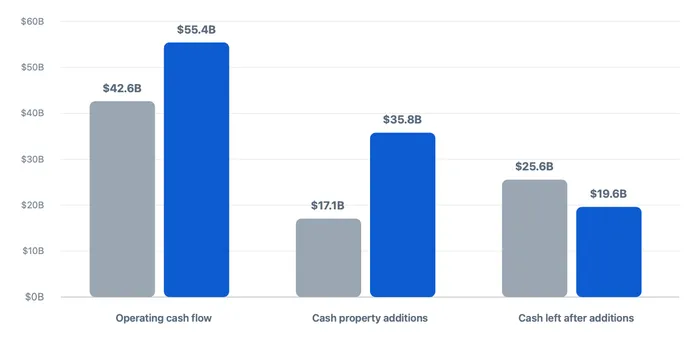
Microsoft generated $55.44B in operating cash and spent $35.80B in cash on property and equipment, leaving $19.64B. That was down from $25.57B a year earlier, meaning cash left after property spending fell by roughly $5.9B.
The reported $41B CapEx figure includes finance leases. The cash-flow calculation only includes cash property additions. Microsoft can still fund much of the build internally, but less cash is being left for other uses.
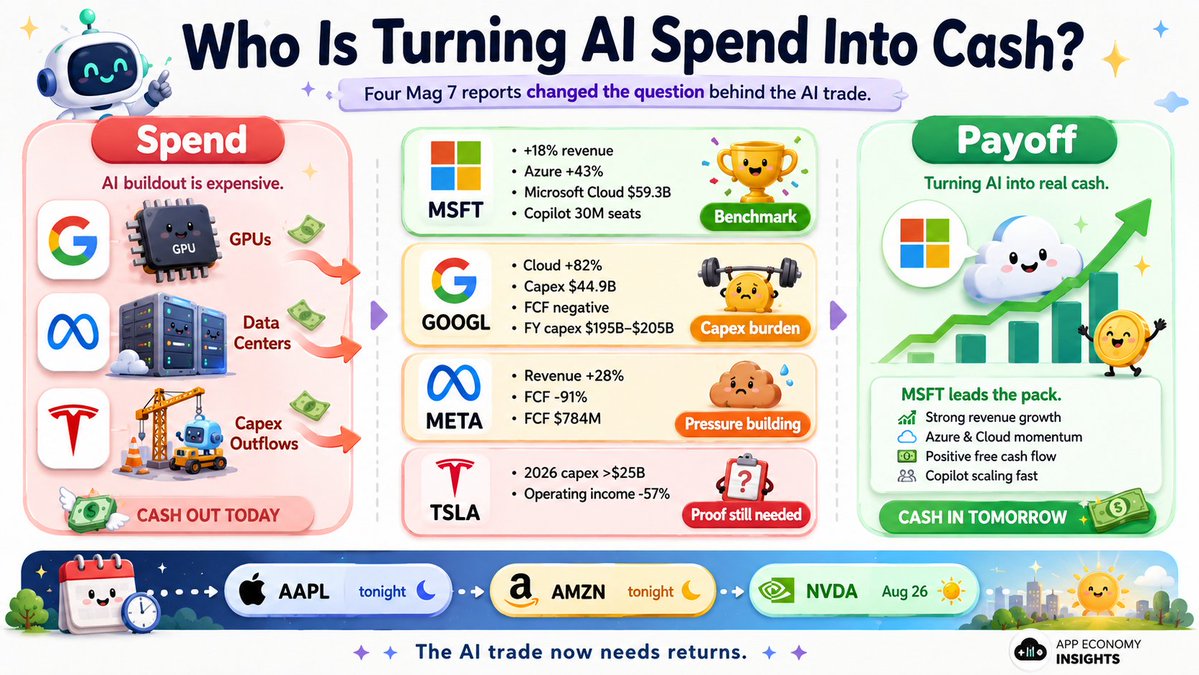
$TSLA faces the same test in a different form: more than $25B of planned 2026 capex for Robotaxi, Optimus and AI infrastructure, while operating income fell 57%.
Tonight, $AAPL and $AMZN are next. $NVDA reports Aug. 26.
The AI trade now needs returns, not another spending promise.
Not investment advice. Do your own research.
Wall Street has stopped counting GPUs.
It is counting the cash left after buying them.
Four Mag 7 reports are in, and the question behind every reaction is now the same: how much revenue and free cash flow does each new dollar of AI capex actually produce?
$GOOGL and $META show where patience starts to thin.
Google Cloud grew 82%, but quarterly capex hit $44.9B, free cash flow turned negative, and the annual capex outlook rose to $195B-$205B.
Meta grew revenue 28%, while free cash flow fell 91% to just $784M.
Strong businesses. Much higher burden of proof.
Build your trading terminal with AI.
AInvest terminal is now on Windows.
Tell Aime what you want. Aime builds your workspace, runs technical analysis, draws on charts, and breaks down earnings in real time.
Try it with $MSFT, $META, or $NVDA 👇
Wall Street has three clocks running today.
2:00 pm ET: Fed decision
2:30 pm ET: Warsh press conference
After the close: $MSFT and $META earnings
1/ Reported $MSFT short positioning is now at its highest in nearly a decade. The market wants proof that AI capex is turning into Azure and Copilot revenue, not another quarter of larger infrastructure bills.
2/ Trump added another risk before the open, warning that the U.S. would “hit Iran very hard.” South Korea, meanwhile, promised additional market-stabilization measures after an emergency meeting, including tighter limits on retail exposure to leveraged single-stock ETFs.
3/ Rates, AI returns, oil risk and leverage are all being tested in one session. The Fed may set the direction. Microsoft and Meta will tell us whether it holds.
Not investment advice. Do your own research.
July was a rotation check.
First-half AI winners gave back sharply:
$SNDK -51.79%
$GLW -50.67%
$BE -44.88%
$MRVL -41.42%
$AAOI -40.51%
Meanwhile, July leadership came from old-economy cash-flow:
$RTX +15.2%
$LMT +14.1%
$CVX +13.2%
$XOM +11.9%
$JPM +9.2%
The market did not stop taking risk. It changed the factor it wanted to own.
Watch whether this is a one-month reset, or the start of a broader move from AI beta into defense, energy, and financials.
That is why $ASML, memory, Korea, Japan, and $NVDA are moving as one trade.
Different businesses. Same factor.
For months, the market asked one question: who sells into AI capex? Now it is asking three harder ones: who still has real bottleneck power, who funds the demand, and who carries the guarantees if the buildout needs investment-grade wrappers.
The first question is about margins. The second is about credit. The third is about how much circular financing the AI trade can absorb before investors stop treating every dollar of capex as clean demand.
Aime Scan: watch CDS spreads, guarantee language, memory pricing, and China toolchain headlines next.
Not investment advice. Do your own research.
Japan and Korea just cracked. That is the warning shot for the AI trade.
Kospi fell as much as 8% on Tuesday, with a temporary trading halt triggered. Nikkei dropped more than 4%.
SK Hynix and Samsung were hit hard, and the same pressure is showing up across $NVDA, $ASML, $MU, Sandisk, and the broader memory chain.
This is not one bad ticker.
It is the AI infrastructure stack getting repriced at once: GPUs, HBM, DRAM, lithography, equipment, packaging, and the balance sheets sitting behind the buildout.
Third, $NVDA is now a credit story too.
The concern is not GPU demand. The concern is whether more of that demand needs Nvidia's balance sheet behind it.
Nvidia's 5Y CDS reportedly jumped as much as 14 bps Monday to 82 bps, per ICE Data Services, after reports of massive AI infrastructure financing discussions tied to OpenAI.
WSJ reported Nvidia is in talks to backstop roughly $250,000,000,000 of OpenAI data-center financing, and may also help finance up to $350,000,000,000 of OpenAI chip purchases.
That starts to look less like pure supplier revenue and more like ecosystem credit support.
Earnings week ahead.
MSFT, META, AAPL, AMZN, COIN, and MSTR all report this week.
Wednesday and Thursday are the crowded windows.
Source: AInvest calendar screenshot. Informational only. Not investment advice.