Should Jawaharlal Nehru be credited
with setting up India’s first IIT as is
claimed by Nehruvian fantasists?
NO.
Should PM Modi be credited with setting up seven new IITs, taking the total to 23?
YES.
Nehru did not ‘create’ IITs. Nor did he set up India’s first IIT.
Dr BC Roy, CM of West Bengal, set up India’s first IIT in Calcutta in 1950; it later moved to Kharagpur on land owned by West Bengal Government.
IIT Kharagpur Act came six years later in 1956.
Soviet Union set up IIT Powai; US set up IIT Kanpur; West Germany set up IIT Madras (all of them with trade surplus and aid).
The idea of setting up Indian institutes of technology took shape in 1946 with Humayun Kabir leading the way and Nalini Ranjan Sarkar Committee preparing a report. Extant records do not mention any role played by Nehru.
So,
Why was the first IIT set up in #WestBengal ?
Because in 1950s West Bengal had the highest concentration of industry in #India.
What went wrong?
Nehru's Freight Equalisation Policy killed industry in West Bengal and all of east India. West Bengal became the 'Disinherited State'.
Rest is history.
■ Unlike the popular belief that the IITs were solely the brainchild of Jawaharlal Nehru, the visionary idea and foundational blueprint actually came from lesser known but remarkable men in the final years of British rule. It was a story of foresight, persistence, and quiet determination that transcended the immediate politics of independence.
■ Imagine this: It’s the closing days of World War II. India is still under British rule, but the winds of change are strong. Factories are awakening, and a handful of far sighted leaders realize that India’s future won’t be built merely on capital or politics, it will be built on technology and homegrown talent.
■ Enter Ardeshir Dalal (1884–1949), a Parsi industrialist and member of the Viceroy’s Executive Council. Having witnessed the transformative power of institutions like MIT in America, Dalal had a bold dream. He believed India needed its own world-class technical institutes to train engineers, scientists, and innovators on Indian soil. This was the true spark and first conceptualization of what became the Indian Institutes of Technology.
■ A vision needed structure. In 1945, Dr. Humayun Kabir and Sir Jogendra Singh helped form a 22-member committee under the Viceroy’s Executive Council. They appointed as chairman Nalini Ranjan Sarkar (also known as N.R. Sarkar or N.M. Sircar)- a prominent industrialist, economist, statesman, and educationist who had served as Finance Minister of West Bengal. The Sarkar Committee worked diligently. In its interim report, they recommended something historic:
□ "Establish at least four Higher Technical Institutes — one each in the Eastern, Western, Northern, and Southern regions of India. Model them after the legendary Massachusetts Institute of Technology (MIT). Focus on quality education, research, autonomy, and producing innovators of international standards."
■ Independence arrived in 1947. The dream didn’t stall. Dr. B.C. Roy, the Chief Minister of West Bengal, seized the Sarkar Committee’s recommendations. He approached PM Nehru and persuaded him to back the establishment of the first institute in Bengal. Nehru, once aligned with the vision, championed it enthusiastically as part of nation building through science and technology.
■ In 1950, the first IIT emerged from the historic grounds of the old Hijli Detention Camp in Kharagpur, a site once used to imprison freedom fighters. It was formally inaugurated in 1951 by Maulana Abul Kalam Azad, with Nehru later laying the foundation stone and describing it as a symbol of India’s urges, India’s future in the making.
■ What followed was:
□ IIT Bombay (1958) — with USSR & UNESCO support
□ IIT Madras (1959) — partnership with West Germany
□ IIT Kanpur (1959) — collaboration with the USA
□ IIT Delhi (1961) — supported by the UK
■ Ultimately, the IIT system stands as a shining example of the contribution of visionary men like Sir Ardeshir Dalal and Nalini Ranjan Sarkar, whose pre-independence ideas and detailed roadmap provided the foundation, with the support of leaders like Dr. B.C. Roy and Jawaharlal Nehru turning that blueprint into a powerful reality for the nation.
Let’s unearth the true depth of our history, one incredible revelation at a time. Join the journey to #KnowTheRealBharat
@atsshow7 RW vale jab netikta ki baat karke gala faad faad ke ugc ke liye modi ko gaali de rhe the tab bada maza aa raha tha bhau ne bola tha ki bharosa rakho modi pe tab tm log mahan baane ke chakkar me sab gud gobar kar diya hai jaipur dialogue k sath milke kuch seekh lo LW valo se
First 500 people who take action can get totally free
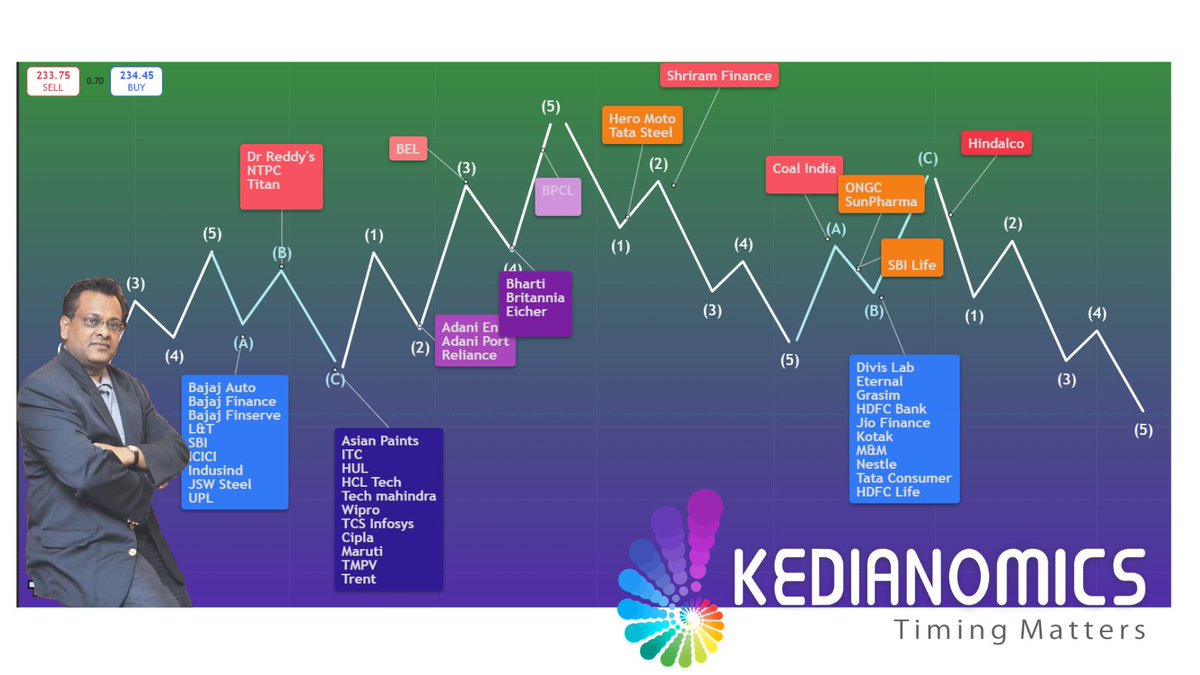
2.30 hr webinar costing 2500 with @sushilkedia where is explains every of 50 stocks of #Nifty going to 27000, where each stock is on the cycle. To get this:
-Follow us [So we can DM regn link]
-Retweet
-Nice Replies help
In 2:30 hr webinar @sushilkedia analysed #Nifty going to 27000+ & exactly which of its 50 stocks are where on the cycle.
As #CSR effort, what is priced INR 2500, can be availed free:
To get registration link:
-Follow us [So we can DM]
- Retweet
-Nice Replies Help
#DontPanic wrote @sushilkedia to our subscribers :
Get ready for next slide in #Crude to 52. Be ready to grab #stockstobuy beyond #Nifty#BankNifty.
To get this analysis on Video for educating yourself, totally free:
- Follow us [So we can DM]
-Retweet
-Nice Replies help
Big statement in this clip : In the last 10 years our oil dependency has gone down by almost 60%. Oil is no longer consequential to our current account 👏👏👏
It is a shame GoI doesn’t talk about this & let people know
BJP is a disaster at perception
अडानी को एक रुपए में ज़मीन देने का मुद्दा वो उठा रहे हैं जिन्होंने ख़ुद अडानी को 10 पैसे में ज़मीन दी थी 😂😂
खैर, आप फैक्ट्स के साथ 1 रुपए में ज़मीन दिए जाने का सच सुनिए।