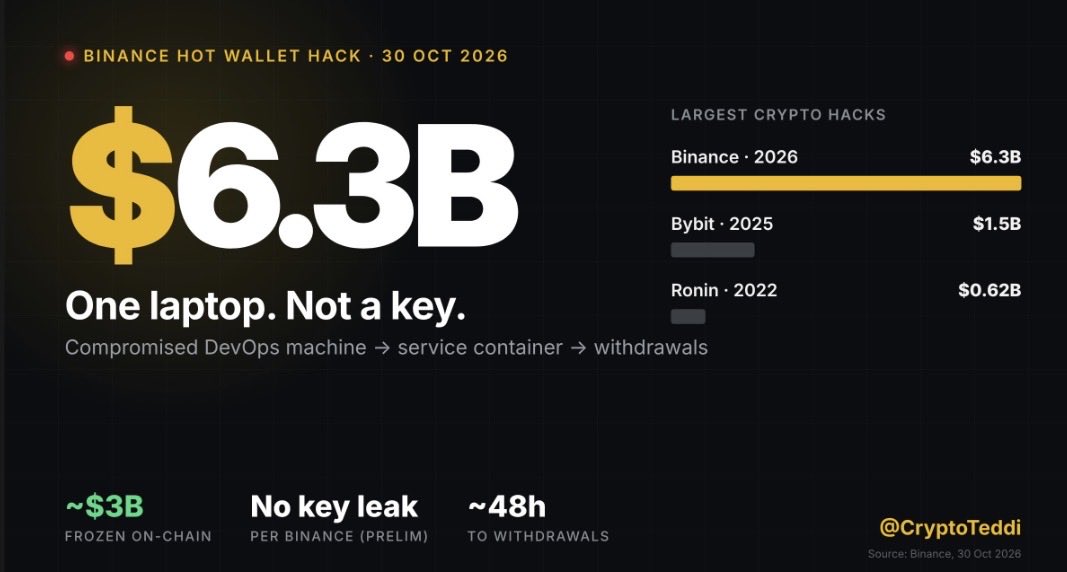
the biggest crypto hack in history didn't need to break any crypto
$6.3B out of binance in ~20 minutes
started with one engineer's laptop
50 signed guesses, 1 worked
analysts point to north korea's lazarus
75 sec breakdown 👇
binance just had the wildest night in crypto
$3.3B out of hot wallets in 40 min
$1.8B frozen by tether + circle
$629M liquidated in 1 hour
and binance still hasn't confirmed what happened
60 sec breakdown 👇
holy f*cking sh*t Karpathy put an entire AI degree on github for free while you are still paying $200/month to watch youtube tutorials from a guy with 3000 followers
7 repos. 306,741 stars combined. in the right order they take you from "how a neuron learns" to "agents that run research overnight while you sleep"
every repo you skip is a layer of understanding your competition at work already has and you do not. and every month you keep "planning to start" is another month someone on your team gets handed the AI project you should have been running
here is the exact order. do not reshuffle it
1. micrograd → https://t.co/hJiSPSIj6a
how a neural net actually learns. backpropagation in about 100 lines of python. this is where every AI engineer on earth started. if you cannot read this file, every other repo on the list is going to feel like black magic to you
2. nn-zero-to-hero → https://t.co/SP4xPWROBQ
his full video course. lecture notebooks that walk you from a single neuron to GPT. the thing people pay $2000 for from AI "bootcamps" that teach a fraction of what is in this one free repo
3. minbpe → https://t.co/C26umjtNQF
how text actually turns into tokens. the tokenizer that sits inside every LLM, in clean minimal code. this is the part 95% of self-taught people skip, and it is why their models never work right
4. nanoGPT → https://t.co/L9KRD3TeSR
your own GPT. the simplest repo in existence to train and fine-tune one. after this file you stop asking "how does ChatGPT work" because you have literally built the smaller version with your own hands
5. llm.c → https://t.co/gvBIEZmQga
the same training with nothing hidden. raw C and CUDA, no PyTorch wrapper doing the hard parts for you. this is where you stop being a prompt engineer and start being an actual engineer
6. nanochat → https://t.co/DCgXmWJXvG
a full chat model end to end. GPT-2 level training that cost ~$43,000 in 2019. in this repo it costs about $48. let that sit for a second. the thing people called a breakthrough is now a weekend project
7. autoresearch → https://t.co/PwBeSJucRR
agents that do the research for you. the agent edits your training code, trains for 5 minutes, keeps whatever improved, discards whatever did not, and repeats all night while you sleep. this is where the people reading this list stop being students and start being whatever comes after that
the brutal truth most people avoid: train one GPT from scratch and you become the person who gets handed the AI project at work, along with the raise that comes with it. keep "planning to start" and you become the person watching that happen to someone else
the classroom half of the same degree, what Stanford actually teaches about AI for real, is below
I PASTED ONE PROMPT INTO GROK BOT AND WENT TO SLEEP
10:58pm, notification: "your desk is ready, paste one prompt and go to sleep"
so I did
it built the whole thing in the chat in 10 seconds
6 agents trading https://t.co/PgQAJWr0b4 all night, hard rules, no code from me
Scout · watches every fresh launch the second it goes live
Filter · kills anything that fails a single check
Analyst · scores what survives, under 0.6 dies
Executor · never more than 10% of the stack per trade
Risk · −8% stop set before the entry, trails winners after +15%
Logger · writes the reason behind every move
for the first hours it said no to everything
11,400 pairs → 11,306 killed → 94 scored → 41 traded
what killed them
3,212 · mint not revoked
2,584 · LP not locked
2,147 · top 10 holders over 25%
1,738 · volume under $40k in the last hour
1,021 · dev wallet tied to past rugs
604 · bundled at launch
PUMPKIN looked perfect, killed for mint not revoked
ZAPPY hit the stop at −$2.09, set before entry
TUFFY caught early on the PumpFun curve, paid +$1,140, best trade of the night
41 trades · 29 green · 12 red · worst loss −$5.25
$300 → $1,065 → $2,056 → $3,313 → $4,217
the exact prompt is in the first reply ↓
this was just the simulated run, tonight it goes live
bookmark this before you copy another random wallet
~$3.3B just moved out of binance hot wallets to a brand new address 167K ETH + 1.6B USDT in one tx, then 780M USDC 17 min later some on-chain researchers say compromise, others say maintenance. binance hasn't said a word yet $629M liquidated in an hour anyway. markets don't wait for confirmation
No private key was stolen. A laptop was.
Binance says a DevOps engineer's machine got compromised, the attacker got into a service container and just... submitted withdrawals. ~$6.3B total.
~$3B already frozen. Binance says SAFU + company funds cover the rest, withdrawals back in ~48h.
For scale, Bybit last year was ~$1.5B.
Meanwhile the exploiter is splitting funds across 20+ wallets and swapping UNI/LINK/AAVE into ETH. ETH is the part nobody can freeze.
Honest question: how does one laptop have withdrawal access to billions?
$BNB $ETH
this is f*cking insane, Claude Code agents turned a reading list into a lab you can run in your browser
Boris Cherny (creator of Claude Code) gave 12 agents 64 research papers and one assignment: build a browser lab where readers can rerun the experiments
pick a fluid simulation, change the conditions and watch how the result changes
switch methods while keeping the same scene. inspect the equations, code and measurements beside the animation
give each group a specific job:
→ readers extract equations, assumptions and experimental settings
→ builders turn the methods into runnable code
→ reviewers compare outputs against the papers
→ interface agents build the controls for exploring each experiment
a simulation can look convincing while producing the wrong answer
reviewers check whether it preserves mass, stays stable and matches the paper's measurements before accepting the implementation
every experiment has to show:
> the claim being tested
> the conditions used
> the difference from the reference result
> the details still needed to verify it
the lab covered 11 methods across 28 reference scenes. seven matched the selected reference results within the stated tolerances; four stayed marked for further review
give Claude Code your paper collection, then ask:
"Turn these papers into an interactive browser lab
1. Extract implementable methods, equations and experimental settings. Attach page references and flag missing details
2. Assign independent methods to separate agents. Use shared inputs and measurement tools so the results can be compared
3. Have reviewers check each implementation against the paper. Record discrepancies and keep unverified results clearly marked
4. Build controls for changing parameters, comparing methods and opening the code behind each result"
start with one paper and reproduce one reference experiment before adding more agents
include the inputs, dependencies and checks so the next reader can rerun it from a clean checkout
watch the agents at work below
@Dima34800318 update: binance confirmed it. estimated impact now ~$6.3B, not $3.3B. ~$3B frozen so far across tether, circle, ripple and others. cause looks like a compromised devops engineer's laptop. binance says it will cover all user losses. withdrawals + deposits paused for now
Opus 5.5 went back to the raw cryo-EM density of the ribosome and found the places where the published model was a choice
Most structures are shared as a finished atomic model, so the blurry regions of the original map arrive looking exactly as solid as the sharp ones.
The method skips the deposited model and reads the density itself, asking at every residue how many fits that blob could honestly support:
> Read: the raw map goes in, not the structure someone already fitted to it
> Fit: every region gets all atomic arrangements the density allows
> Rank: where only one fits, it's settled, where several fit, all are kept
• What re-reading the density exposed
> Two flexible loops that had been modelled in a single confident pose
> A residue placement that changes the mechanism and the map can't decide
> Regions where the published model is clearly right, far more than expected
• Why this matters more for the ribosome than anywhere else
> Its moving parts are exactly the parts that blur in the map
> Every textbook mechanism rests on how those parts were fitted
> A fitting choice made in 2011 is still being cited as a measurement
One full map re-interpretation runs in about 25 minutes.
And the part that broke my brain:
A structure everyone treats as solved had four regions with multiple valid fits.
None of them are wrong, and only one of them is in the figure.
Same density. One version shows you what the data couldn't narrow down.
The hard part was never building the structure.
It was admitting where the map stopped telling you ↓
I generated $7625 overnight using an automated Claude setup.
I’ve documented the exact, step-by-step process behind this timezone arbitrage strategy.
What you need👇
• Claude
• A Mobile
• 24 hours to test it ( no cost )
How to access the guide👇
1. Comment “ SetUp ”
2. Like & RT
3. Follow @Tec_with_Luis (so I can send it via DM)
The system runs continuously, scanning global news across Japanese, European, Australian, and Middle Eastern markets.
It identifies pricing inefficiencies situations where outcomes are already reflected overseas, but U.S. markets have yet to adjust.
After 9 days of running this setup, the results have been consistent and eye opening.
Most traders focus on EST. Markets don’t.
While one region sleeps, another resolves events in real time.
That timing gap is the opportunity.
Follow @Tec_with_Luis to receive the full breakdown.
( First 1500 people will get it! Like, comment, and follow quickly )
holy f*ck, web designers have no idea what's coming
the ones who learn these tools now will be fine. the ones who don't will be searching job in 2027.
7 design repos you need to know to survive AI, try this asap:
1. UI UX Pro Max
gives Claude real design taste: 192 color palettes, 74 font pairings, rules for every industry. your fintech app stops looking like a crypto casino
https://t.co/2Xc39AfBXz
2. Impeccable
catches "AI slop" design the moment it's written. tell it to critique, polish or make it bolder, and it actually does
https://t.co/kWm0SYafPZ
3. Framelink Figma MCP
paste a Figma link into Claude Code and get that exact layout in code. no more eyeballing screenshots
https://t.co/26T5Z2cUMH
4. React Bits
215+ free animated components and backgrounds. the difference between "nice site" and "wait, how did they do that"
https://t.co/wbFbtbGSg0
5. GSAP Skills
the official skills that teach your AI proper GSAP: timelines, scroll animations, text effects. and GSAP is fully free now, every plugin included
https://t.co/SzFTq7Qda3
6. HyperFrames
write HTML, get a finished video. your AI can make product promos and motion graphics without After Effects
https://t.co/Hlp0yKfjBB
7. MCP for Blender
this one's wild. Claude gets hands inside Blender and builds real 3D scenes, models and materials from a text prompt
https://t.co/RGXkoZ3lEr
the cell in this video?
I built it myself with Claude Code and a few of these 3D and motion tools. no studio, no team.
want to make something like this?
like + save this post, comment "CELL" or DM me and I'll send you the exact prompt.
honestly this should be f*cking illegal
your LLM takes 30 seconds to think about a trade, but candle closed 29 seconds ago.
Jev answers in 70 to 500 milliseconds. it can't write a word. it returns BUY / SELL / HOLD and a probability, and that's all a scalp needs.
3 repos already built on it:
-> jev-trader: one AI trade decision every single block, on a live MON-USDC market
https://t.co/PNJ2g1Ry4L…
-> QuantDinger: a full open-source AI trading OS with Jev built in. research, strategy, agent trading
https://t.co/XS7cOToLe3…
-> AIStock: "one person can become their own super-analyst"
https://t.co/9Bb66iaEgC…
$0.042 per million input tokens. output is free.
that's thousands of decisions for the price of one LLM call.
the catch: fast is not the same as right. a wrong call in 200 milliseconds is still a wrong call. paper trade it first.
> let the big model do the research.
> let Jev pull the trigger.
> let code set the stop.
bookmark this before your bot is the slow one in the room.
This is one of the most insane and stunning use cases I've ever seen someone built with Opus 5.5.
Seriously, AI enables so much creativity, it opens worlds. I love it!