A Father raised three sons.
All three became millionaires before the age of 35.
When he was asked how he did it,
He said:"I forbade them from one habit while they were growing up. "
Elon Musk hasn't sold a Tesla share in years and lives off $1 billion in personal loans
His Tesla stock keeps appreciating
The loans charge him 2-3% interest
The IRS never sees a single dollar of capital gains tax
This is exactly how the wealthiest people in America accumulate wealth without paying taxes and it's available to anyone with $100K+ in assets
The strategy is called "borrow against appreciated assets" or sometimes "buy borrow die." It's the single most powerful tax-minimization strategy used by ultra-wealthy individuals in America
Mechanics:
When you SELL an asset that has appreciated, you owe capital gains tax. Federal long-term capital gains rates: 0%, 15%, or 20% depending on income. Plus state capital gains in most states (CA: 13.3%; NY: 8.82%). Plus net investment income tax of 3.8% for higher earners (IRC Section 1411)
For someone like Elon Musk selling $1B in Tesla stock, the total tax bill would be approximately:
Federal capital gains at 20%: $200M
Net investment income tax at 3.8%: $38M
Texas state tax: $0 (Texas has no state income tax, this is why Elon moved there)
Total tax bill on selling $1B: $238M
When you BORROW against appreciated assets, you owe ZERO tax. Loan proceeds are not income under IRC Section 61. They never appear on your tax return. They never trigger a tax event
For Elon to access $1B in cash for spending purposes, the math is:
Sell $1B in Tesla stock: $762M in net proceeds after tax
OR
Borrow $1B against $1B in Tesla collateral at 2-3% interest: $1B in net proceeds tax-free
Selling costs him $238M in taxes
Borrowing costs him $20-30M/year in interest (or roughly $200-300M over a decade if held that long)
But the borrowing strategy has additional benefits:
Tesla stock continues to appreciate. Over 10 years, $1B in Tesla stock has historically appreciated to multiples of that. Selling locks in the gain at today's value. Borrowing keeps the upside
The interest paid on the loan is potentially tax-deductible if structured as an investment loan (IRC Section 163(d)). Effective after-tax cost can be reduced to 1-2%
The loan never has to be repaid during his lifetime. He can refinance it indefinitely. When he dies, his heirs inherit the stock at a "stepped-up basis" (IRC Section 1014). The accumulated capital gains die with him. The heirs sell the stock at the stepped-up basis, pay off the loan, and keep the entire upside tax-free
The wealth transfers from Elon to his heirs entirely tax-free if structured correctly. Estate tax is a separate question but is largely avoidable through proper trust structures
The ultra-wealthy version of this strategy:
Borrow against appreciated stock
Use the loan proceeds for consumption (homes, cars, art, business operations)
Never sell the underlying stock
Refinance the loan at maturity to extract more cash if the underlying has appreciated
Pass everything to heirs at death with stepped-up basis
Heirs sell with $0 in accumulated capital gains tax owed
This strategy is sometimes called "buy, borrow, die" by tax planners. It's the foundation of how billionaire wealth perpetuates across generations without significant taxation
Available products for this strategy:
Pledged Asset Line (Schwab): borrow up to 50-70% of portfolio value at SOFR + 1-2%
Securities Backed Line of Credit (Morgan Stanley, Goldman): similar terms, $1M+ minimum
Custom Lending Solutions (private banking): for $10M+ portfolios, rates can drop to 1-2%
The accessibility tier:
If you have $100K+ in investment assets at Schwab/Fidelity/Vanguard, you can open a Pledged Asset Line. Typical terms: borrow up to 50% of your portfolio value at SOFR + 1.5-3% (current rates roughly 6-8% all-in). No fixed monthly principal payments. Interest only or pay nothing as long as the loan stays below the maintenance threshold
For someone with $200K in stocks/ETFs:
Borrow $100K at 6.5%
Use the $100K for any purpose (real estate down payment, business operations, etc.)
Annual interest cost: $6,500
Tax savings vs selling stocks: roughly $20,000-$30,000 in deferred capital gains
Net benefit: $13,500-$23,500/year in tax savings during the borrowing period
For someone with $1M in stocks/ETFs:
Borrow $500K at 6.5%
Use the $500K for real estate purchases, business equity, etc
Annual interest cost: $32,500
Tax savings vs selling stocks: roughly $100,000-$150,000 in deferred capital gains
Net benefit: $67,500-$117,500/year
Comparison to the alternative:
If you sell $500K in long-term appreciated stock to access cash:
Federal capital gains at 15%: $75,000 owed
State capital gains (varies): $20,000-$40,000 owed
Net cash to you: $385,000-$405,000
If you borrow $500K against the same stock:
Net cash to you: $500,000
Tax owed: $0
Annual interest cost: $32,500
Even paying $32,500/year in interest, you're $90K-$110K ahead in year 1 and the gap grows because your stock keeps appreciating while you hold it
The compounding effect over 20 years:
Person A sells $100K of Tesla stock at 15% capital gains, takes $85K. Spends it
Person B borrows $100K against $100K of Tesla stock, takes $100K, spends it. Stock keeps growing at historical rate (let's say 20%/yr conservatively)
20 years later:
Person A: stock is gone. Whatever they bought with $85K is whatever it is
Person B: still owns the original $100K in Tesla, now worth $3.8M. Refinanced the loan multiple times. Currently owes maybe $200K against $3.8M in collateral. Net wealth on this position: $3.6M
Same starting position. Different decision. $3.5M+ difference in 20 years
Important caveats:
The strategy works only when underlying asset is appreciating
Margin call risk if asset value drops below maintenance threshold
Interest costs accumulate over time and eventually reduce the net benefit if rates rise enough
Some borrowing limits apply (typically max 50-70% of portfolio value)
The strategy is most powerful for:
Concentrated stock holdings in publicly traded companies (especially employee stock from tech companies, founder stock, ESOP grants)
Large diversified portfolios held in taxable brokerage accounts
Real estate equity (similar strategy via cash-out refinances)
Business equity (some forms of borrowing available against ownership stakes)
The strategy is least useful for:
Small portfolios under $50K (interest costs eat any benefit)
Retirement accounts (can't borrow against IRAs/401(k)s; some 401(k)s allow loans but limited to $50K)
Assets without an established lending market (collectibles, private real estate that's hard to finance)
The reason this isn't standard financial advice:
Most financial advisors are compensated based on assets under management. They make more money when you keep assets invested. They don't necessarily make money when you optimize for cash extraction. The strategy is genuinely good for sophisticated clients but doesn't fit the standard advisor compensation model
Banks DO know about this strategy. They actively market it to wealthy clients. The Pledged Asset Line and securities-backed line of credit products are billion-dollar businesses at every major brokerage. They're just not marketed to ordinary retail clients because the minimums and complexity make them inappropriate for mass market
The threshold for accessing this strategy:
$100K+ in liquid investment assets = entry-level access via Schwab/Fidelity
$1M+ = full access to most products and competitive rates
$10M+ = access to private banking rates of 1-2%
$100M+ = Elon-level rates of essentially 0% real cost after tax deduction and stock appreciation
At each tier, the math becomes more favorable. The richest Americans access this strategy at rates that mean borrowing $1B is essentially free relative to their portfolio appreciation
Most middle-class Americans never use this strategy because:
They don't know it exists
They don't have $100K+ in taxable investment accounts
They follow standard advice that says "live within your means and don't borrow"
The wealthiest Americans use it constantly because:
They have the assets
They understand the math
They follow advice from advisors who are sophisticated about tax optimization
The gap between the two groups isn't talent. It's understanding that the tax code is written to reward holding assets indefinitely and penalize selling them. Selling = taxable event. Holding + borrowing = no taxable event. The system rewards never realizing gains
Elon never sells Tesla. He never pays capital gains tax. The IRS doesn't collect a dollar from his accumulated wealth. The strategy is legal. It's mathematically optimal. And it's been written into the tax code since before any of us were born
You don't need to be Elon to use this strategy. You need $100K and a Schwab account
(we get business owners up to 250k in 0% interest business funding, link in bio)
Eric Schmidt (ex-Google CEO): “if you really want to make money, it’s actually easy. found an agentic AI company.”
If I had only 30 days to do that , I'd begin here and save this:
Agent Architecture
https://t.co/Xyy3e9AjAQ
Claude Code 101:
https://t.co/tZbHeRDWkj
Claude Code in Action:
https://t.co/RDYEVbydhW
Prompt engineering (official):
https://t.co/aYQzAWmObh
Interactive prompt tutorial (hands-on):
https://t.co/5k9My0hYgY
CLAUDE.md & how to give Claude memory:
https://t.co/gtmOGKAvDe
Skills, teach Claude reusable workflows:
https://t.co/DJFqh3E6OB
MCP, time connect Claude to Slack, GitHub, Drive:
https://t.co/XbRdmmcYmP
Routines (automate tasks 24/7):
https://t.co/LGbhOeWWdJ
Claude Code Ultimate Guide (community):
https://t.co/56DAmEuqH8
Awesome Claude Code (skills, hooks, plugins):
https://t.co/jUIBuxvV5K
All 13 Anthropic Academy courses (free certs):
https://t.co/rHn0gDmtGH
Claude Code full docs:
https://t.co/KYHnapDdHG
All of this is for free at $0/month
Then read this guide by this builder
Everyone should publish a book on Amazon using AI and make $2,000/month from it.
Sadly, 99% of people have no idea how to do it.
Here's the full step-by-step system:
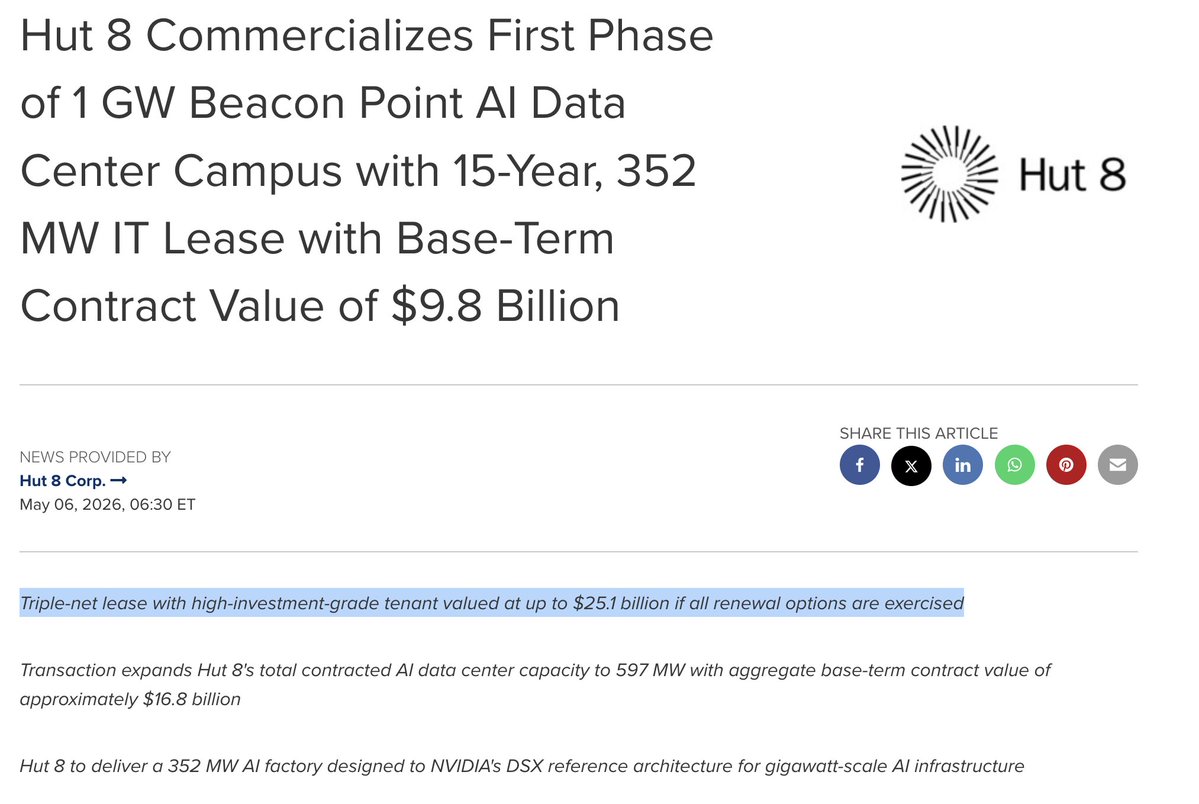
Bitcoin miner turned AI bubble co $HUT 8 just put out a press release claiming it signed a contract worth $9.8 billion, with options increasing the value up to $25.1 billion.
What's in the fine print?
- delivery of services will begin in Q3 2027, if the counterparty isn't bankrupt or doesn't cancel the lease by then
- the $9.8 billion is over 15 years, which annualizes to a mere $653 million
- the $25.1 billion is over 30 years, during which period the GPUs servicing the contract will need to be scrapped and replaced several times over
The stock is up 13% pre-market on the news. No one reads the fine print when there's an AI delusion promising daily gains.
If I sold my company tomorrow, I'd build my next multi-million dollar business in 90 days using Claude.
Here's the exact 5-person AI team I'd hire on day one. Steal every prompt.
Singapore's Foreign Minister published the architecture for his "second brain for a diplomat" yesterday. Architecture diagrams, design rationale, the works. A developer-style writeup of his own system.
It runs on a Raspberry Pi. It connects to his WhatsApp and Gmail, transcribes voice notes locally, ingests speeches and articles, and builds up a knowledge graph over time. It answers questions, drafts speeches, condenses information. He says he doesn't dare switch it off.
What @VivianBala built is one-of-one. There's no other setup like it. But what he built it from isn't.
He composed four open-source pieces:
- @NanoClaw_AI , the agent framework: https://t.co/JlIJqOVBFG
- Mnemon, the persistent memory layer: https://t.co/ugrB7uF6XL
- OneCLI, the credential proxy that keeps API keys out of the containers: https://t.co/sTGn59abpF
- The LLM Wiki pattern by Andrej Karpathy, the synthesis approach: https://t.co/wqvlVzcnyk
None of them are his. The composition is his. And then he published the composition: https://t.co/azzfijyzPs
He didn't keep it internal as Singapore's edge. He didn't spin it into a product. He didn't gatekeep. He wrote it up and put it on GitHub.
There are tens of thousands of doctors, lawyers, researchers, investors, and operators building one-of-one setups for themselves right now. Some simpler than Vivian's, some more elaborate. The impulse will be to sit on it. Treat it as your edge. Think about what product or company you could spin out of it. Resist that impulse.
Vivian put it directly: "The diplomat who learns to work with AI will have a meaningful edge. I think that edge is now."
The specific thing Vivian composed will be obsolete in months. His real edge isn't the system. It's his ability to build it. Being plugged in, up to speed, able to cut through the noise and connect the right pieces into something that brings real value.
Sharing the blueprint doesn't give that away. It amplifies it.
You become a beacon. Other people working on the same things find you. They share what they're building, suggest improvements, point at things you didn't know existed. You learn faster. You stay in the center of where things are happening. Publishing isn't giving away your edge. It's doubling down on it.
Lots of talks of AI improving workflow and efficiency, AI models and workflow do in fact accelerate efficiency of mundane task, yet to further enhance overall professional work efficiency, one has to forgo the privacy of personal data
#AIthreat#AImodel
Convenience, efficiency and speed at the expense of privacy. One has to think what is the priority. AI models are still in their infancy phase, I foresee they will be deeply entrenched in our daily lives, until a major disaster happens one day,
This 1 hour lecture from a Carnegie Mellon professor who had 3 months to live will teach you more about living than every self-help book you’ve ever read combined.
Bookmark this & give it 1 hour today. It’s the most productive start you can give your week.