found a remotely triggerable out-of-bounds read in the Linux kernel's H.323 connection tracking parser (CVE-2026-23455, CVSS 9.1 Critical). no authentication. no privileges. send a packet and the kernel reads memory until it hits an unmapped page. this code has been reachable from the network since 2007.
H.323 is a VoIP signaling protocol from the 1990s that refuses to die. it predates SIP. it's the protocol your office phone system was probably running before someone migrated to Teams, and in a lot of places nobody migrated. telecom carriers still use it for trunk signaling. hospitals run it for nurse call systems and overhead paging. hotels use it for room phones. building intercoms, elevator emergency phones, courtroom recording systems, prison phone networks, air traffic control voice switches. I keep finding it in places where I'm like, who is maintaining this, and the answer is always nobody, it just works. scariest sentence in infra.
every Linux firewall or NAT gateway that handles this traffic loads nf_conntrack_h323. full ASN.1 PER decoder. inline in the kernel. parsing untrusted packets from the network in kernel context. the module exists because H.323 uses dynamic port allocation for media streams so the firewall needs to understand the signaling to open the right ports. it auto-loads when H.323 traffic hits a conntrack rule. on many distributions it's loaded by default. you don't configure this or opt into this. someone behind your gateway plugs in a phone and now you have an ASN.1 parser in your kernel processing packets from the internet. the attack surface is a UDP packet to port 1719 or a TCP connection to port 1720 on any Linux machine doing NAT for a network that might have a phone on it somewhere. the parser runs before the packet reaches userspace, and there is no firewall rule that helps because the firewall itself is the thing running the vulnerable code.
DecodeQ931() processes Q.931 signaling messages. the UserUserIE code path reads a 16-bit length from the packet and decrements it by 1 to skip the protocol discriminator byte:
len = (buf[p] << 8) | buf[p+1] p++; len-- return DecodeH323_UserInformation(buf, p, len, ...)
if the encoded length is 0, len-- wraps to -1. len is a signed int. -1 gets passed to the decoder, which interprets it as a very large positive value and walks through memory far past the end of the packet buffer. the decoder iterates through ASN.1 fields, following structure, dereferencing pointers, until it hits an unmapped page or a parse error. one malformed packet, unbounded kernel memory disclosure. depending on slab layout the adjacent memory could contain kernel pointers that defeat KASLR, crypto keys, credentials from other processes, fragments of network packets belonging to other users.
so the programmer who wrote this in 2007 was implementing RFC 2225. the RFC says the UserUserIE field contains a protocol discriminator byte followed by a variable-length body. the discriminator is always present. so len-- is always safe because len is always at least 1. the RFC says so. the protocol guarantees it. the wire does not care about your protocol guarantees. the wire is untrusted input. but once you've internalized "there's always a discriminator byte" the decrement looks like bookkeeping, and every reviewer after you internalizes the same thing because the code reads naturally and the RFC agrees and nobody is going to stop and ask "but what if len is zero" because the protocol says it can't be.
the code is wrong because the programmer understood the protocol. someone who understood H.323 less might have added a defensive check, but someone who understood it perfectly trusted the wire to be well-formed. a reviewer who also understands the protocol reads len-- and sees bookkeeping. the bug is invisible to expertise. you can only see it by distrusting the wire unconditionally, which means ignoring what you know about the protocol. I don't have a clean answer for how you systematize that.
static analyzers can't flag it because every individual operation is valid. the length read is bounds-checked. the decrement is legal C. the function call is type-correct. fuzzers might hit it if they generate a zero-length UserUserIE but protocol-aware fuzzers tend to generate valid protocol structures, which means len >= 1, which means they systematically avoid the one input that triggers the bug. the tool that finds this is a human reading code and asking "what if this value is zero" at every arithmetic operation on untrusted input. boring question. answer is almost always nothing. the 1% where it isn't nothing is a 9.1 Critical and you have no way to know which 1% until you've asked everywhere.
protocol-specific conntrack helpers get written once for a deployment need. they work. they ship. then they sit in the kernel for two decades because the protocol still exists somewhere and removing the module would break someone's phone system in a hospital basement. nobody is reading the code for bugs. they're keeping it compiling. eighteen years. 9.1. if (len <= 0) break;.
originally reported by @VidocSecurity (Klaudia Kloc and Dawid Moczadło). I confirmed, reproduced, and patched it. patched in stable 5.10–6.19.
❗️ Over 30 official Red Hat npm packages were compromised. How they got in:
- A Red Hat employee's GitHub account was compromised.
- Attackers pushed "orphan commits" (detached from branch history) straight in, bypassing code review with no pull request.
- Payload "Miasma" (Mini Shai-Hulud variant) steals GitHub/cloud/Vault/SSH/npm secrets. Rotate everything since June 1.
- The commits added a workflow (ci.yaml) + script (_index.js) that abused npm trusted publishing, requesting a real OIDC token to publish backdoored versions.
I have been saying this for a while.
It was only a matter of time until someone started running the much cheaper Chinese models on US-based infrastructure.
Until now, you could still argue:
"Who wants to send sensitive data to a Chinese provider?"
Healthcare, defense, government, finance - for many of them this was basically a no-go.
But if the same model runs on US-hosted hardware, with a US-based inference provider, many of those objections get weaker.
And then it gets interesting.
What happens when investors realize that maybe 50-70% of enterprise AI use cases don't need OpenAI or Anthropic at all?
Maybe they run fine on:
- cheaper hosted models
- open-weight models
- local models
- or some future box of GPUs nobody had on their bingo card
The big frontier models may still be needed for the hard stuff.
But if only 10-20% of workloads really need them, the ROI story looks very different.
That is where the card house starts to shake a bit.
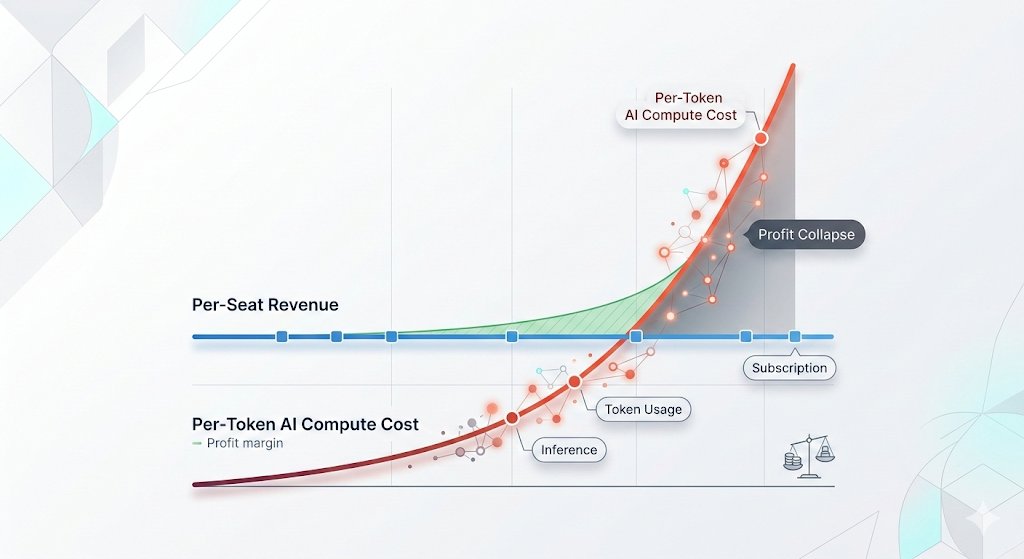
🦔Microsoft canceled its internal Claude Code licenses this week after token-based billing made the cost untenable, even for a company with effectively infinite cloud resources. Uber's CTO sent an internal memo warning the company burned through its entire 2026 AI budget in just four months. American AI software prices have jumped 20% to 37%, and GitHub (owned by Microsoft) is dropping flat-rate plans for usage-based billing across its products.
My Take
The AI subsidy era is ending in real time. The same company that put $13 billion into OpenAI and built the Azure infrastructure powering most of Anthropic's compute just looked at the bill from a competitor's coding tool and decided it was not worth paying. That is not a productivity failure on Anthropic's end. Token-based pricing is forcing every enterprise customer to confront the actual cost of running these models at scale, and the number turns out to be far higher than the flat-rate experiments suggested.
This ties directly to my Gemini Flash post yesterday. Anthropic, OpenAI, and Google all raised effective prices in the last six months. Enterprises that built workflows assuming AI costs would keep falling are now watching annual budgets evaporate in months. Two outcomes look likely from here. Either enterprises scale back AI usage to fit budgets, which slows the revenue ramp the labs need to justify their valuations ahead of IPOs, or the labs cut prices and absorb the losses, which makes the unit economics worse at exactly the wrong moment. Both paths land in the same place, the numbers stop working, and somebody has to take the writedown.
Hedgie🤗
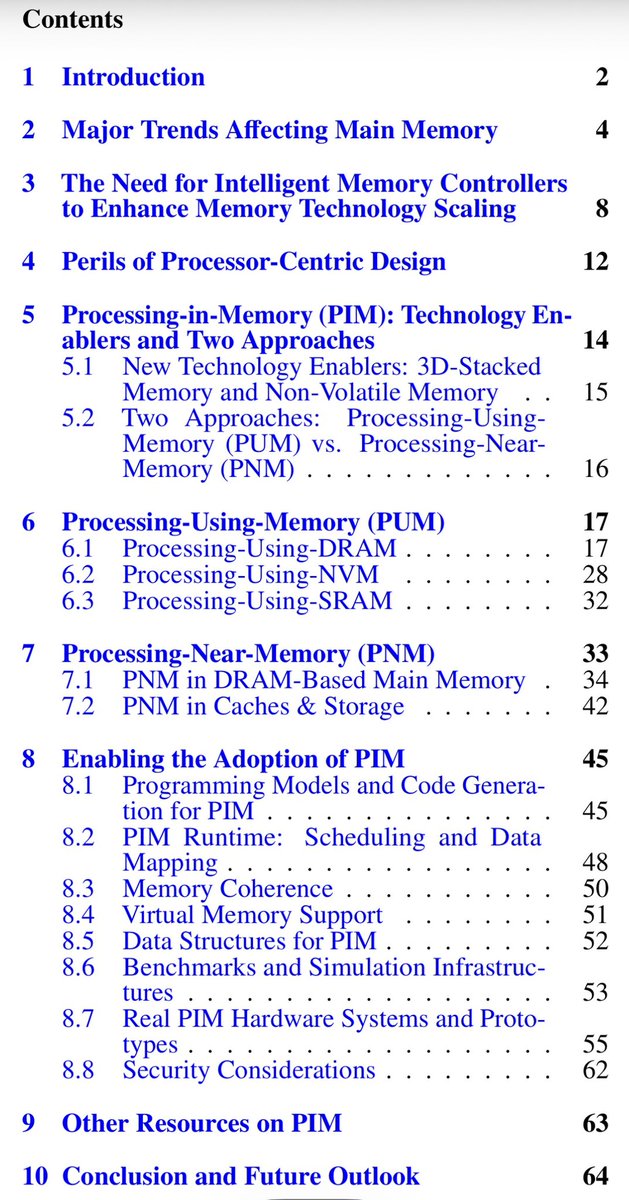
I just released Memtest86+ v8.10! 🥳🎉
-- TL;DR changelog --
➡️ Better support for Intel Lunar/Panther Lake
➡️ Better Bandwidth measurement
➡️ Add support for x2APIC
➡️ Enable SIMD (SSE2) on x86_64 build
➡️ Fix timings on LPDDR5
➡️ Fix AMI BIOS boot issues from unexpected W^X policy change
➡️ Fix older GRUB boot issues
➡️ Fix SecureBoot code & binary structure for future shim review
➡️ LA64-specific improvements
➡️ Bug fixes
Thanks to all contributors!
Check it out at: https://t.co/2UH56ubzw4
Source code on Github as usual! #FLOSS
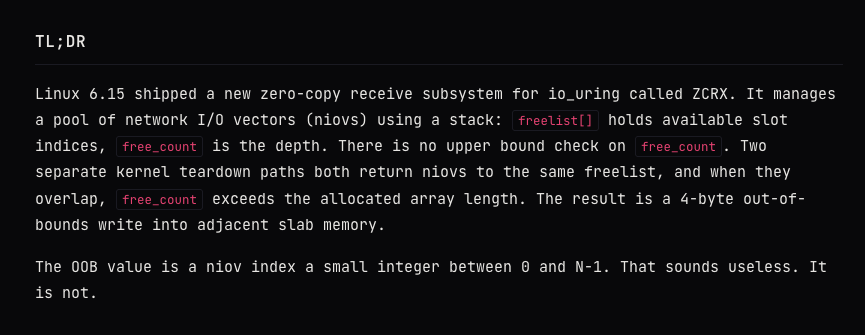
🚨 A third Linux kernel local-root flaw has been disclosed: Fragnesia. 🚨
Like Copy Fail & Dirty Frag, Fragnesia gives root on all major distributions. Every supported AlmaLinux release is affected.
Help us test the patched kernels: https://t.co/yCiumsl4Nr
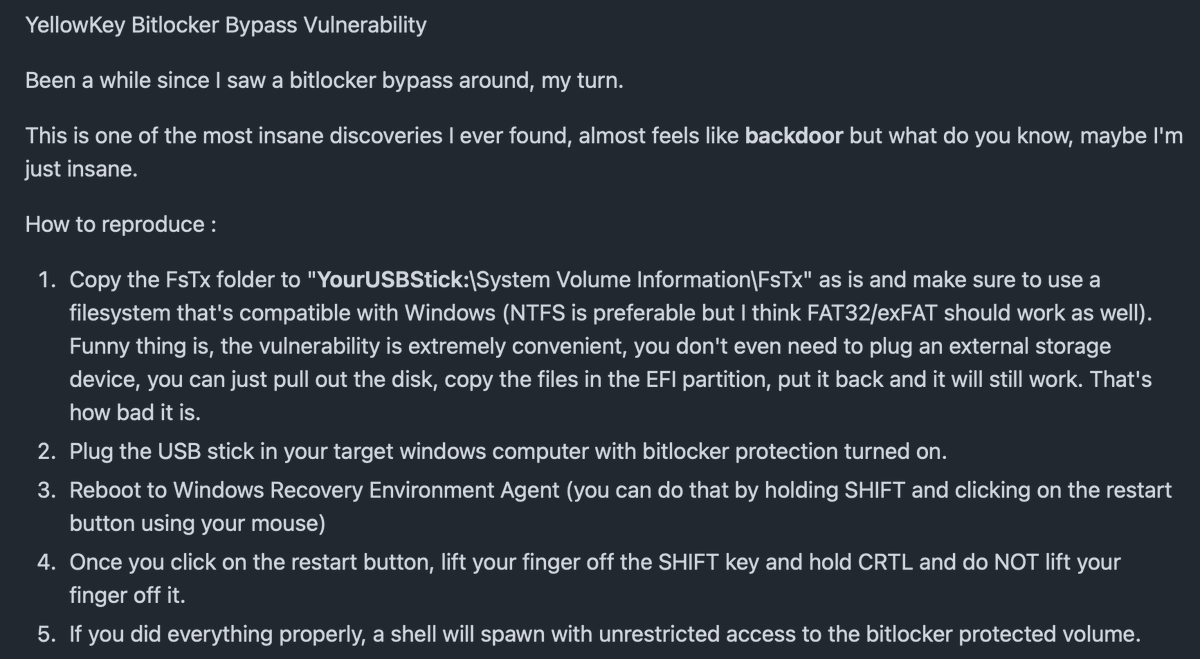
the YellowKey Bitlocker Bypass is genuinely one of the craziest Windows security concepts you'll seen in a while.
it basically turns normal Windows behaviour into malware.
no exploit.
no kernel bug.
no scary ransomware binary.
just trusted Windows components, signed binaries, and Defender assumptions being chained together into something extremely cursed.
modern EDRs are very good at detecting malware.
but they're much worse at detecting Windows itself becoming the attack.
If you think an 18-year-old bug is irrelevant, think again.
Badkeys by @hanno found DKIM keys still vulnerable to the 2008 Debian OpenSSL bug 16 years later.
❗️ Linux is having a brutal week. Another local to root privilege escalation vulnerability just dropped: "Copy Fail 2: Electric Boogaloo."
This is the third Linux LPE in a row, after Copy Fail and Dirty Frag. The PoC is public on GitHub. There is still no coordinated patch.
https://t.co/6XifksYgZ6
‼️🚨 One of the world's largest Certificate Authorities, DigiCert, was compromised by a malicious screensaver file sent through a customer support chat. Their antivirus blocked the malware four times. The agent kept clicking. The fifth try got through.
27 code signing certificates were stolen and used to sign malware.
DigiCert ultimately revoked 60 certificates.
Per DigiCert's incident report, filed in Mozilla's CA compliance tracker as Bug 2033170, here is how it unfolded:
April 2: an attacker contacted a DigiCert helpdesk agent through the company's customer support chat channel, posing as a customer. The lure was a zip file pitched as a screenshot. Inside the zip was a .scr file. On Windows, .scr files are executables, and this one carried a malicious payload.
Opening a file a customer sent through the official support channel is what an agent is supposed to do. Support staff are the one role designed to accept files from strangers.
DigiCert's endpoint security blocked four infection attempts. On the fifth, the support analyst's machine was infected.
DigiCert detected the infection, ran an investigation, and concluded the incident was contained.
Eleven days later, an external researcher tipped DigiCert off about misuse of DigiCert-issued code signing certificates in the wild. That tip led to the discovery of a second compromised machine, belonging to a different support analyst, infected through the same vector. The EDR on that machine had not been functioning correctly, so the original investigation missed it.
The second machine gave the attacker access to DigiCert's internal support portal. That portal lets support staff reach limited views of customer accounts, including initialization codes for ordered but not-yet-issued code signing certificates. Combining a stolen initialization code with an approved order let the attacker pull a real, validly issued code signing certificate. They did this 27 times.
DigiCert's own list of what went wrong:
- File-type filtering on the customer support chat channel did not catch the .scr
- EDR coverage was inconsistent and incomplete, creating a blind spot
- Initialization codes for code signing certificates were not adequately protected
DigiCert says it got lucky. An outside researcher found the malware abuse before DigiCert did. Without that tip, the second machine and the active certificate theft might still be running today.
Apple built AirDrop.
Then locked the best version of it inside their ecosystem.
So a developer on GitHub said:
“What if every phone, laptop, and OS could send files like AirDrop for free and also locally?”
Its called LocalSend.
You can share files with no account, no cloud, no subscription, and no company sitting in the middle.
This is what Tien Do Nam built for us.
Just device to device file sharing over your local network.
Works on Windows, macOS, Linux, Android, and iOS.
The billion-dollar version is locked.
The open-source version is free:
https://t.co/tLWCOFNYo9
https://t.co/fLeB5Q4SF2





![GuanniQu's tweet photo. found a remotely triggerable out-of-bounds read in the Linux kernel's H.323 connection tracking parser (CVE-2026-23455, CVSS 9.1 Critical). no authentication. no privileges. send a packet and the kernel reads memory until it hits an unmapped page. this code has been reachable from the network since 2007.
H.323 is a VoIP signaling protocol from the 1990s that refuses to die. it predates SIP. it's the protocol your office phone system was probably running before someone migrated to Teams, and in a lot of places nobody migrated. telecom carriers still use it for trunk signaling. hospitals run it for nurse call systems and overhead paging. hotels use it for room phones. building intercoms, elevator emergency phones, courtroom recording systems, prison phone networks, air traffic control voice switches. I keep finding it in places where I'm like, who is maintaining this, and the answer is always nobody, it just works. scariest sentence in infra.
every Linux firewall or NAT gateway that handles this traffic loads nf_conntrack_h323. full ASN.1 PER decoder. inline in the kernel. parsing untrusted packets from the network in kernel context. the module exists because H.323 uses dynamic port allocation for media streams so the firewall needs to understand the signaling to open the right ports. it auto-loads when H.323 traffic hits a conntrack rule. on many distributions it's loaded by default. you don't configure this or opt into this. someone behind your gateway plugs in a phone and now you have an ASN.1 parser in your kernel processing packets from the internet. the attack surface is a UDP packet to port 1719 or a TCP connection to port 1720 on any Linux machine doing NAT for a network that might have a phone on it somewhere. the parser runs before the packet reaches userspace, and there is no firewall rule that helps because the firewall itself is the thing running the vulnerable code.
DecodeQ931() processes Q.931 signaling messages. the UserUserIE code path reads a 16-bit length from the packet and decrements it by 1 to skip the protocol discriminator byte:
len = (buf[p] << 8) | buf[p+1] p++; len-- return DecodeH323_UserInformation(buf, p, len, ...)
if the encoded length is 0, len-- wraps to -1. len is a signed int. -1 gets passed to the decoder, which interprets it as a very large positive value and walks through memory far past the end of the packet buffer. the decoder iterates through ASN.1 fields, following structure, dereferencing pointers, until it hits an unmapped page or a parse error. one malformed packet, unbounded kernel memory disclosure. depending on slab layout the adjacent memory could contain kernel pointers that defeat KASLR, crypto keys, credentials from other processes, fragments of network packets belonging to other users.
so the programmer who wrote this in 2007 was implementing RFC 2225. the RFC says the UserUserIE field contains a protocol discriminator byte followed by a variable-length body. the discriminator is always present. so len-- is always safe because len is always at least 1. the RFC says so. the protocol guarantees it. the wire does not care about your protocol guarantees. the wire is untrusted input. but once you've internalized "there's always a discriminator byte" the decrement looks like bookkeeping, and every reviewer after you internalizes the same thing because the code reads naturally and the RFC agrees and nobody is going to stop and ask "but what if len is zero" because the protocol says it can't be.
the code is wrong because the programmer understood the protocol. someone who understood H.323 less might have added a defensive check, but someone who understood it perfectly trusted the wire to be well-formed. a reviewer who also understands the protocol reads len-- and sees bookkeeping. the bug is invisible to expertise. you can only see it by distrusting the wire unconditionally, which means ignoring what you know about the protocol. I don't have a clean answer for how you systematize that.
static analyzers can't flag it because every individual operation is valid. the length read is bounds-checked. the decrement is legal C. the function call is type-correct. fuzzers might hit it if they generate a zero-length UserUserIE but protocol-aware fuzzers tend to generate valid protocol structures, which means len >= 1, which means they systematically avoid the one input that triggers the bug. the tool that finds this is a human reading code and asking "what if this value is zero" at every arithmetic operation on untrusted input. boring question. answer is almost always nothing. the 1% where it isn't nothing is a 9.1 Critical and you have no way to know which 1% until you've asked everywhere.
protocol-specific conntrack helpers get written once for a deployment need. they work. they ship. then they sit in the kernel for two decades because the protocol still exists somewhere and removing the module would break someone's phone system in a hospital basement. nobody is reading the code for bugs. they're keeping it compiling. eighteen years. 9.1. if (len <= 0) break;.
originally reported by @VidocSecurity (Klaudia Kloc and Dawid Moczadło). I confirmed, reproduced, and patched it. patched in stable 5.10–6.19.](https://pbs.twimg.com/media/HJy9NmMasAARPQL.jpg)