The next wave of AI adoption is less about what AI can do and more about what organizations are willing to change to take advantage of it.
The first wave was tools. Most organizations that were going to adopt them have adopted them.
The second wave is harder because it isn't about technology at all. It's about the processes, structures, and role definitions designed for a world where the current tools were the constraint. That world no longer exists but most organizations are still running the infrastructure built for it.
The meeting cadence designed around how long it used to take to gather information. The approval chain designed around errors AI now catches automatically.
The team structure designed around task categories that have since collapsed into single workflows.
The organizations that will look back on this decade as transformative aren't the ones that adopted the most tools. They're the ones willing to redesign themselves around what the tools made possible.
The most honest thing anyone said about AI productivity this year came from a CFO who asked a question nobody wanted to answer.
"If we're all so much more productive, where did the time go?"
The efficiency gains were real. Reports that took days took hours. Research that took hours took minutes. The math on time saved was well documented.
But the output hadn't changed proportionally. The decisions weren't faster. The strategy wasn't sharper. The meetings weren't shorter.
The time hadn't disappeared. It had been redistributed into the same meetings, the same email threads, the same low-value coordination that had always consumed it. AI cleared one layer of work and the cleared space immediately filled with more of what was already there.
AI doesn't automatically create space for better work. It creates space. What fills that space is a leadership decision not a technology outcome.
What did your organization do with the time AI gave back?
The AI tool isn't the competitive advantage. The workflow built around it is.
Most companies adopt the same models, the same platforms, the same tools as everyone else and wonder why the efficiency gains aren't translating into differentiation.
Tools are copyable in days. The workflow built through months of iteration, the institutional knowledge about where AI creates leverage in your specific context, that takes time to build and is significantly harder to replicate.
The organizations with real AI advantages in three years aren't the ones with access to the best models. Access is a commodity. They're the ones that started building workflows early enough that the knowledge is already compounding.
The model is the ingredient. The workflow is the recipe. Nobody is going to hand you the recipe.
Three years from now every company will say they were early on AI.
Most of them won't have been.
Being early doesn't mean being first to buy a subscription. It means being first to change how the organization actually works because of what the technology makes possible.
PwC's 2026 research found the top 20% of AI adopters are 2.6 times more likely to report AI is helping them reinvent their business model entirely rather than just making existing operations more efficient. GetApp
The gap between the top 20% and everyone else isn't tools or budget. It's the decision to treat AI as a strategic question rather than an operational one.
That decision is still available. It won't be indefinitely.
The most underrated AI skill in 2026 isn't prompting.
It's editng.
Anyone can generate. The feed is full of proof. Content that is technically correct, covers the right topics, sounds like something worth reading until you realize three paragraphs in there's nobody home. No real perspective. Nothing that could only have come from a
particular person.
The people creating genuinely valuable work with AI
treat the output as a first draft that requires a real editor.
Who bring their actual point of view to the revision rather than accepting the model's instinct for what the piece should say.
The AI can write. Only you can make it yours.
AI is making the average better. It's making the best irreplaceable.
The floor is rising. Average output is getting closer to good output across almost every knowledge work category.
But the ceiling is rising faster. The people with exceptional taste, judgment, and domain expertise are becoming dramatically more valuable because now they can operate at a scale that was previously impossible.
The strategist who could advise three clients can now advise thirty. The analyst who could process one dataset can process ten. The writer with a genuinely distinctive voice can produce at a volume that used to require a team.
AI is not a great equalizer. It's a great revealer.
GitHub Copilot didn't replace a single developer at Microsoft.
It made them 55% faster. And more satisfied. Because they spent more time on the creative complex parts of the work rather than the repetitive ones. ZeroBounce
The 55% is the number that gets quoted. The satisfaction increase is the one worth sitting with.
The developers weren't just faster. They were doing more of the work they were actually hired to do.
The organizations getting this right aren't asking how many people they can replace. They're asking how much better they can make the people they already have.
Those are different questions with very different answers.
What would your best people do with their time if AI cleared the path to it?
The companies winning with AI don't have better tools than everyone else. They have better questions.
Most organizations ask: what can we automate?
Reasonable question. Reasonable results. Faster reports, shorter turnarounds, slightly leaner workflows.
The ones pulling ahead ask: what becomes possible now that wasn't possible before? What problem has been unsolvable because the economics didn't work and does AI change those economics?
Those questions lead somewhere different. Not incremental efficiency but genuine expansion of what the business can do.
The gap between those two questions is compounding every quarter.
Justin Bieber's clothing brand made $15 million in two Coachella weekends.
The AI angle nobody is talking about is what kept it alive in the four years before that.
A celebrity brand without a celebrity generating cultural moments is just a brand. The ones that survived built something underneath the fame that could run without it. Personalization that kept existing customers engaged. Content systems that didn't require the founder present for every piece. Inventory infrastructure that could handle $15 million in two weekends without breaking.
The Coachella moment was the spike. The infrastructure was what made the spike profitable rather than just a headline.
Every famous person can generate a moment eventually. What separates the brands that compound from the ones that disappear between moments is whether they built something that works when the founder isn't on stage.
AI doesn't create the cultural moment. It makes the cultural moment worth having.
What does your business look like when its biggest advantage isn't in the room?
Most companies are in the bamboo phase of AI right now and quitting because nothing looks like it's working yet.
The workflows built then abandoned. The tools adopted then dropped because results weren't immediate enough. The AI strategy that lived in a deck and never made it into actual work.
The first three months of serious AI adoption almost always feel like nothing is happening. The team is learning. The workflows are being rebuilt. The time savings haven't materialized yet because the learning curve is eating them.
But something is being built underneath. Institutional knowledge. Muscle memory. Taste for what good AI output looks like versus what just looks like AI output.
That foundation doesn't show up in any metric until suddenly everything moves faster than it did before.
The companies that will look back on 2026 as the year everything changed aren't the ones who saw results immediately. They're the ones who kept building when nothing was visible yet.
What's the AI capability your organization has been building quietly that hasn't shown up in results yet?
and some people still think he's the guy from that 70s show.
Ashton Kutcher just topped a global ranking of celebrities most in tune with AI, scoring 96 out of 100. Co-founder of Sound Ventures, one of the earliest celebrity-led AI investment portfolios.
while everyone was watching him on a sitcom he was quietly becoming one of the most sophisticated tech investors of his generation.
the report argues that brand partnerships, cultural relevance, and investor positions will compound for the figures AI engines recognize and quietly transfer away from the ones they don't.
that's not a celebrity problem. it's a business problem wearing a celebrity's clothes.
what are you building that the next version of the world will recognize as authoritative?
Most companies are making the same AI mistakes twice and calling it a learning curve.
The first time is fair. Wrong tool, wrong use case, no clear owner, no way to measure whether it was working. That's a learning error. You found out something useful.
The second time is a different category.
The teams compounding with AI right now aren't the ones that haven't made mistakes. They're the ones that built something from the first round. A clearer framework for evaluating tools. A more honest process for measuring whether something is actually working. A decision about who owns AI outcomes rather than everyone being vaguely responsible and nobody actually accountable.
AI implementation failure is almost never a technology problem. It's a learning problem.
What's the AI mistake your organization made early that you've actually built something from?
Most companies aren't behind on AI because they lack access or budget or talent.
They're behind because every time the decision came up someone said not yet and it felt responsible and six months passed and they said it again.
Not yet is a decision. It just doesn't feel like one until it's too late to pretend otherwise.
You don't get clarity before you move. You get it after.
What's your organization's not yet that's quietly become the default answer?
"just throw it in AI and make it work"
every marketer has lived this meeting.
here's what nobody says out loud: AI can make almost anything faster. it cannot make a bad brief good. it cannot replace the strategy that wasn't written. it cannot care about the outcome the way someone who actually understands the problem does.
AI is a multiplier. if what you're multiplying is vague, the output is just vague faster.
the brief still needs to be good. the thinking still needs to happen. the human still needs to be in the room.
"just throw it in AI" is not a creative direction. it's a way of avoiding one.
The people falling behind on AI aren't the ones who don't have access to the tools. They're the ones who decided they already understood it well enough.
AI is one of those rare subjects where genuine curiosity is more valuable than existing knowledge. What's true about it today is meaningfully different from six months ago and will be different again six months from now.
The professionals compounding the fastest share one quality that has nothing to do with technical skill. They stayed in student mode. They kept asking what's possible now that wasn't possible before.
That posture is the actual advantage. The specific tools change constantly. The curiosity that keeps you learning them doesn't.
The day you decide you've figured out AI is roughly the day it starts leaving you behind.
What's the most recent thing you learned about AI that genuinely surprised you?
Selena Gomez is a billionaire. 80% of her net worth comes from Rare Beauty, launched in 2020.
Not from streaming. Not from acting. Not from 400 million followers. From ownership.
The AI angle nobody is talking about: Rare Beauty scaled the way it did partly because the infrastructure to build a brand at that speed didn't exist five years ago the way it does now. Compressed product development. Content at scale. Demand signals that used to take months to analyze.
The celebrity brand moment is an AI adoption story dressed in a different outfit.
The tools that compressed the timeline from idea to billion dollar brand are the same ones sitting inside most organizations going underused.
What would your business look like if you applied that same infrastructure to the problem you're already closest to?
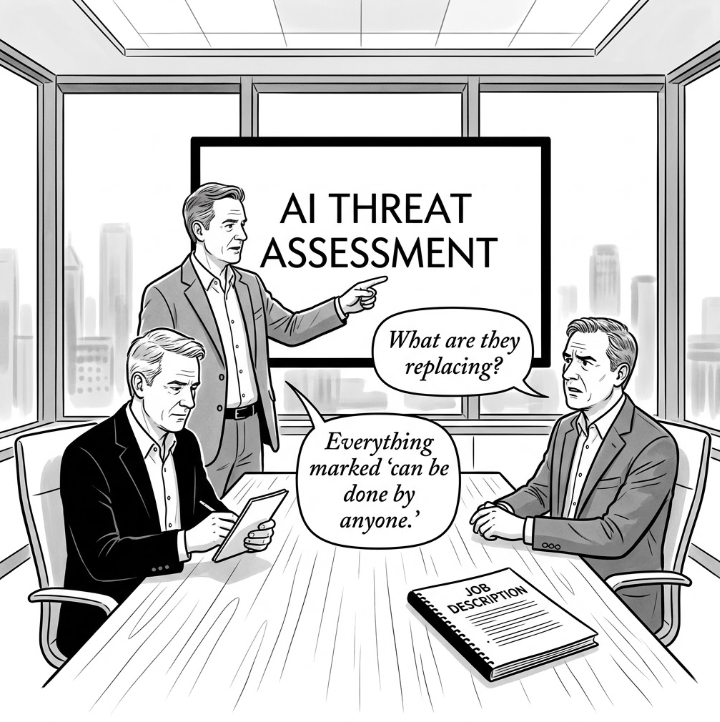
The companies most afraid of AI replacing their people are usually the ones whose people are doing the most replaceable work.
Not a criticism. A diagnosis.
The answer isn't to protect the work. It's to change what the work is before AI makes the decision for you.
What percentage of your team's week is spent on work that genuinely requires them specifically?
LegalZoom achieved measurable productivity gains from AI in 90 days.
Not through a full transformation program. By scoping tightly to one workflow before expanding anywhere else.
Most companies fail at AI adoption not because the technology doesn't work but because they try to change everything at once.
Pick one workflow. Make it work. Measure the result. Move.
Samsara did the same thing in the same timeframe. Different industry, same discipline, same outcome.
Start narrow. Go deep. Prove it. Scale from proof not from optimism.
What workflow in your business could show a measurable result in 90 days if you committed to it completely?
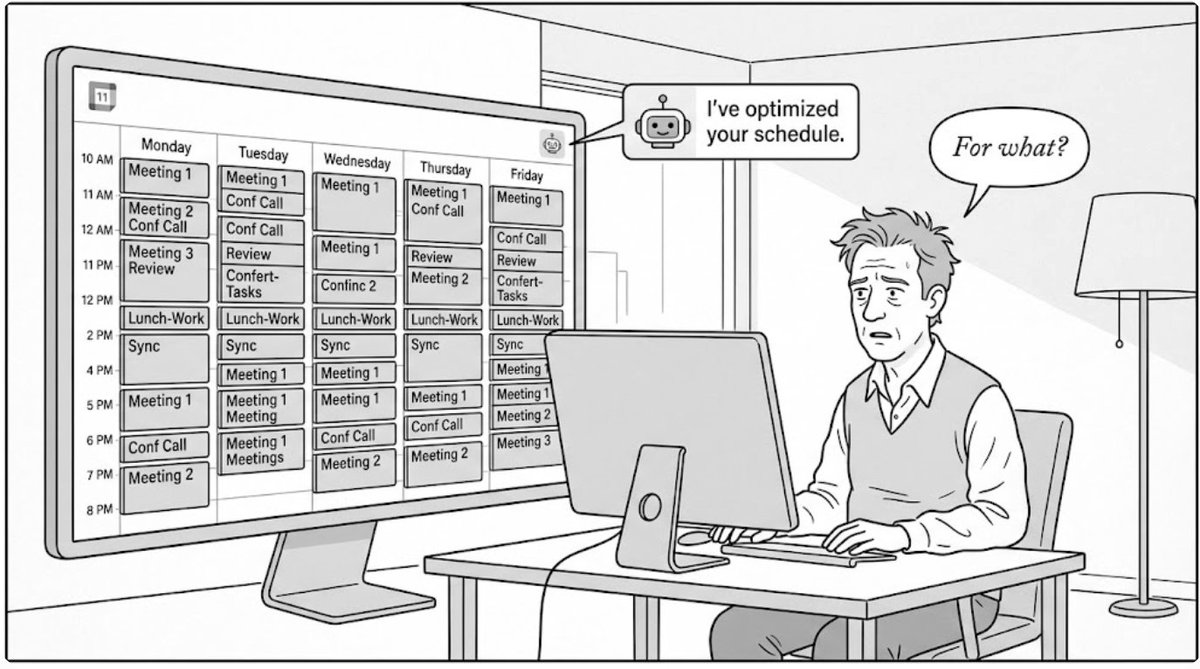
AI didn't create the meeting problem. It just made it cheaper to have more of them.
The most powerful thing AI can do for your calendar isn't optimize it. It's make the cost of filling it so low that you finally have to ask whether everything on it deserves to be there.
What's the last meeting you automated that should have been an email?
Walmart saved $2.3 billion in inventory costs in one year.
AI monitoring supply chain variables in real time reduced out of stock situations by 30%.
One problem. One application. One number.
Most organizations treat AI as a broad capability investment. The companies producing the most measurable returns treat it as a precision instrument. Find the constraint. Apply the tool. Measure the delta.
$2.3 billion from one use case.
What's the single most expensive unsolved problem in your operation right now?