A Japanese immunologist spent 20 years proving that the chemicals trees release into the air walk into your bloodstream, hunt down your stress hormones, and arm your immune system in ways no therapist or pharmaceutical has ever matched, and most of the data has been sitting in Japanese medical journals for two decades waiting to be translated.
His name is Qing Li.
He is a clinical professor at Nippon Medical School in Tokyo and the president of the Japanese Society of Forest Medicine. The Japanese government has been funding his research since 2004, and the body of work he has produced is the reason forest bathing is now an officially prescribed clinical therapy in Japan and Korea.
The story actually starts in 1982, when the Japanese Ministry of Agriculture, Forestry and Fisheries coined the term shinrin-yoku to describe the practice of slow, mindful walking in a forest. They did it for a practical reason.
Japan was urbanizing fast, stress-related illness was climbing, and the country had thousands of square kilometers of forest sitting unused. The idea was to give people a reason to walk into the trees... They had no idea what was actually happening to the human body during those walks until Qing Li ran the first proper experiment in 2005.
He took twelve healthy adult men on a three-day, two-night trip to a forest park. They walked for a few hours each day. Nothing strenuous. No prescribed routes or breathing exercises. They simply walked slowly through the trees, breathing the air, looking at the forest.
Li drew blood and urine samples before the trip, on the second day, on the third day, on day seven after returning home, and again on day thirty.
The numbers that came back from the lab were not what anyone expected.
The activity of a specific type of immune cell called the natural killer cell, which is the cell your body uses to hunt down cancer cells and virus-infected cells before they can spread, had jumped by roughly 50 percent during the forest trip. The actual number of natural killer cells circulating in the bloodstream had increased significantly.
Three different anti-cancer proteins that those cells produce, called perforin, granzymes, and granulysin, had all risen sharply. And the effect did not disappear when the men went home. The immune boost was still measurable on day seven and was still partially present on day thirty.
Two hours a day in a forest had upgraded the immune system for a full month.
Li ran the same experiment with women a year later and found nearly identical results. Then he ran it with a control group who took a three-day trip through an urban area with the same amount of walking, the same hotel quality, and the same diet.
The urban group showed no measurable change in natural killer cell activity at all. The forest was doing the work, not the vacation.
The mechanism turned out to be a class of airborne molecules called phytoncides. Trees produce these compounds to defend themselves against insects, bacteria, and fungi. Pine, cedar, oak, and cypress trees release them in particularly large amounts, especially in warmer weather and after rainfall.
When you walk through a forest, you are inhaling those molecules into your lungs and absorbing them through your skin, and once inside your body they appear to directly stimulate the production and activity of the very immune cells Li was measuring in his lab.
Roughly 50 percent of the health benefit of a forest walk, according to Li's data, comes from the chemistry of the air itself. The other half comes from what the forest is doing to your nervous system.
This is where it stops being only about the immune system and starts being about stress.
A separate Japanese research team measured cortisol, the body's main stress hormone, in 84 participants across 35 different forest sites. They drew samples before and after a 30-minute walk in each forest and compared them to control walks in matched urban environments. The cortisol levels of the people who walked in the forest were lower than the cortisol levels of the people who walked in the city by a significant margin. Their heart rates were lower. Their blood pressure was lower.
The activity of their parasympathetic nervous system, which is the part responsible for rest and recovery, had gone up. The activity of their sympathetic nervous system, which is the part that drives fight or flight, had gone down.
Then a researcher at the University of Michigan named MaryCarol Hunter ran the cleanest version of this experiment ever done. She recruited participants from a city and told them to take a nature pill three times a week for eight weeks.
They were free to choose the time, the place, and the duration of the nature experience, as long as it was outside, in daylight, and free of phones, conversations, and aerobic exercise. They sent her saliva samples before and after each session so she could measure cortisol changes accurately and rule out the normal daily drop in stress hormones that happens to everyone.
The result was that participants experienced a 21.3 percent drop in cortisol per hour spent in nature, with the biggest payoff happening between minutes 20 and 30 of the walk.
After that, the cortisol kept dropping, but more slowly. The threshold dose for measurable stress relief was just 20 minutes outside in something that looked and felt like nature.
What none of this means is that nature is a substitute for therapy or for medication when someone genuinely needs them. Therapy treats different things than a walk does, and Li himself has been careful in interviews to call forest bathing a complementary intervention rather than a replacement for clinical care.
But what the research has settled is that the human body has a physiological response to being among trees that operates on the same biological systems modern medicine is trying to reach with drugs and clinical protocols, and that response is fast, measurable, and free.
The strangest part of Li's work is the implication he keeps repeating in interviews. The average person now spends more than 90 percent of their life indoors. Their cortisol stays elevated. Their natural killer cells stay sluggish.
Their parasympathetic nervous system rarely gets a chance to take over. The system that was tuned by millions of years of life under a canopy of trees is being asked to run permanently inside a box made of drywall and screens.
Your body has not forgotten what it is supposed to do in a forest. It is waiting for you to walk into one.
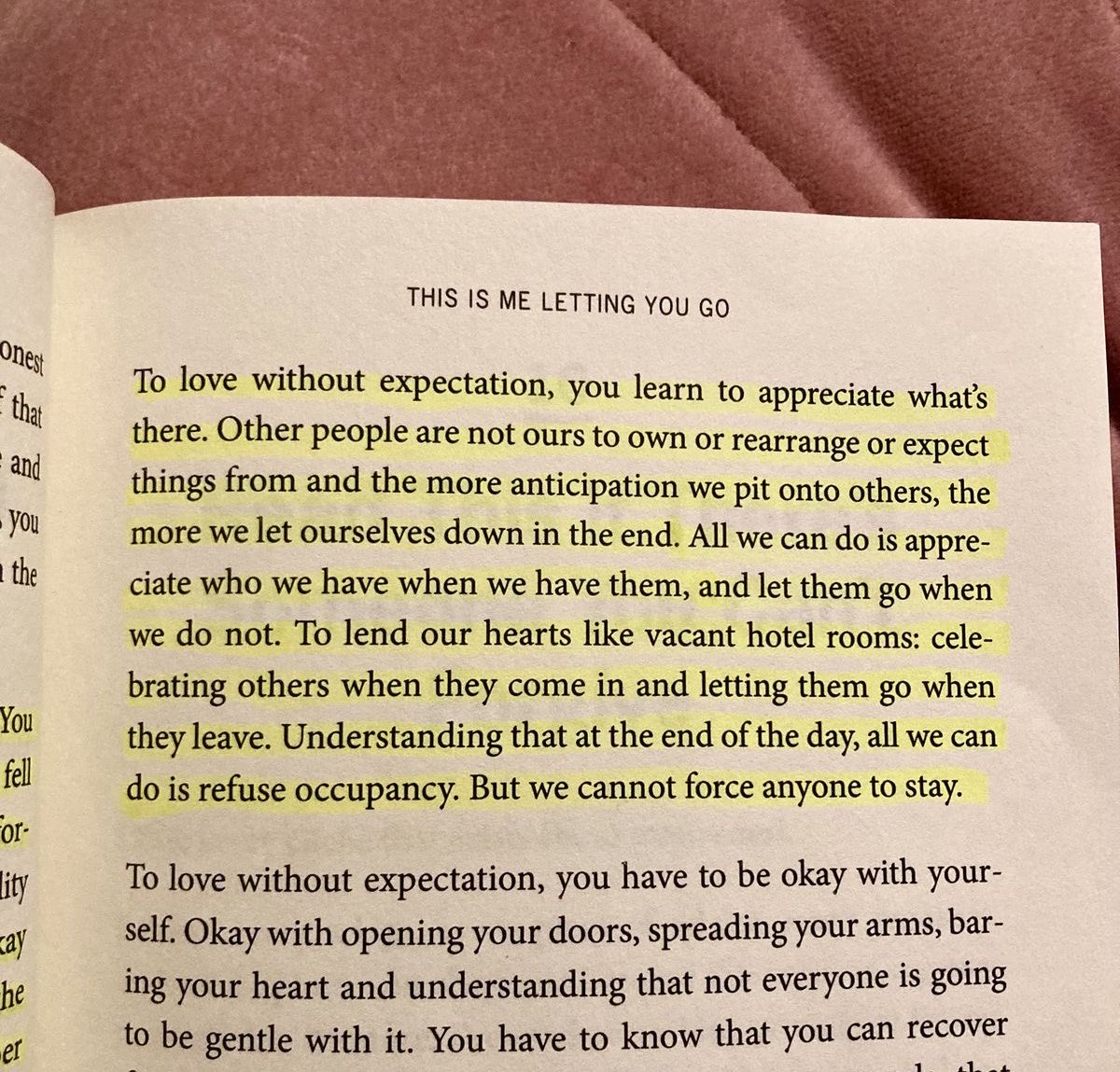
my favourite kind of person is both exacting and deeply kind
they have a precise point of view on what good looks like, but deliver it with generosity, care, and belief
aka high standards without cruelty, discernment without condescension
Today’s Mantra:
I AM opening my heart and
mind to the goodness of life.
I AM allowing things to get
easier and work out better
than I can imagine.
✨✨✨✨✨✨✨✨
Excited. Jumping up and down.
Vuta N'kuvute at @NgalabiShorts
24th June!!!!
I've waited 4 years to watch this!!!!
Been a fan of @amilshivji 's work since Samaki Mchangani and T-Junction.
We Goooooo 🏃🏾♀️
there is something incredibly satisfying about reading the first page of a book, and immediately something in your brain sits up and goes 'oh, i'm going to like this' — and then every subsequent page proves you right.
On the last page of Of Mice and Men, a man shoots his best friend in the back of the head. He does it while the friend sits there calm and happy, looking out at the water and picturing the little farm they were finally going to buy.
George and Lennie are two farm workers with nothing, moving from ranch to ranch looking for work. Lennie is huge, with a child's mind. George is smaller and sharper, worn out from looking after him, and he stays anyway. Almost every other worker is alone, but these two have each other, and a plan: a small patch of land where Lennie can raise the rabbits he keeps asking about. He makes George tell him about that farm over and over, the way a kid asks for the same bedtime story every night.
Lennie loves soft things. Mice, puppies, anything he can hold and stroke. He never understands that the same hands can crush whatever he is petting. So when a young woman on the ranch lets him touch her soft hair, then panics and screams, he panics too and holds on too tight, and she dies. The other men grab their guns and go after him.
George reaches him first. He finds Lennie down by the river, where they had camped their first night. He tells him to look across the water and picture the place one more time, the rabbits, the land that would finally be theirs. And while Lennie sits there grinning, lost somewhere inside that picture, George raises the gun and pulls the trigger, sparing him from the men crashing through the brush behind them.
Steinbeck almost called the book Something That Happened. Then he found a line in an old Robert Burns poem, about a farmer who wrecks a mouse's nest by accident while plowing a field. The line says the best laid plans of mice and men fall apart anyway. He named the whole book after that idea, before you read a single page. The dream was doomed from the cover. It had been sitting right there in the title all along.
The whole book, George swears he and Lennie are different from the other men, because everyone else is alone and they have each other. The last thing George ever does is make himself one of them.
The most colorful film in this picture came out in 1968. It has more color than the two space movies made decades after it, and old cameras have nothing to do with why.
Each strip works like this. Take a whole movie and break it into every single frame, the still pictures that flash past to make the motion. Shrink each frame down to one thin colored line. Stand them side by side in the order they happen, so the left edge is the opening scene and the right edge is the credits. You end up with one of these bands: a whole film's color, beginning to end, in one picture. A two-hour movie is about 170,000 of those frames, all packed into one strip.
The bottom strip is 2001: A Space Odyssey, from 1968. Look closely and it's stuffed with deep reds, electric blues, and streaks of purple and green. The director, Stanley Kubrick, put those colors there on purpose and used them to carry the story, the way another director leans on music. The boldest splashes come near the end, in the film's famous final stretch, where the screen erupts into pure color during the astronaut's trip through a tunnel of light.
The middle strip, all washed-out beige and grey, is Interstellar from 2014. The faded look was the whole point. Director Christopher Nolan wanted the dying Earth to feel drained and used up, and the crew pulled it off for real instead of on a computer. They planted actual corn, blew dust into the air, and kept filming until the green washed out of the shot. The dust and the dead crops are sitting right there in the color.
Up top sits Project Hail Mary, this year's big space film, glowing warm brown and orange. Most space movies lean cold and blue. The man behind the camera on Dune, Greig Fraser, went the other way and reached for warm orange. He even took cues from 2001 itself. He shot it on a modern digital camera, then ran all the footage back through real, physical movie film, because film carries a warmth that digital can't fake on its own. You can feel that warmth in the colors.
So the three strips are really three answers to one question: what should space feel like. A mind-bending trip, lit like a dream. A cold, empty place that doesn't care whether you make it home. And a world worth saving, warm enough to feel like home.
You've seen this wave. A giant blue wall of water curling over a tiny boat, with Mount Fuji small in the distance. The man who painted it was a broke 70-year-old who had been drawing for 64 years and still thought he was no good. His name was Hokusai.
He picked up a brush at six. By his fifties, his work was selling all over Japan. But late in life he wrote that nothing he made before 70 was worth a glance. Sixty-four years of drawing, and he called all of it worthless. Most people would have quit decades earlier.
Over about 70 years he made close to 30,000 drawings, prints, and paintings. That works out to more than one for every day he worked. And he never settled. He changed his name more than 30 times, dropping the old one whenever his style shifted. He moved house 93 times, sometimes just to dodge people he owed money. Around the time of the wave he signed his work with a name that meant one again, his way of saying he was starting over.
His life was rough. Lightning hit him at 50, and he lived. His second wife died in 1828. A grandson ran up gambling debts and wiped out his savings. In 1839 a fire destroyed his studio and much of the work inside it. Through all of it, he kept drawing, up before the sun and still at it after dark.
At 75 he wrote that he was only beginning to understand how birds and plants and fish were put together, and that he would not get it fully right until 90, then 100, then 110, when every line he drew would finally feel alive. He lived to 88, in a time when most people around him never saw 50. On his last day, he asked for five more years, just so he could finally become a good painter.
About 8,000 copies of that wave were printed while he was alive. Around 130 still exist. Today it sits on Japan's money, hangs in famous museums, and turns up on shirts and tattoos all over the world. In November 2025, one early copy sold in Hong Kong for 2.8 million dollars, from a man who died poor, certain he had never quite learned to draw.
Nobody forgets the entrance of a house that made them feel welcome.
Before you meet the people inside, you have already met the building. That first impression lives in you longer than most things. Every culture that has ever built with intention understood this.
The question is why so many of us stopped caring about it.
Some of the best projects I have shared here are from one architect. Francis Kéré grew up in Gando, a small village in Burkina Faso with no school. As a child he walked 40 kilometres to sit in a classroom that was dark, airless and suffocating. He went to Berlin, studied architecture, and came back. Something most African experts in the diaspora never do.
He came back to fix what he had lived through.
Gando Primary School was completed in 2001. The bricks are local clay stabilized with a small amount of cement, made on site by the community. Children gathered stones for the foundation. Women hauled water for brick production. The entire village built their own school. That decision was not just logistical. It was economic. Every material purchased stayed in the local economy. Every skill learned on that construction site stayed in the hands of the people who learned it. The building created income, training and dignity before it was even finished.
The roof floats above the building. A perforated brick ceiling sits below it with a deliberate gap between the two layers. Hot air rises and escapes through the perforations before the metal canopy above can transfer its heat into the classroom. Temperatures outside exceed 40 degrees Celsius. Inside, children can learn.
This is what community centered infrastructure looks like. The community is not the beneficiary at the end of the process. They are the process. They build it, they own it, they maintain it, because it was never handed to them. It was built with them.
It won the Aga Khan Award for Architecture in 2004 and launched one of the most consequential architectural practices working in Africa today. One man returned home, built with what the ground offered, and proved that the most advanced climate solutions and the most dignified economic development can come from the same handful of earth.
Kéré Architecture | Gando, Burkina Faso 🇧🇫 | 310 m² | 2001
📸 Siméon Duchoud, Erik Jan Ouwerkerk
En los años 70, una empresa siderúrgica japonesa llamada Nippon Steel tenía un problema: sus instalaciones industriales habían arrasado el paisaje y necesitaban plantar algo verde alrededor. Llamaron a un botánico de la Universidad Nacional de Yokohama llamado Akira Miyawaki.
Lo que Miyawaki plantó no se parecía a nada que Nippon Steel hubiera visto antes.
Miyawaki había nacido el 29 de enero de 1928 en la prefectura de Okayama, en el seno de una familia de agricultores. Estudió ecología vegetal en Hiroshima y luego se marchó a Alemania a trabajar con el botánico Reinhold Tüxen, pionero de la fitosociología, la ciencia que estudia cómo las plantas forman comunidades entre sí. De Tüxen aprendió el concepto que definiría toda su carrera: la vegetación potencial natural, es decir, lo que crecería en un lugar determinado si el ser humano no lo hubiera alterado nunca.
Cuando volvió a Japón en 1960, empezó a recorrer templos y santuarios sintoístas. Había allí algo que el resto del país había perdido: los chinju-no-mori, los bosques sagrados que rodeaban los lugares de culto y que llevaban siglos sin ser tocados porque se consideraban protegidos por los dioses. Eran densos, caóticos, extraordinariamente ricos en especies. Miyawaki los cartografió durante años como referencia de lo que debía existir.
Cuando Nippon Steel lo llamó, aplicó exactamente esa lógica: averiguó qué especies habrían crecido naturalmente en ese suelo, preparó la tierra con materia orgánica, y plantó decenas de especies nativas juntas, en alta densidad, dejando que compitieran y se organizaran como lo haría un bosque joven. Sus colegas lo miraban con escepticismo. Decían que los árboles se ahogarían entre sí.
No se ahogaron. Crecieron diez veces más rápido que en reforestaciones convencionales. En dos o tres años se volvían autosuficientes. Capturaban treinta veces más CO₂ que los bosques plantados de forma tradicional. Y eran treinta veces más densos.
El método se extendió. Miyawaki plantó más de 4.000 bosques en 40 países a lo largo de su vida, desde Japón hasta Malasia, Brasil, Francia y España. En sus propias palabras, recogidas en su discurso al recibir el Premio Blue Planet en 2006: "En lugar de restaurar simplemente los bosques que existían antes, este trabajo implica crear genuinos bosques nativos a través de rigurosos estudios de campo e investigación ecológica para asegurar un futuro sin cometer errores."
Murió el 16 de julio de 2021, a los 93 años.
Lo que dejó no es solo un método de plantar árboles. Es una pregunta que cualquier ciudad del mundo puede hacerse antes de empezar: ¿qué bosque quería crecer aquí antes de que llegáramos nosotros?
Fuentes: Wikipedia / Akira Miyawaki — datos biográficos verificados con fechas y premios
Universidad de Washington Tacoma, Miyawaki Microforest Project — documentación técnica del método con datos verificados: 10x velocidad, 30x densidad
Mongabay, "Miyawaki forests are a global sensation" (junio 2023) — análisis académico con fuentes primarias del método y sus críticos
Fundación Asahi Glass, Premio Blue Planet (2006) — cita directa de Miyawaki en su discurso de aceptación
Making movies can be so gratifying. You get to make things with your friends that live forever. And then you get to watch the works of other groups of friends throughout history doing exactly what you're doing. It's hard to put into words how wonderful a sensation that can be.
A cardinal hired Bernini to carve this and waited over a year to get it. Weeks after it finally arrived, he gave it away to another family for nothing. He had just lost everything that made him powerful, and this was how he tried to claw it back.
The cardinal was a man named Scipione Borghese. For sixteen years his uncle was the pope, and that made Scipione close to untouchable, with the money and clout to match. He hired the best young sculptor in Rome, a 23-year-old named Bernini, to carve a set of statues for his house. This was one of them.
Then his uncle died. The next pope came from a rival family, the Ludovisi, and the power shifted away from Scipione overnight. So when Bernini delivered this finished sculpture in 1622, Scipione kept it only a few weeks, then handed it to the new pope's nephew. It was a gift, and everyone understood the point. He was buying his way into the good graces of the family that now ran Rome.
That one move is why the last line of the tweet is the dull part. The sculpture barely sat in Scipione's house. It went to the rival family and stayed locked in their private collection for the next 286 years. The public had no way to see it. It only reached the Galleria Borghese, the Rome museum anyone can visit today, because the Italian government bought it in 1908.
The scene comes from an old myth that people invented to explain winter. Pluto, the god of the dead, tears open the ground, grabs a young goddess named Proserpina, and drags her down with him. Her mother, the goddess who makes the crops grow, is so wrecked by grief that she lets every plant on earth die. That dead stretch is winter. A deal finally gets made: Proserpina comes back up for half the year, and when she does, the world turns green again.
The old name throws people off. Back then, the word "rape" simply meant to grab someone and carry them off. The title is describing a kidnapping, nothing more.
Bernini was 23 when he carved this, and he was already showing off. Find the spot where Pluto's hand grips her thigh. The marble dips inward, the way soft skin gives when fingers press into it. He dug the curls of the beard out with a thin drill so they catch shadow like actual hair, then carved a single tear sliding down her cheek. He once bragged that he had taken hard stone and made it bend like wax. Stand in front of it, and you believe him.