Entrepreneur & CEO Cardiogeni PLC @Celixirltd. ExBCG and Roche. Fulbright Scholar, Uni of Oxford, Harvard Business School and Kellogg. Personal opinions
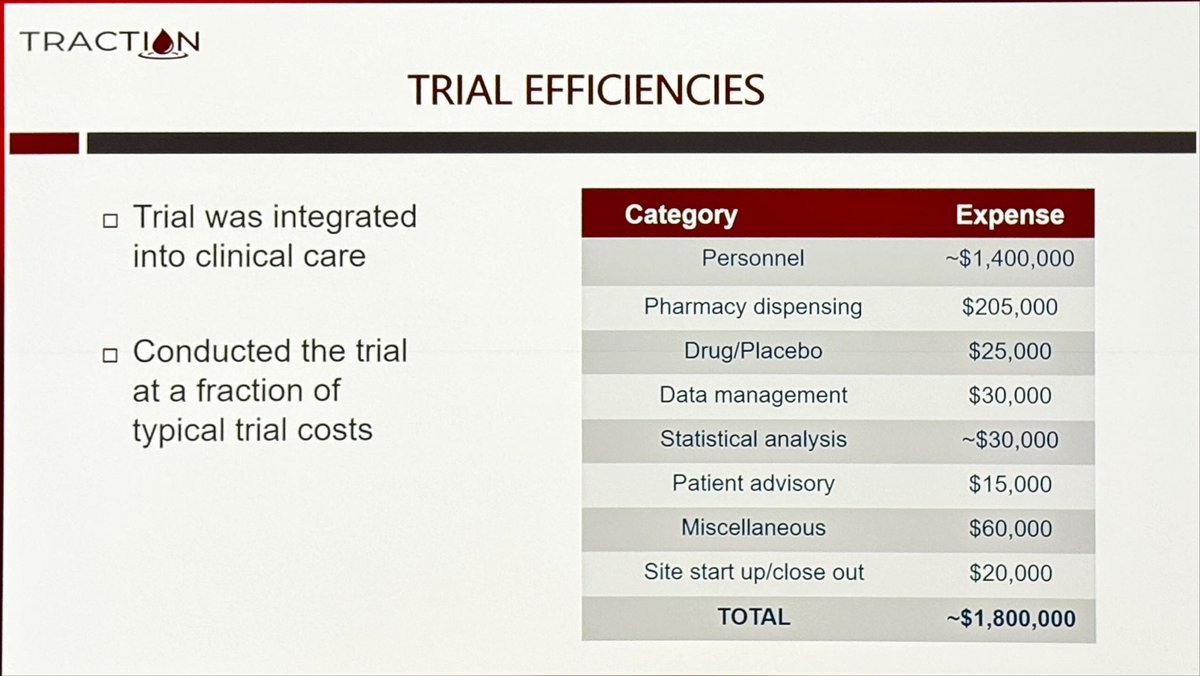
They did an 8000 patient clinical trial at a cost of just $1.3 million by incorporating the trial into routine clinical practice. #ASH25 Traction trial.
Would have cost >100 times more ordinarily.
We need to completely revamp the clinical trial bureaucracy. https://t.co/8qWaBwC62W
Scientists have uncovered how #leukaemia cells “cheat death”; rewiring their mitochondria to evade one of today’s most effective treatments. The discovery could lead to new ways to defeat drug-resistant leukemia. #TCSC#Leukemia#Oncology#Cancer#Cells https://t.co/9rFqyxxlB8
Varsity (Ivy League) athletes earn 3.4% more over their entire careers, and attain more senior positions than their classmates despite entering college with lower academic qualifications
How does undergraduate participation in varsity sports enhance career success? @HarvardHBS's Paul Gompers ’86, Ph.D. ’93, and colleagues at the @nberpubs compared the careers of Ivy League varsity athletes to those of their non-athlete classmates.
#Harvard
https://t.co/VaY7n8kktt
'Talent is everywhere, but opportunity is not. Except at Oxford.'
VC Prof Irene Tracey shares what she wants the University to be remembered for.
Read the Vice-Chancellor’s Oration in full ⬇️
$ROQ Roquefort presentation reveals the biotech is a leader in emerging targeted treatment field https://t.co/ERx7iJ2GPY @roqueforttherap $ROQAF #ROQ#ROQAF
Back in 2014, Novartis ditched its RNAi research, giving the lead scientist the first "courage award" for stopping bad projects!🤦♂️
Novartis ex-CEO Joseph Jimenez said at the time, "One of the reasons why spending in the pharmaceutical industry is so high is that many scientists keep their products alive far beyond when they should be. If you help them feel like it's OK to stop the project, you're going to save hundreds of millions of dollars."
At that time, Novartis had an option to buy the RNAi platform for $100 million. Alnylam desperately needed that money to keep going as a company. Novartis didn’t want to pass $100 million. The funny part is that after five years they acquired one asset for almost $10 billion with the acquisition of the Medicines Company and inclisiran for lowering cholesterol! 🤯
Although there’s something I have to give to Novartis; it was the last from the big pharma to abandon RNAi...
2010: Roche exits RNAi space and cuts 50 jobs
2011: Pfizer exits RNAi space and cuts 100 jobs
2011: Merck shuts down RNAi research centre and cuts 50 jobs
I'm on the plane to Boston and can't stop thinking about this story! Okay, some thoughts... (still need your input because my mind can't comprehend all this!)
1. A pharma's top scientist once said to me something along the lines "Pharma has money and its model is to buy whatever it wants to buy when it wants, i.e. when the science is proven and when it fits its strategic focus". I get that, but still, are you saying to that no one at big pharma ever cried over RNAi? No, I don't get that.🫤
2. Just because Pharma has money doesn't mean they know which project will succeed or fail. I mean, those are people too, and no one can predict biology! Fair...
3. To be more fair to Pharma, they may call me out on survivorship bias here with Alnylam. "Okay, but how many projects did we ditch that ended up failing anyway?" Okay... also fair enough.
4. Scientists at Alnylam said... "For us internally, we always knew the science worked and we couldn't understand why pharma was leaving the ship..." Well, in that case, I guess the key is effective communication to external partners. Can you make it so simple and clear for them to see as if they were one of you working on this thing in the lab every single day?
5. But one may say... this is hindsight bias... the Alnylam folks think that they knew they'd be successful because they're now successful!
6. You may say... "Why are you writing about all this? When you're working on a new modality, on something that hasn't been done before... you'll inevitably have to walk the path alone in the end." Roche, Novartis, Merck, all were not wrong to abandon RNAi at the time...
7. Why was pharma not wrong to pass? Someone else would argue by quoting @Jmaraganore himself, "We almost stopped investment in the conjugate effort (delivery method) because I was excited about where LNPs were going, and we had limited resources. It was around that 2010 period where we had to do these restructurings. But Mano Manaharan pleaded for me to do that one last experiment. And Akshay Vaishnaw, our President now, was supportive and said, John, just let him do it. And I conceded."
The discovery of the GalNAc conjugates, was a significant breakthrough for Alnylam. These conjugates allowed for more efficient and targeted delivery of RNAi therapeutics, making treatments easier to administer and more effective. Without this discovery, Alnylam might have faced greater challenges in developing viable RNAi therapies, potentially impacting their ability to survive and thrive in the end. I don't know... John? Someone else?
So, there is the luck factor as well! This is where I'm getting at.
8. BUT, it's difficult to draw the line between luck and not luck. You may say, Mano was an awesome scientist, and both Akshay and John were amazing managers and leaders who let Mano do the last experiment. And if you call this luck, you may also say that biotech is apriori a game of luck when your chances of success are less than 10%! Let's call it all luck! :)
9. Now that I'm thinking about it, even if you are the best communicator, you may never be able to explain to the outside world why you think your science will work. You have to keep going and be willing to walk the path alone until everyone else sees it eventually... They are not wrong; you just have to keep walking the path... even if YOU are proved wrong in the end... That's the only way...
Okay… my back is hurting. I need to walk in the aisle… Any more thoughts all? Give me the points 10, 11, 12... for my list above please!!!
Loving you, Angelos.
ps: thank you @BarryGreene for telling me the story about the Novartis award! :)
Roquefort Therapeutics secures Japanese patent protection for MK technology; has big plans for the land of the rising sun @roqueforttherap #LSE#OTCQB#ROQ#ROQAF https://t.co/JWVkZ5sgiQ
$ROQ Roquefort Therapeutics secures Japanese patent protection for MK technology; has big plans for the land of the rising sun https://t.co/ei5dFX1Aq2 @roqueforttherap $ROQAF #ROQ#ROQAF
Yes, quality and cost of manufacturing are important regulatory and commercial issues in novel modalities. But in addition, key strategic decisions like the indication selection and development program are not as straightforward (vs. NMEs / mABs)
When looking at companies with novel modalities, like cell therapy, investors need to pay even more attention to manufacturing & CMC
There are not a lot of experts with these modalities & that matters to regulators
#learnbiotechinvesting#biotech#investing#BiotechPrometheus
When looking at companies with novel modalities, like cell therapy, investors need to pay even more attention to manufacturing & CMC
There are not a lot of experts with these modalities & that matters to regulators
#learnbiotechinvesting#biotech#investing#BiotechPrometheus
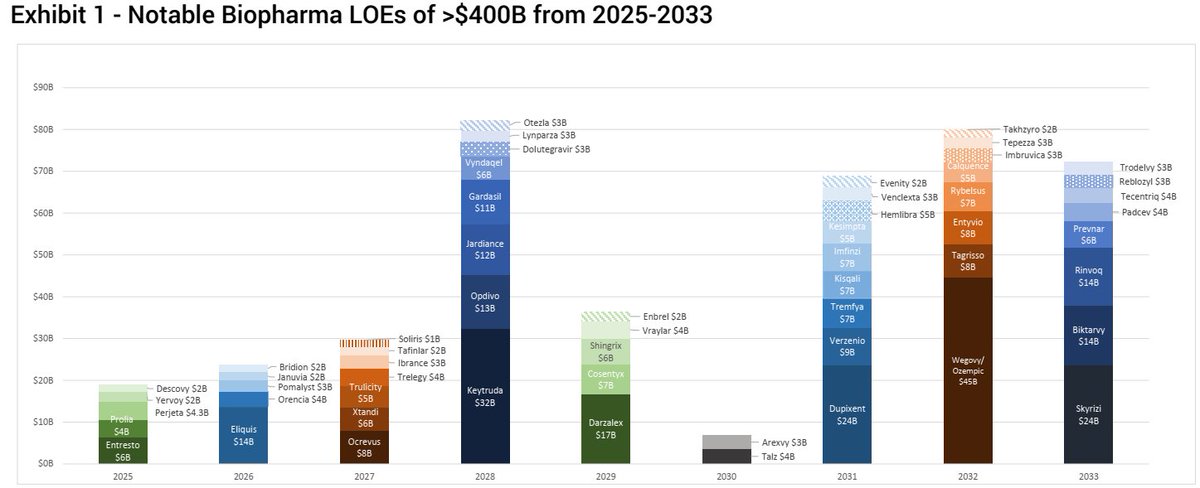
The patent expirations are driving Big Pharma’s need to acquire new products. Approved products are scarce and expensive and so, most Big Pharma are buying Biotech comapnies with products in development.
In Q1 2024, Oncology was the top therapy area for M&A deals in Q1 2024, with a total deal value of $29bn.
Immunology-focused M&As had the largest growth with a 314% surge in deal value in Q1 2024 totalling $14bn.