@ThinkWithSaurav I think, allocation would be key here, what we allocate at what stage, how we will increase allocation as we move forward with more conviction is going to be key.
@ThinkWithSaurav This is very interesting way to look at possible opportunities. Usually, people go with screener queries and data driven approach, here, you are building it top down. Not waiting for numbers to reflect in P&L and order book but get handle on them before things turn up.
My sincere advise to Indian investors. I gain nothing by saying this.
12 years did nothing for you as investors. Check the returns, adjust it in USD CAGR. The returns are dismal.
You are basically witnessing financial repression.
In this decade: middle class lost its financial ability to send kids abroad, travel abroad.
Give it 1 more decade: you will see serious deterioration in quality of goods we consume.
There is NOTHING you can do. This is happening. And, will keep happening.
The only thing in your control is your decision: on how you invest your available capital. If you are upper middle class, please open a foreign brokerage account. Invest.
You will say: oh you want to sell us your course? oh bhai, don't buy anything, it is fine. Just go and invest in QQQ/S&P 500 whatever you like. Go to better, more transparent markets.
You don't have to do this with your already invested money. Whatever new money you are making, make better calls with it. Only invest in Indian stocks when they go super cheap.
I am saying all this because:-
I don't want hard working fellow folks to get absolutely bankrupt in the name of investing in "hope". You're hardworking you absolutely deserve a much better life.
Companies having precision manufacturing capabilities with exposure to Europe defense and aerospace clients can have very strong tailwinds in coming years .
#investing#aerospace#defense
₹1,60,000 crore.
That's how much has been committed to Semiconductor projects across 6 Indian states.
10 projects approved. 4 in Gujarat alone.
One facility has already started shipping chips commercially. Two more are in pilot production. And a ₹91,000 crore fab, the biggest single manufacturing investment in Indian history, just broke ground.
But here's what nobody's asking: who actually gets paid when a ₹91,000 crore factory gets built?
Not the chip company. Not yet. The factory won't produce revenue for 3 years.
The money flows first to equipment suppliers, specialty chemical makers, gas producers, EPC contractors, power infra companies, and the OSAT players who'll test what comes off the line.
I went through every approved project to map exactly where the money is going.
The Projects:
🔹Tata Electronics + PSMC (Taiwan) — ₹91,000 crore semiconductor fab at Dholera, Gujarat. 300mm wafers. 28nm mature node.
50,000 wafer starts per month.
Production target: mid-2027.
This is India's first real wafer fabrication plant.
🔹Micron Technology — ATMP facility at Sanand, Gujarat. MoU signed June 2023. Commercial production started February 2026.
Already shipping packaged DRAM and NAND memory.
India's first operational semiconductor plant.
🔹CG Semi (CG Power subsidiary) + Renesas (Japan) — India's first full-service OSAT facility at Sanand. Launched August 2025.
Covers both traditional and advanced packaging.
🔹Kaynes Semicon — ₹2,800 crore OSAT at Sanand. Planning 13 chip assembly lines.
Target: 1 billion chips per year.
Also, building a multilayer HDI PCB plant in Chennai.
🔹Tata Semiconductor Assembly (TSAT) — ₹27,000 crore assembly and testing facility at Morigaon, Assam.
🔹HCL-Foxconn JV — ₹3,706 crore chip assembly and packaging unit in Uttar Pradesh.
🔹SPEL Semiconductor — expanding IC packaging capacity. India's oldest backend semiconductor player.
Gujarat's Sanand region alone has 4 of these 10 projects. It's becoming India's first semiconductor cluster.
Now here's the part that changes how you think about this sector.
Everyone calls these "semiconductor stocks." But there are 5 completely different stages in the chain. Each has a different margin profile, different capex intensity, and a completely different risk-reward setup. Buying them all in one basket is like calling Tata Steel and TCS both "Tata stocks."
I mapped which listed company sits where.
Stage 1 — Chip Design (where 50% of the value is captured)
Lowest capex. Highest margins. India already has 20% of the global semiconductor design workforce — over 1 lakh VLSI engineers. 24 chip design projects approved under the Design Linked Incentive scheme. This is India's actual competitive moat. Not manufacturing. Design.
🔹Tata Elxsi - VLSI design, embedded systems, automotive chip software.Margins 25%+. Works with global auto and semiconductor firms. Zero fab risk.
🔹MosChip Technologies - pure-play ASIC design and mixed-signal IP. Direct exposure to global chip design outsourcing.
🔹ASM Technologies - niche semiconductor engineering services for global chip companies.
IIT Madras is also developing a 7nm SHAKTI processor targeting 2028. ARM and Intel both opened advanced design offices in Bengaluru in 2025 — ARM for 2nm AI accelerators, Intel expanding to 13,000+ engineers.
Stage 2 — Fabrication (₹91,000 crore and zero listed exposure)
A single fab costs $10–20 billion. The Tata-PSMC Dholera project is the only real one under construction. No listed pure-play exists here today.
But here's the investable angle most people miss: before a fab produces a single chip, it spends 3 years buying lithography equipment, ultra-pure gases, specialty chemicals, deionized water systems, and cleanroom infrastructure.
Budget 2025 eliminated customs duties on lithography tools and ultra-pure gases specifically for this.
ISM 2.0, launched in Budget 2026, is focused on exactly this — domestic production of semiconductor equipment and materials. The ECMS allocation was raised from ₹22,919 crore to ₹40,000 crore because demand from approved projects already exceeded the original target.
The companies supplying the fabs will generate revenue years before the fabs themselves do.
Stage 3 — OSAT / Assembly & Testing (the stage India is moving fastest on)
This is the bottleneck. You can design a chip in Bangalore and fabricate it in Taiwan, but someone needs to package, assemble, and test it. India now has 3 listed companies building real capacity here:
🔹CG Power — CG Semi's Sanand OSAT with Renesas is already operational. From power equipment company to semiconductor in 3 years. One of the most dramatic corporate pivots in Indian industrial history.
🔹Kaynes Technology — 13 assembly lines planned. 1 billion chips/year target. Also building HDI PCB capacity. 3-year stock return before correction: +495%.
🔹SPEL Semiconductor — India's only dedicated listed OSAT player. Small but irreplaceable in this chain.
Micron's Sanand plant is also ATMP — already in commercial production as of February 2026.
Stage 4 — EMS (Electronics Manufacturing Services)
They don't make chips. They make everything chips go into. Every phone, every EV, every telecom tower, every defence system. They benefit from every stage above scaling up.
🔹Dixon Technologies — India's largest EMS company. Revenue nearly doubled YoY to ₹128,357 million in Q1 FY26. Planning a $3 billion display fab. Moving from contract assembler to semiconductor-adjacent manufacturer.
🔹Syrma SGS — expanding into automotive, industrial, and semiconductor-grade PCB assembly.
Stage 5 — End-Use / Defence Integration
🔹Bharat Electronics (BEL) — signed MoU with Tata Electronics in June 2025 covering the full semiconductor chain: fab, OSAT, and chip design. Defence-grade chip demand is the stickiest, least cyclical demand in this entire ecosystem.
🔹RIR Power Electronics — 50+ years making power semiconductors. Got Odisha govt approval for ₹510 crore Silicon Carbide (SiC) fabrication facility. SiC is the compound semiconductor EV and renewable energy companies need.
The big picture:
India's semiconductor market: ~$50 billion today. Projected $100 billion by 2030. $300 billion by 2035.
Government outlay: ₹76,000 crore under ISM 1.0. ISM 2.0 just launched. ECMS raised to ₹40,000 crore.
By 2029, India expects to design and manufacture chips for 70–75% of domestic applications.
India has been a chip consumer for 30 years. What's happening now — across Dholera, Sanand, Morigaon, and Noida — is the first serious attempt to become a chip producer.
But the value chain isn't one trade. It's five different trades with five different risk profiles.
->Design captures 50% of the value at 25%+ margins.
->OSAT is the bottleneck where India is moving fastest.
->Fabrication is where ₹91,000 crore is going but listed exposure is zero.
->EMS benefits from everything above it scaling.
->And the equipment/materials suppliers — the companies ISM 2.0 was literally designed to create — might be the most underappreciated layer of all.
Most people buying "semiconductor stocks" don't know which stage of the chain they're betting on.
Now you do.
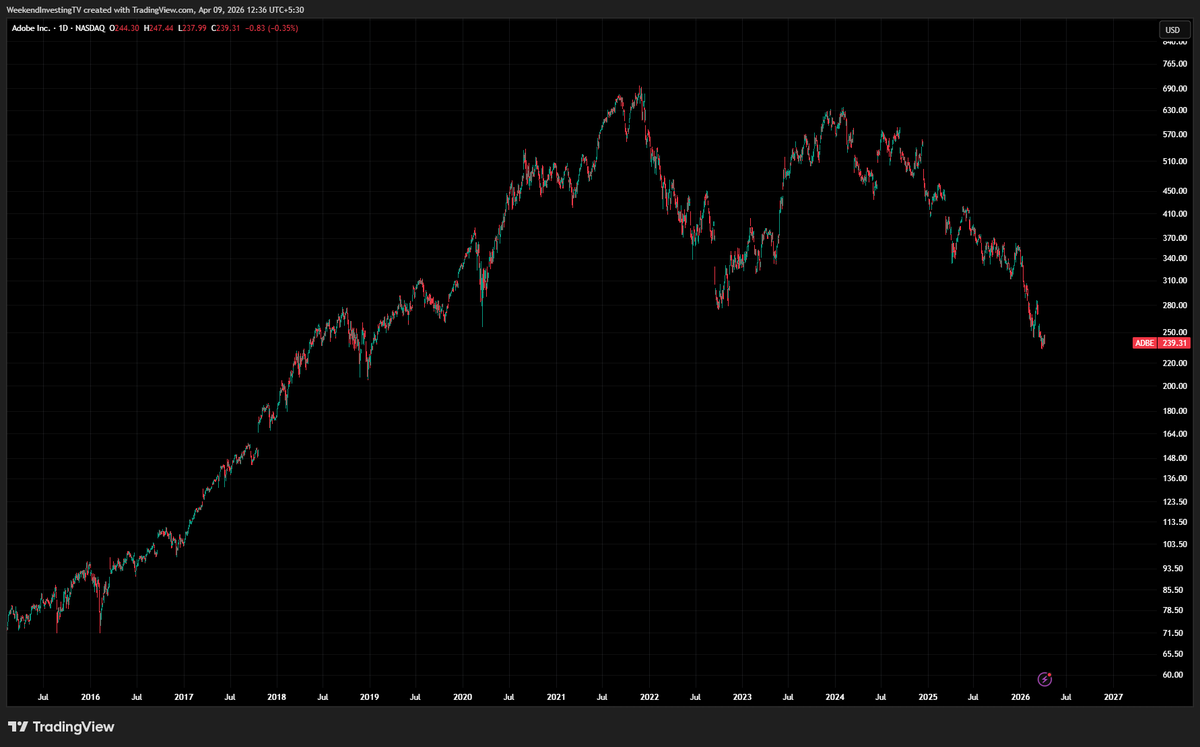
I had a meet with an investor who was working with Adobe for long and as a result had a good position in stocks. He said he is very disturbed due to its fall from 700 to near 230 and is a matter of concern for his concentrated position.
This dilemma is commonplace. The stock went up near 30X from 2011 to 2021 and is now mean reverting.
At what point will one exit ? Nike is another such case.
What would you have done.. do comment.
Transmission is a Decadal Theme | India’s Silent Power Revolution
- I'm from the Power sector with 12+ years of experience.
- Here's why I’ve allocated 30% of my long term Portfolio in this decadal theme with huge tailwind
1⃣ Massive Market Size & Tailwinds
Transmission market: ₹3.56 Lakh Cr
➡️ Huge headroom for growth
2⃣ Tower–Substation–Conductor Value Chain
🔹Tower: ₹1.6 Lakh Cr (40%)
🔹Substation: ₹1.8 Lakh Cr (50%)
🔹Conductors: ₹20k Cr to ₹35k Cr (5 to 10%)
➡️ Major Cost sits in just these 3 - massive opportunity for infra players
3⃣ Government-Backed Capex Explosion
🔹₹4.25 L Cr (2022–27) + ₹4.90 L Cr (2027–32)
🔹Total: ₹9.15 Lakh Crores in 10 years
🔹42% of current transmission line capacity to be added
➡️ Once-in-a-generation policy-led cycle
4⃣ Demand Drivers = Long-Term Secular Growth
🔹EV grid readiness
🔹AI/Data centers’ 24x7 power needs
🔹Renewable + Peak-load balancing = New substation demand
🔹Smart Cities & Tier 2/3 urbanization
5⃣ Tech Upgrade: The New Backbone
CEA plan includes:
🔹HVDC (LCC + VSC), STATCOM, Digital Substations
➡️ Infra is moving from steel to silicon. This isn’t just capex, it's intelligence upgrade.
Capacity Additions – Already in Motion
6⃣ Transmission Line:
- FY22: 4.56 L ckm
- FY27E: 5.71 L ckm → FY32E: 6.48 L ckm
Substations (MVA):
- FY22: 10.7M → FY32E: 23.4M MVA
➡️ More than 2x growth = multi-year compounding across the value chain
7⃣ Who Benefits? Transmission Value Chain Stocks ?
🏗️ Tower:
🔹KEC International – India’s largest tower EPC player with global presence
🔹Skipper Ltd – Export-driven tower manufacturer with substation ambitions
🔹Transrail Lighting – Full-spectrum EPC with monopoles, civil, and rail electrification
🔹Techno Electric – Asset-light EPC player focused on HV towers and substations
🔹Bajel Projects Ltd – New demerged entity with strong tower + GIS EPC pipeline
🔹Kalpataru Projects International (KPIL) – Global transmission EPC giant with ₹64K+ Cr OB, active in 75 countries
🏭 Substations:
🔹ABB India – Leader in HVDC, STATCOM, and digital substations
🔹Siemens Ltd – High-tech player in automation, protection & control systems
🔹Bajel Projects Ltd – Active in 220kV & 400kV GIS/AIS substations
🔹Shilchar Technologies – Supplies power transformers for EHV substations
🔹TARIL – Trusted grid transformer supplier, expanding into 765kV ultra high-voltage market
🔌 Conductors:
🔹KEI Industries – Key cable supplier across power infra and exports
🔹Apar Industries – India’s largest conductor maker with HTLS leadership
🔹Dynamic Cables – Fast-growing conductor + cable supplier for T&D projects
📌These players are at the heart of India’s $9.15L Cr grid overhaul. Some will be 5x–10x over the decade.
- Any major We missed out . Do mention in comment
- No Buy/Sell recommendation
#StocksInFocus #StocksToWatch #taril #Shilchar #siemens #bajel #transrail #kei #aparind #abb #skipper #kec #kpil
If you have Lump-sum amount of 1 Crore ,
Just Invest in any Balanced Advantage or Aggressive Hybrid Fund
Wait for 1-2 Year
Then Start SWP :- 50-60K PM
Increase Monthly amount by 10K-15K Every year .
This Pension will be for LifeTime
#FinancialPlanning#Investing
📸Sector: VFX Companies
📸India's thriving film industry and vast pool of skilled technicians have turned it into a leading hub for VFX production.
📸4 micro and small-cap companies engaged in VFX production and allied activities.
[A thread...]🧵👇
Patterns I use to find multibaggers :
I have mentioned some past examples and some multibaggers in the making
1.Operating leverage kicking in with high gross margins and increasing utilisation. (Danlaw Technology,Fredun Pharma)
2.Change in management.( Kintech Renewable)
3.Spin off into separate entity. ( Aarti Surfactant)
https://t.co/7Bj7rDeCP6 off big write off. ( Ujjivan Small)
5.Sector Re-rating+ capex going live ( Deepak Nitrite + TRIL )
6.Government Policy Push Creating big Total Addressable market for small companies. ( RMC Switchgear , Avantel )
7.Companies making breakthrough and disrupting technology which is more efficient in operation and costs a fraction. ( Taylormade Renewable)
8.Change in consumer behaviour and disposable income. ( Brand Concepts, Jeena Seekho )
9.Ordinary business/Commodity Business run by a Crazy Management who is amazing at execution and is hungry for growth. ( Apl Apollo , Annapurna Swadhisht, Hindustan Foods, )
https://t.co/987E7AeYHn Generation Studying well and coming back and Taking Over( Arman Finance)
11.Change in plans for Monetisation of assets ( Raymonds).
12.Reverse mergers and mergers , value unlocking. ( Exhicon,Remus Pharma , Mono Pharma)
https://t.co/RT1n3RGVeL Leaders In Sunrise Sectors ( guess some ).






![raghavwadhwa's tweet photo. 📸Sector: VFX Companies
📸India's thriving film industry and vast pool of skilled technicians have turned it into a leading hub for VFX production.
📸4 micro and small-cap companies engaged in VFX production and allied activities.
[A thread...]🧵👇 https://t.co/o2U0zSF2X5](https://pbs.twimg.com/media/GGR-nNPXIAAS4dG.png)


