If you know anyone looking for a good and fairly AI-proof career, watchmaker (= watch repairer) seems a promising one. Every watchmaker seems to have more work than he can handle, mechanical watches are increasingly popular, and it will be a while before AI does this.
San Francisco’s come back is real but we still have a serious problem.
The unfortunately truth is that thousands of Fentanyl addicts live here. Most are not born and raised in SF but they have come to use drugs and are housed in our shelters and SROs. They take a drug that is 30-50x more addictive than heroin and as a result are not interested in drug treatment which is offered to them regularly. As long as these people live here and are not in treatment, the conditions on the street will be impacted by their presence. As long as they are here and using, dealers will figure out how to sell them drugs. I dont judge these addicts, they aren’t violent and I can’t imagine trying to combat a fentanyl addiction. But that doesn’t change the fact that their presence creates negative externalities that impact our city everyday.
Too many people are talking about the symptoms and not the problem.
52% is huge! People choosing to bike or scoot in SF are making a rational choice for themselves and reducing traffic congestion for everyone else. Policy should make that choice safer, and even more rational. @jeremys@sfstandard
https://t.co/b4X8kWH8wP
@SFist A human driver actually hit my 7 year old daughter in a San Francisco crosswalk while she was crossing at a consistent pace.
You didn’t cover that story.
Hmmm . . . Agnos lost an election for supporting waterfront public space in place of a highway. Today, we celebrate his forethought and exactly no one is calling for a freeway over the Embarcadero. Any lessons in this for today?
https://t.co/DW5DgzupZj
In case you forgot (or never knew) just how bananas politics can be, read Michael Schneider of @streetsforall in the @latimes on the CA state law that applies to a single street. https://t.co/ZHZFGHMkTT
@mattyglesias I wouldn’t equate this policy with grade inflation & coddling generally. Notwithstanding the squishy references to mental health & intrinsic motivation in the announcement, the policy sounds good to me. Why not give students 4 months to figure out expectations and study habits?
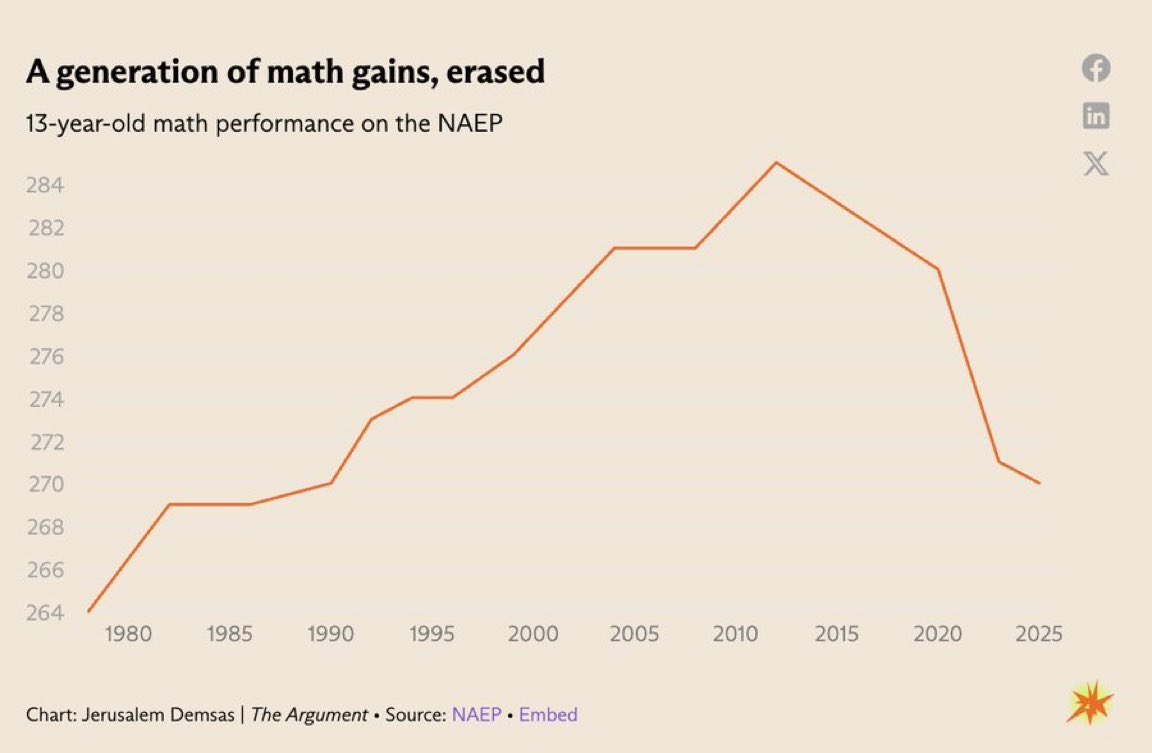
the destruction of American education over the past decade is an incredible self-own
competence is objective. a child can either do the math or they can’t. but in the u.s., a lot of people have reasons not to say that!
parents don’t want to hear their kid is struggling. teachers don’t want scores used to manage them. districts don’t want embarrassment. progressives worry accountability will create inequity. conservatives don’t want federal authorities. so we end up with process, weak standards, and excuses to explain away bad outcomes.
people object that it’s phones, covid, demographic change.
ok! but we fail globally when others have phones, covid too — vietnam is much poorer than the u.s., yet performs well in international math comparisons. some countries treat math as a basic skill everyone needs to master. here, it is part of a fight about fairness, autonomy, and feelings
in the age of AI — if people can’t do basic math, read closely, or think through problems, ai won’t make them more capable. it will become something they rely on without understanding. the countries that come out ahead in the global race won’t just have better technology. they’ll have people who know how to use it, question it, build on it. we need the national ability to decide something is worth doing coherently (teaching math!)
the US has the money to teach math well but it has not shown the will. we are failing the next generation
@nyt This is not a sentence.
“The vice president asserted that Iran would gain little if it did not agree to U.S. demands in the next phase of negotiations and will involve Iran's nuclear program.”
https://t.co/422xMjjcIo
@bett_yu Recent months? Where have these neighbors been the last decade? There are ebbs and flows but this is not a new problem, even to side streets or that park. That park has been a hotspot since I moved to that neighborhood more than 10 years ago.
@GerberKawasaki@MikeBloomberg@BloombergDotOrg We need AVs *and* other modes. 1 car per traveler is a lot of real estate on shared roads no matter who is driving. Autonomous drivers seem safer on avg but can make congestion worse (and make less exemplary drivers mad and dangerous).
@scsherrill Thanks for highlighting! Too often, accidents that don’t result in grievous injuries fly under the radar.
Investigating these fully is the first step. Traffic enforcement and design can both help.
Sincerely, Mother of another child hit in a crosswalk
Pedestrian safety is public safety!
Last week, a woman and her baby in a stroller were struck by a car at Laguna & Chestnut. Thankfully, neither of them died but it’s a reminder that street design has consequences.
In 2025 alone, 16 people in San Francisco lost their lives after being hit by cars. These deaths are preventable.
Your kid should be able to walk to Marina Middle School without fear of being hit by a car. We have to build streets that prioritize pedestrian safety.
Thank you to @walksf and @streetsforallsf for their advocacy to make our streets safer.
Got ideas to redesign Laguna & Chestnut? Send them to [email protected] or DM me here. We’ll highlight some of the best ideas, and we’ll keep you updated on how @sfmta_muni redesigns this intersection.
In March 2020, when New York issued a stay-at-home order in response to Covid, JP Morgan had not yet broken ground on the new 270 Park Avenue. The project was still in the demolition phase. The firm debated whether to halt, scale back, or redesign the (massive) project. Given the rise of remote-work and the ongoing boom in financial-services employment in Texas and elsewhere, it’s sobering to consider a world where JP Morgan decided not to move forward, or to dramatically scale the project back.
In our world, of course, Jamie Dimon insisted that the firm was committed to NYC. But as he observed in his annual letter to shareholders, JP Morgan now has more employees in Texas (32,000, up from 26,000 in 2015) than in New York (24,000, down from 30,000).
There are other Jamie Dimons making the call about whether to build or continue building big, ambitious projects in NYC, where costs are skyrocketing, wages are stagnant, and the direction of travel with respect to policy does not strike many investors, entrepreneurs, and large employers as encouraging.
Employers are looking for some reassurance about where the city is headed in 5+ years, and it’s easy to see why.