State-of-the-art museum & research library with 100,000+ artifacts from Columbus to the Space Race. Educate. Enlighten. Inspire. Engage. Powered by Mercury One.
Thomas Jefferson tried to end slavery in 1769.
He was barely in the Virginia colonial legislature before he put forward legislation to emancipate slaves under the British Crown.
The King vetoed it.
So when Jefferson sat down seven years later and wrote that the King had "suppressed every legislative attempt to prohibit or restrain" the slave trade — that wasn't just a political grievance.
That was personal.
And we almost missed it entirely. This document was sitting in our collection, nearly went on air upside down, and the moment we read it the only question we could ask was — how were we not taught this?
This is robbery of our heritage.
Does knowing this change how you see Jefferson? Drop it in the comments. @glennbeck
Everyone wants to talk about what Jefferson owned.
Nobody wants to talk about what he was fighting against.
In 1775, there was not a single nation on earth that didn't practice slavery. Not one world leader who didn't hold slaves. The founders weren't products of a more enlightened era — there was no more enlightened era. They were creating one.
American exceptionalism doesn't mean America never got it wrong. It means that when America got it wrong, she fought to make it right. Jefferson was in that fight long before 1776 ever arrived.
That's the history they don't teach you. That's why we're here. @glennbeck
Ordinary men did extraordinary things so we could be free.
250 years under our Declaration. 250 years under our Constitution. The longest of any nation in the world.
If you knew what it actually cost — you'd celebrate too.
Freedom is never guaranteed. Liberty is not self-sustaining. Every generation must decide whether it is willing to bear the responsibilities necessary to remain free.
The men of Philadelphia answered their call.
The question is — will you?
Happy America 250. God bless you.
🧵History has a way of making the impossible seem inevitable — because we know how the story ends.
But on July 4th, 1776, nothing was certain. A thread.
But the story didn't end with them.
Dr. Joseph Warren said it before the first shot was ever fired:
"On you depend the fortunes of America. You are to decide the important question on which rests the happiness and liberty of millions yet unborn."
Ordinary men did extraordinary things so we could be free.
250 years under our Declaration. 250 years under our Constitution. The longest of any nation in the world.
If you knew what it actually cost — you'd celebrate too.
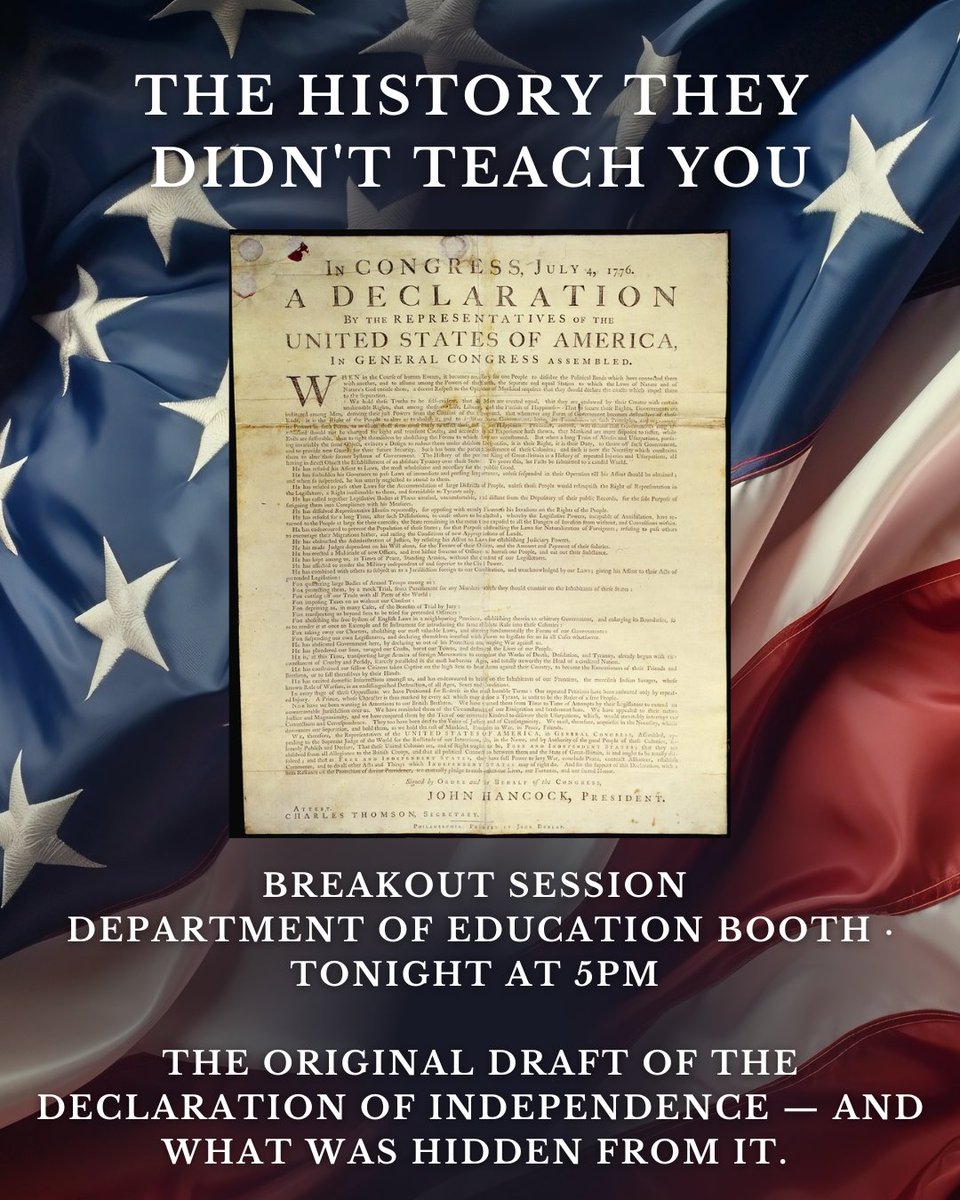
🚨 If you're at the Great American State Fair — be at the Dept. of Education booth TONIGHT at 5PM.
Our Director of Education is breaking down the hidden history of the Declaration's original draft. First person there gets a limited edition America 250 coin.
Don't miss it. @usedgov
Why do artifacts matter?
Because history isn't just something you read. It's something you experience.
Years ago, a World War II veteran stood in front of a display case, staring silently at General Dwight D. Eisenhower's five-star helmet. After several minutes, he revealed why:
"That was my commanding officer on D-Day."
When he was invited to hold and wear the helmet once again, the room fell silent. The memories, the sacrifice, the history—it all became real.
This is why The American Journey Experience exists.
When you can see the actual artifact, hear the story, and connect with the people who lived it, history is no longer a chapter in a textbook. It becomes personal.
Because when history can be touched, it can be understood. And when it can be understood, it can be passed on. Learn more at https://t.co/W1TABqPeOe
We are LIVE at the Great American State Fair — and you don't want to miss what's happening on the Main Stage today. Glenn Beck, Tim Barton, Elijah O'Neal, and Mike Noriega are taking the stage starting at 2PM to talk about the history, the faith, and the future of this country. If you're here today, be there. Main Stage. 2PM.
History is best understood through the original documents.
To celebrate America's 250th birthday, we've reproduced Thomas Jefferson's original rough draft of the Declaration of Independence—including passages most Americans have never seen.
Limited to just 500 copies.
Get yours before they're gone.
🇺🇸 https://t.co/W1TABqPeOe
As America celebrates 250 years, there's never been a better time to go back to the original documents.
Our limited-edition facsimile of Thomas Jefferson's original draft of the Declaration of Independence reveals passages omitted from the final version—including Jefferson's condemnation of the slave trade.
Limited to 500 copies.
Get yours: https://t.co/W1TABqOGYG
Why does The American Journey Experience exist?
Because people forget.
In Joshua 4, after God brought the Israelites across the Jordan River, He instructed them to build a memorial of twelve stones—not for themselves, but for future generations.
"When your children ask, 'What do these stones mean?' tell them what God has done."
The purpose of a memorial is not simply to remember the past. It is to make present again the stories, sacrifices, and truths that shaped us.
History matters because memory matters.
When we forget where we've been, we lose sight of who we are.
That's why we preserve artifacts. That's why we tell stories. That's why The American Journey Experience exists.
To ensure that the next generation knows what came before them—and why it matters. Learn more at https://t.co/W1TABqPeOe
"How could Jefferson write 'all men are created equal' if he didn't believe enslaved people were men?"
It's a question many Americans have asked—and one rarely discussed in classrooms.
In the original draft of the Declaration of Independence, Thomas Jefferson included a lengthy grievance condemning the slave trade, accusing King George III of violating the rights of people "captivated and carried into slavery."
Most strikingly, Jefferson emphasized one word: MEN.
Not property. Not cargo. Not possessions.
Men.
The original draft reveals a complicated and often overlooked chapter of our nation's founding—one that challenges many of the narratives we've been told.
History is rarely as simple as a headline. That's why the documents matter. Learn more at https://t.co/W1TABqOGYG
Long before there was a Declaration of Independence, there were pastors in pulpits.
Long before Lexington and Concord, ministers across the colonies were teaching biblical principles of liberty, self-government, and the God-given rights of man.
The story of America's founding didn't begin on a battlefield—it began in the hearts and minds of a people who believed there were truths worth defending.
As we approach America's 250th birthday, it's worth remembering that great movements are often born when ordinary people choose to stand for what is right.
History didn't start with a shot heard around the world. It started with conviction. Learn more at https://t.co/W1TABqPeOe