Published quarterly, The American Journal of Preventive Cardiology is the official journal of the American Society for Preventive Cardiology @ASPCardio
Despite a high mortality rate, information on aortic dissection remains limited. New research in AJPC points to some key risk factors related to this medical emergency.
Don't miss out on these important findings—read more here: https://t.co/QzuXujV0nN
#AJPC #PreventiveCardiology #CardiologyResearch
Check out some of the highlights from the #ASPC2026 Welcome Reception!
It was a great way to kick off this year's ASPC congress.
#ASPCCongress#ASPC#CVPrevention
New in AJPC: Even with normal myocardial perfusion imaging, rheumatoid arthritis patients face a higher risk of major cardiovascular events. Standard imaging may miss hidden risk; see why RA matters for heart health.
Read: https://t.co/rdVHPdR2qK
#AJPC#PreventiveCardiology
New research links cadmium and lead exposure to higher cardiovascular mortality — while mercury shows a surprising inverse association. See how environmental heavy metals impact heart health.
Read more: https://t.co/VAMgnansW8
#AJPC#PreventiveCardiology#HeartHealth
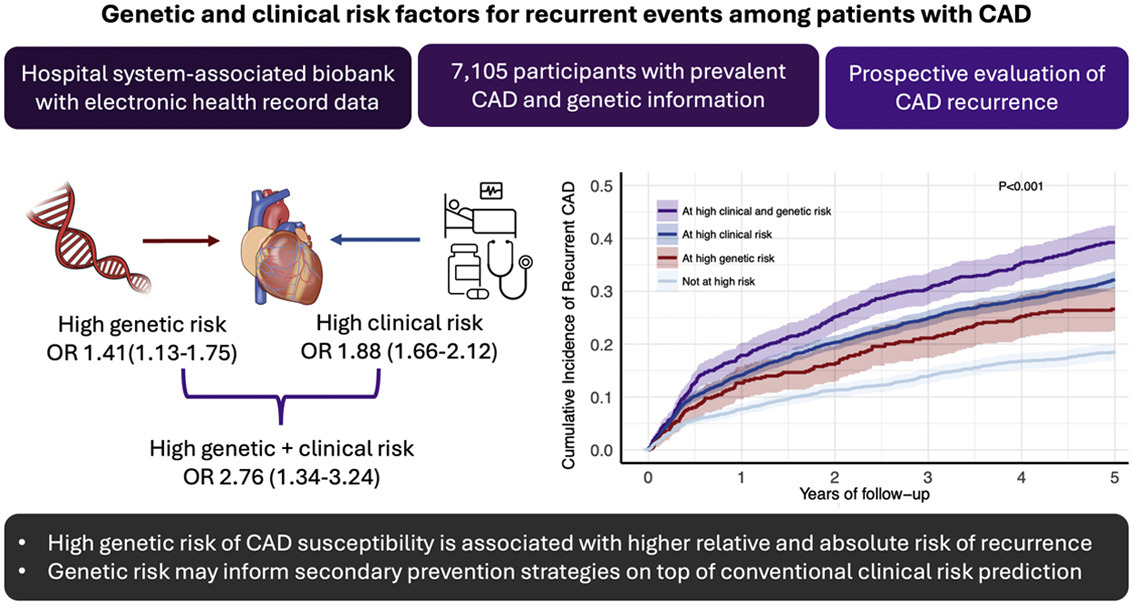
New article available in AJPC! "Genetic and clinical risk factors for recurrent events among patients with coronary artery disease."
Read Here: https://t.co/U8nV3zj7ir
#CardiologyResearch#AJPC#PreventiveCardiology
🏥 Women with type 2 #diabetes and ASCVD are more likely to be prescribed a #GLP1 than men, whereas men are more likely to be prescribed an SGLT2 inhibitor than women.
Learn more about these findings published in @AJPCardio ⬇️
@CardiologyToday
https://t.co/G7FR6MLbq2
💊 Most adults with type 2 #diabetes and ASCVD are not being prescribed SGLT2 inhibitors or GLP-1 receptor agonists, and sex disparities exist among those who were prescribed the medications.
Read more about this @AJPCardio study👇
@CardiologyToday
https://t.co/NestqBYID0
We Learned This Lesson with LDL-Cholesterol Decades Ago. Lp(a) Is Teaching It Again.
We've drawn lipid panels on hospital admission for decades — because cholesterol values become unreliable once inflammation kicks in after a heart attack. New data suggest #Lp(a), a powerful genetic risk factor, follows a strikingly similar pattern — just in reverse. My new #editorial with @DrNathanWong in @AJPCardio what that means for testing in the acute setting. 7 takeaways:
Editorial https://t.co/rYG4SZ3msy
Paper: https://t.co/eLXyiNZfnW
1. Lp(a) moves the opposite direction from other lipids after a heart attack. #LDL cholesterol famously drops in the days following an acute event. Lp(a) does the reverse — it rises, and stays elevated for months.
2. The #elevation isn't brief. This isn't a short-lived spike. Levels remain meaningfully above baseline for the better part of a year — long after most patients have left the hospital.
3. #Timing changes what the number means, and that has real stakes. A test drawn months later, at a routine follow-up, likely overstates a patient's true steady-state risk. Guidelines attach real clinical consequences to elevated Lp(a) — get the timing wrong, and a patient can be over- or under-treated based on a number that was never their true baseline.
4. The #parallel to lipid testing isn't coincidental. The same logic that put lipid panels into admission order sets — capture the value before physiology distorts it — applies here too, just inverted.
5. Not everyone needs #retesting, but some do. Patients with clearly low or clearly high levels tend to stay there. It's the intermediate group, near the clinical threshold, who are most likely to be reclassified — and who benefit most from a second look.
6. #Admission is a narrow, closing window. Testing during the hospital stay captures this genetic risk marker before the patient disperses into outpatient care, where screening habits and awareness vary widely between providers.
7. The #surge might not just be a marker — it might be part of the mechanism. Is the early spike in Lp(a) simply reflecting risk after ACS, or actively contributing to why that first week is so dangerous? The current data couldn't settle it — the authors say their study was underpowered to detect a link, not that one doesn't exist. Larger studies are needed.
#Bottomline: A single Lp(a) measurement, drawn at the wrong time, can mislead. Testing at admission — mirroring long-established lipid practice — may be the most reliable way to capture this risk marker before it drifts. As with LDL a generation ago, formalizing that practice — potentially as a tracked performance measure — could be what finally moves testing rates.
@khurramn1
#Cardiology #Lipoproteina #ACS #PreventiveCardiology #Dyslipidemia #CardiovascularHealth
Menopause hormone therapy and heart health: what does the evidence actually say?
@DrMarthaGulati shares an important nuance for PCPs and cardiologists: hormone therapy hasn't been shown to protect against heart disease, even though that's sometimes the message patients hear. The real takeaway is about risk assessment. For women at low cardiovascular risk, hormone therapy for menopause symptoms is often a reasonable option. But it's worth being clear about what it can and can't do.
Want to go deeper on women's cardiovascular health? Join us this Saturday, September 12, for our 1st Annual Virtual Symposium on Women's Cardiovascular Health and Prevention, an evidence-based update on risk assessment, imaging, lipids, cardiometabolic health, and more.
Register: https://t.co/TsNjpLsOgr
#MenopauseMatters #WomensHeartHealth #CardiovascularHealth #Cardiology #PreventiveCardiology #ASPC @YulithRoca
New article this month in AJPC, "Age and sex specific coronary plaque characteristics among South Asians: Insights from the DILWALE CTA study."
Read here: https://t.co/rC4tyHULAg
#CardiologyResearch#HeartHealth#AJPC#PreventiveCardiology
Looking forward to seeing the full results. Lots to still learn and unpack..
Topline results announced: Lp(a)Horizon did not meet primary endpoint
https://t.co/rMX6ILFrCX
🎉 Happy 96th Birthday, Dr. @NanetteWenger! 🎉
Today, we celebrate the remarkable life and legacy of Dr. Nanette Wenger, a true pioneer in cardiovascular medicine and an enduring champion for women’s heart health.
For decades, Dr. Wenger has inspired generations of physicians, researchers, and advocates through her groundbreaking work, leadership, and unwavering commitment to advancing cardiovascular care.
Please join us in wishing Dr. Wenger a very happy birthday and celebrating an extraordinary career dedicated to improving the heart health of countless patients.
Novartis announces Lp(a)HORIZON Phase III topline results
“did not meet its primary endpoint”
There will be a lot to unpack here https://t.co/UBfd8miBXC