When I was in high school, my Dad was fired from his corporate job in Kansas City. It was a bad breakup. He was told by recruiters no one would hire him ever again. He was scared but kept going mostly because he had no choice. He had two kids (my sister and me- both of us adopted from South Korea) and a 13 percent mortgage on the home my 75 year old mother still lives in today.
A banker friend alerted him of a few one hour photo labs in Wichita, Kansas. The business was on the verge of bankruptcy and needed a major capex upgrade. Seeing an opportunity with no job offers on the horizon, my father agreed to buy the businesses basically for a song and financed the needed capex upgrade with a bank loan from the bank. The bank didn’t want to run the business and saw someone willing to try to grow the business back to health.
For 5 years, my dad drove 3 hours each way from Kansas City to Wichita 3 days a week. 5am he would leave and arrive in Wichita around 830am. In the evenings he would try to be home by 8pm dinner.
Despite the brutal schedule, he made almost all of my varsity soccer games in high school and club soccer games on the weekends. USA Cup in Blaine, Minnesota? Sun Bowl in Tampa, Florida? Blue Chip College Showcase in Cincinnati? Regionals in Indianapolis? He was there for all those tournaments.
My dad ended up selling the photo labs after 5 years because he saw long term technology risk to the business (this was well before the iPhone) and was fatigued chasing Boeing to pay their invoices.
He was now in his 50s and never really worked again despite trying to find another W2 (zero offers) and failing to find another business to buy. Ageism was a Herculean hurdle for him even 20 years ago. Luckily my mom’s single income and a paid off mortgage and consistent savings was enough for my mom to be in a strong financial situation today after he passed from cancer about a year ago.
13 pct mortgage, a corporate career that threw him to the curb, a brutal commute for 5 years (6 hours a day, 3 days a week) and job market that rejected him after he sold the photo business. Not fun. He never complained. Ever. I would have complained.
I complain weekly (ask my wife and daughter). Right now I’m frustrated with the order book.
Today I looked online to see if Picture Perfect in Wichita was still in business today. Incredibly it is lol (picture below).
I miss my dad terribly - Thanksgiving was his favorite holiday. Today is a reminder for me how lucky I am (I mean I was in an orphanage in South Korea age 3 before being adopted - talk about hitting the jack pot!)
It’s embarrassing in some ways how good most of us have it. 7 pct mortgage rates, stock market not far off from all time highs, super computers on our phones, self driving cars, etc => my father had none of these at my age.
Going forward this holiday will be my reminder to myself to stop being a snowflake. Being healthy and being able to feed my family is absolutely winning. Wishing everybody a wonderful holiday. Go Chiefs!
En España, muchos servicios públicos afrontan este incremento exponencial en la demanda inducido por la IA con los presupuestos prorrogados desde 2023.
Vamos a flipar. 😃
¿Vosotros también lo habéis notado?
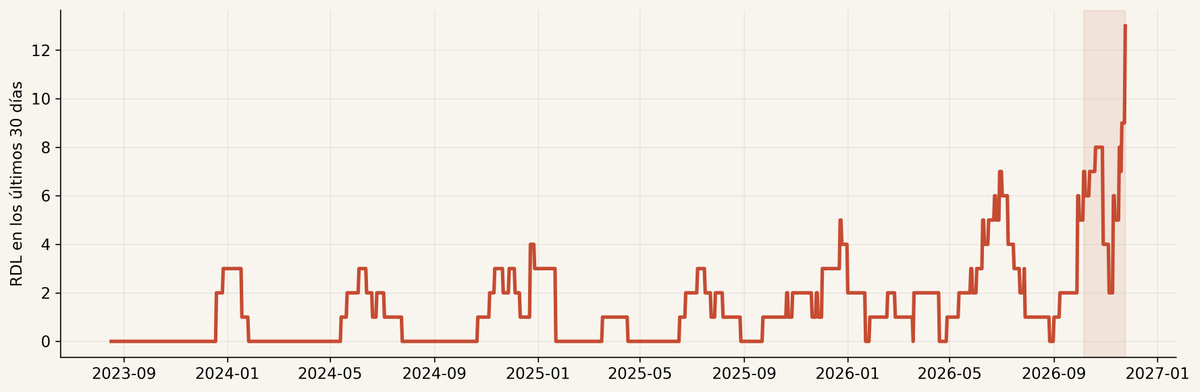
Me he montado un script para peinar todos los Consejos de Ministros desde el inicio de la legislatura y analizar la evolución de la producción normativa del Gobierno.
El gráfico muestra el número de reales decretos-leyes aprobados en ventanas móviles de 30 días.
Desde la disolución de las Cortes, en apenas 50 días:
🔸17 decretos-leyes, frente a los 48 de toda la legislatura.
🔸Una frecuencia de aprobación por Consejo de Ministros 5,75 veces superior.
🔸Un máximo de 13 decretos-leyes en 30 días.
Aquí los datos, vuestras las conclusiones
Cada cierto tiempo es habitual leer que la subida del SMI no destruye empleo porque en estos últimos años España lo ha subido y ha mejorado las cifras de su mercado laboral.
Vayamos al año 2019. En 2019 el salario mínimo subió un 22,3% y se crearon 400.000 empleos. Para algunos, caso cerrado.
Tres estudios con registros de la Seguridad Social, incluido uno encargado por el Ministerio de Trabajo, encuentran un coste en empleo concentrado en los trabajadores y negocios más vulnerables.
Correlación frente a causalidad, en este vídeo 👇
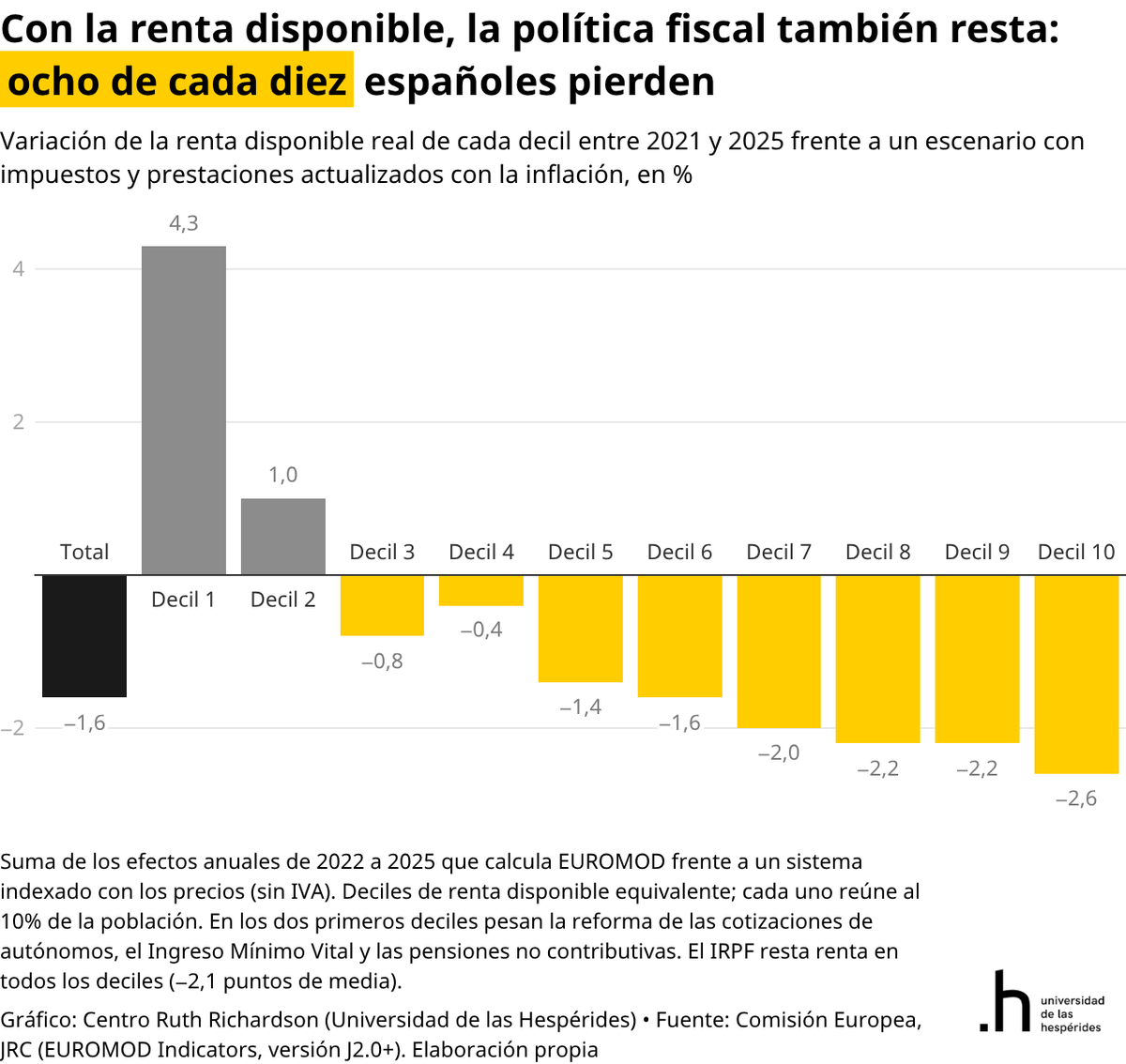
Durante años, la caída del salario medio sirvió para hablar de devaluación salarial, aunque parte se debía al efecto composición. Ahora que el salario neto real no crece, se propone mirar la renta disponible de los hogares, con pensiones y prestaciones incluidas.
Entre 2021 y 2025, impuestos y prestaciones han restado un 1,6% de renta disponible real frente a un sistema actualizado con la inflación. Pierden ocho de cada diez españoles.
Se puede mover la portería, pero la progresividad en frío sigue marcando gol.
"Tengo las rodillas despellejadas de mirar tanto debajo del coche", dijo Ernest Lluch en septiembre de 2000. #ETA lo mató a tiros dos meses después #TalDiaComoHoy.
#Vivirsabiendoquetevanamatar#Memoriareciente
¿Me ayudas a recordarle? Si lo hacemos seguirán viviendo en nuestra #Memoria
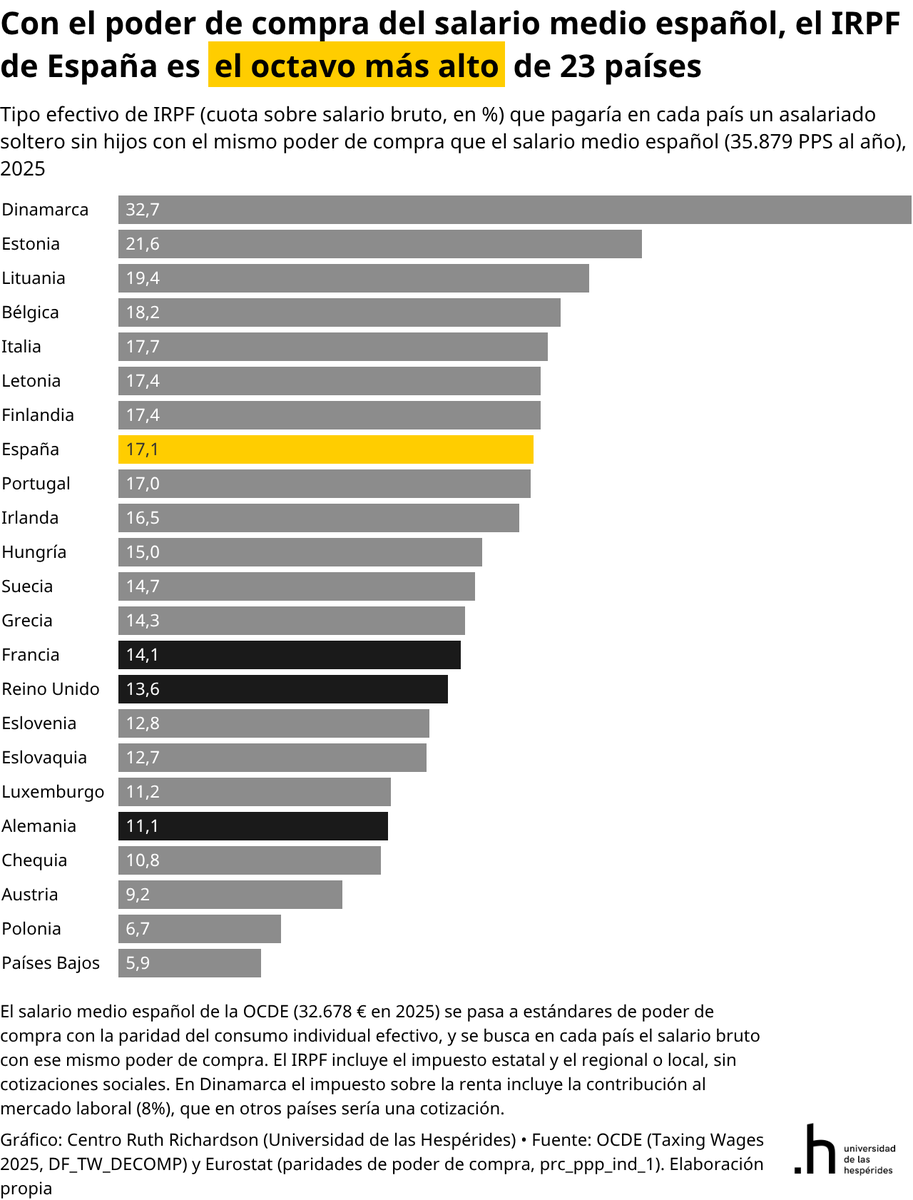
Comparar el IRPF entre países tiene una trampa. El salario medio alemán compra 1,7 veces más que el español, así que su tipo efectivo no se puede comparar con el nuestro sin más.
He tomado el salario medio español de 2025 (32.678 €, según la OCDE), lo he pasado a poder de compra (35.879 PPS) y he buscado en cada país el salario que compra exactamente lo mismo.
¿Qué muestra? El tipo efectivo de IRPF que pagaría ese mismo trabajador, soltero y sin hijos, en 23 países europeos.
España aplica un 17,1%, el octavo más alto. Francia se queda en el 14,1%, Reino Unido en el 13,6%, Alemania en el 11,1% y Países Bajos en el 5,9%.
Con el mismo poder de compra, un trabajador medio español paga en IRPF seis puntos más que en Alemania.
La idea es de @Jongonzlz, que lo hizo con España, Alemania, Francia y Reino Unido. Aquí la amplío a 23 países.
Guys, this is very serious and you have to read this right now. The Riemann Hypothesis may have just been solved, and if the claim holds, it's an insane achievement.
In mathematics there is a famous problem called the Riemann Hypothesis, and it's about prime numbers. Primes are numbers like 2, 3, 5 and 7 that can only be divided by 1 and themselves. Every other number is built by multiplying them together, so they're the building blocks of all numbers. You can never tell exactly where the next prime will show up, but if you step back, there's a pattern.
Around 1,000, about 1 in 7 numbers is prime. Around a million, about 1 in 14. Around a billion, about 1 in 21. Primes get rarer at a steady, predictable pace.
Because of that pattern, mathematicians can estimate how many primes there are below any number. But the estimate is never exactly right. It's always a little off, and the big question is how far off it can get. Think of flipping a coin 1,000 times. You expect 500 heads, but you'll get something like 480 or 520. It's a little off, but never wildly, and you can predict how far off it will be.
In 1859 a mathematician named Bernhard Riemann found that the prime estimate's error isn't random. It's controlled by a hidden set of special numbers. Where those numbers sit decides how big the error gets. Riemann guessed that every single one of them sits on one straight line. If he's right, the error always stays small, just like the coin, and primes are as orderly as they could possibly be. If even one of those numbers is off the line, the error can grow much bigger, and primes are far messier than we think.
So far computers have found trillions of these special numbers, and every single one is on the line. But there are infinitely many, so checking will never be enough. You need a proof that covers all of them at once. For 167 years nobody has found one. It's one of the seven hardest unsolved problems in mathematics, with a million dollar prize attached.
Now a mathematician has posted a note saying that, working with Claude, he believes he has that proof. He says a computer has already checked every step, and that Claude raced ahead of him near the end. Experts still need to confirm it, but this isn't a random internet claim.
If it holds, it doesn't mean we can predict every prime. It means we finally know the pattern can never go wildly wrong. Thousands of math papers that begin "assuming the Riemann Hypothesis is true" become proven fact overnight. We'd also get firm limits on how far apart primes can be, and a guarantee that a fast method for testing whether a huge number is prime always works. And no, your bank account isn't in danger. Online security depends on how hard it is to break a huge number into its prime factors, and this proof doesn't make that any easier. If anything, it gives the math behind encryption a stronger foundation.
If it holds, this is bigger than one math problem. A question that beat the greatest minds in history for 167 years would have been cracked by a human and an AI in a matter of weeks. If AI can find answers and computers can check them, the limit on science is no longer how smart we are. It's how many good questions we can ask.
Cuando comparamos cuánto IRPF se paga en distintos países nos solemos encontrar dos problemas: ni los salarios son iguales ni el coste de la vida es el mismo.
Además, el IRPF es progresivo: cuanto más cobras, más porcentaje de tu renta pagas.
Por eso, comparar el tipo efectivo del trabajador medio de cada país puede resultar engañoso. No estamos comparando trabajadores con la misma capacidad adquisitiva.
Para intentar resolverlo, he construido este gráfico que combina datos de Eurostat y la OCDE.
¿Qué muestra?
El eje horizontal representa el salario bruto anual ajustado por paridad de poder adquisitivo (PPA). El vertical, el porcentaje del salario que se paga en IRPF. Los rombos indican el salario medio de cada país, también expresado en poder adquisitivo comparable.
¿Qué descubrimos al comparar España, Alemania, Francia y Reino Unido?
Resulta que, a mismo poder adquisitivo del salario, España tiene tipos efectivos del IRPF superiores a los tres países en prácticamente todo el rango de salarios.
Por ejemplo, si fijamos un salario de 40.000 PPS, el tipo de España es del 18,2%, frente al 15,5% de Francia, un 14,3% en Reino Unido, y un 12,3% en Alemania.
Y otra cosa que se ve en la gráfica es que, a pesar de que el salario medio en Alemania tiene casi el doble de poder adquisitivo que el de España, tiene prácticamente el mismo tipo de IRPF (17,2%).
Why did Spain fall behind Western Europe during the early stages of industrialization?
Our new paper with Eduard Alvarez-Palau and @HennebergJordi in Explorations in Economic History argues that a big part of the answer lies in transport and geography👇 #EconHistory
Cómo se echan de menos películas del estilo de La Princesa Prometida (1987)
Aventura, romance, comedia y fantasía combinado a la perfección.
Y lo bien que ha envejecido… MÁGICA
Comprobado. Con la última actualización de los parámetros del IRPF y un año más sin deflactar, TODOS los salarios por encima del SMI seguirán pagando más IRPF en 2027 que en 2019.
Y todos los que están por debajo del SMI pagarán más (por el MEI).