🔥 Just published in @MSKPhysioJnl
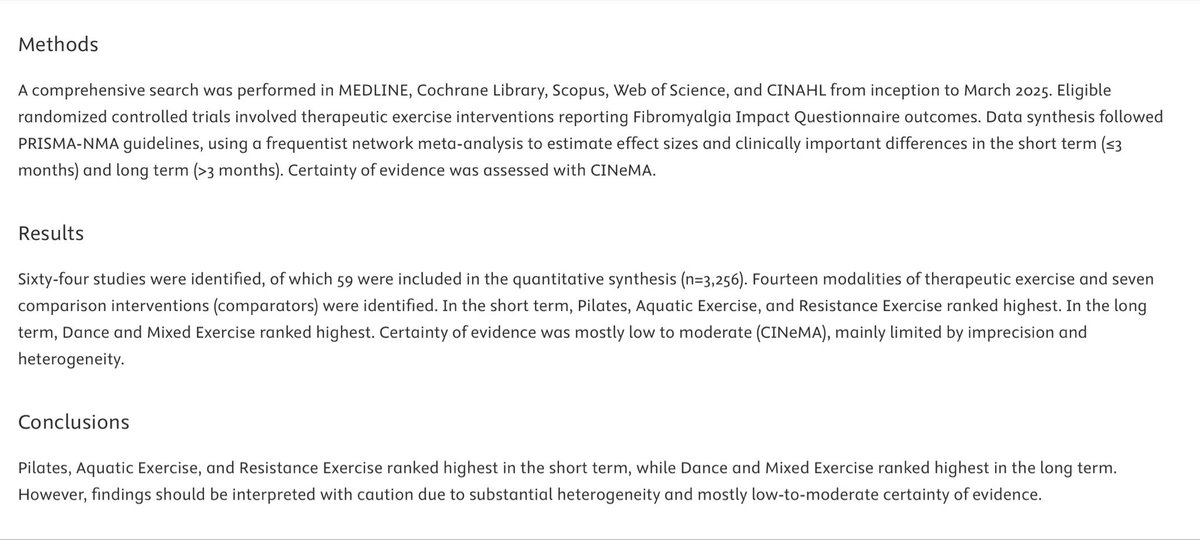
"Which exercise is most beneficial for treating women with fibromyalgia? A systematic review and network meta-analysis"
🔓OPEN ACCESS: https: https://t.co/CzDeM0ZJLT
If exercise is “MEDICINE” for fibromyalgia then which type, should we prescribe?
The message is clear. There is no single “BEST” exercise. Instead, the optimal choice may depend on timing, patient preference, and long-term adherence. Notably, modalities such as dance may offer additional benefits through enjoyment, social engagement, and sustainability.
However, clinicians should interpret these rankings cautiously, as evidence certainty remains low to moderate and heterogeneous. This paper reinforces a key principle in rehabilitation. Exercise selection should be individualised, meaningful, and sustainable, rather than protocol driven.
#Exercise therapy #Fibromyalgia #Fibromyalgia impact questionnaire #Pain
Read more here: https://t.co/GpzXOODS6M
Just published 🔥
"Effects of pain neuroscience education plus resistance training on pain, disability, and sensitization in women with fibromyalgia syndrome: A randomized controlled trial"
🔓 OPEN ACCESS: https://t.co/aQ2ZJ9uc7b
@nirit_rotem@MSKPhysioJnl Thanks for your comment. The goal wasn’t to find “the best exercise.” I agree there’s no single best option for a complex condition. We simply examined whether any modality showed greater effects on FIQ. In fact, that’s exactly what we found: none is “the best.” Best regard! 🙂
🔥 Just published in @MSKPhysioJnl
"Which exercise is most beneficial for treating women with fibromyalgia? A systematic review and network meta-analysis"
🔓OPEN ACCESS: https: https://t.co/CzDeM0ZJLT
Which exercise is most beneficial for treating women with fibromyalgia? A systematic review and network meta-analysis.
https://t.co/IIbs7nEUhR
Pilates,Aquatic Exercise,& Resistance Exercise ranked highest in the short term,while Dance & Mixed Exercise, highest in the long term.
Which exercise is most beneficial for treating women with fibromyalgia? A systematic review and network meta-analysis. - Musculoskeletal Science & Practice https://t.co/whW33F7LZn
@Retlouping Actually, the "moderate" level of evidence is quite high considering that the nature of active interventions does not allow for blinding of the therapist and patient. Therefore, physical exercise studies can NEVER have "strong" evidence. Best regards!
@Retlouping I have no conflict of interest with the study's results, but suggesting that the results are "overestimated" due to an incorrect and superficial reading of the study doesn't seem right to me
😍BARBELLS FOR BACK PAIN😍
Huge bias stroking time… a new systematic review confirms what many of us already know:
Resistance training helps many with chronic low back pain!
✅ Less pain
✅ Less disability
✅ Better quality of life
https://t.co/zZiSgxu5u5
And yes I’m aware that not all the results reached clinical significance and the other limitations of this review
And yes I know its not going to work well with everyone, and not on its own without education and empowerment!
But its a damn sight better than ‘laser-guided electro-dry needling or ‘functional postural realignment therapy’ thats for sure!
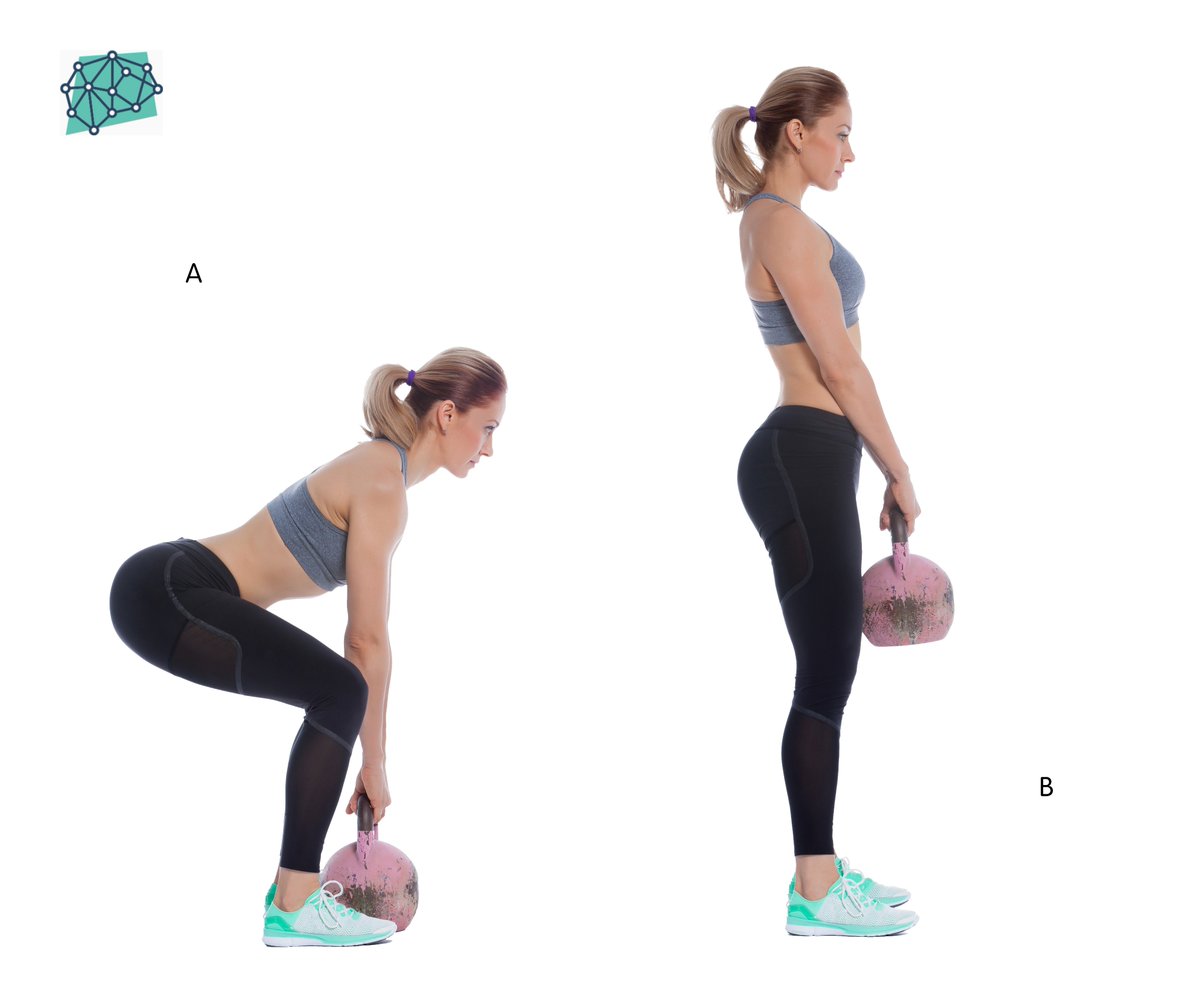
Less massages and manips… more kettlebells and bands!
¿Eres profesional de la salud y trabajas con pacientes con dolor crónico? Como sabes, el Ejercicio terapéutico es una herramienta fundamental y en esta jornada te daremos las claves para su correcta prescripción.
Únete al Webinar Online de la I Jornada del Grupo de Trabajo de Fisioterapia y Dolor de la SED.
"Prescripción de Ejercicio Terapéutico en Pacientes con Dolor Crónico"
➡️ 13 NOVIEMBRE 2025 ➡️ De 9:00h a 19:00h
👉 Inscripción grauita en https://t.co/rRdt6dFe3v (link en bio)
#FisioterapiayDolorGTSED25
Does resistance training improve pain intensity, quality of life, and disability in people with chronic nonspecific low back pain? A systematic review and meta-analysis
https://t.co/ORoVSJKdnp
🧠 En resumen:
El entrenamiento de fuerza reduce el dolor y la discapacidad en el dolor lumbar crónico inespecífico con evidencia moderada.
🎯 Es una intervención eficaz, segura y de alto valor clínico.
Si deseas acceso al texto completo, comparte este hilo y escríbeme por MD.
El dolor lumbar crónico inespecífico #CLBP es una de las principales causas de discapacidad en todo el mundo 🌍
Sabemos que el ejercicio terapéutico se recomienda como primera línea de tto, pero… ¿Qué modalidad es más eficaz?
🧵
💪 Recomendaciones para la prescripción de ejercicio:
2–3 sesiones/semana × ≥12 semanas
4–6 ejercicios (sentadilla, peso muerto, planchas, remos, crunch, extensiones de espalda)
2–3 series de 10–20 repeticiones a 30–40% 1RM