The quinoa boom boosted farmers' incomes but also made quinoa unaffordable for many poorer households who relied on it as a staple. With 1/3 of global population priced out of healthy diets, reducing their cost requires both supply- and demand-side action, sequenced correctly.
The #SOFI2026 report's projections incorporate the expected impact of the Strait of Hormuz crisis. Fertilizer shortages are jeopardizing harvests, and impacts could follow within 3-6 months. El Niño could intensify them. SOFI 2026 is out on 21 July. https://t.co/SWpTKuwT5P
Three years of progress against hunger is encouraging. But the recovery is fragile under pressure of compound shocks like geopolitical fracture and weather extremes. Building resilient agrifood systems is essential to protecting the gains. #SOFI2026
https://t.co/XQdb45792c
ODA remains an essential source of financing. But future progress will depend on countries’ ability to mobilize private investment and other sources of capital. My conversation with @DaniNierenberg
https://t.co/EWYulZvYIH
75% of what consumers pay for food is added after it leaves the farm. So why do governments continue to focus only on what happens on the farm? Shifting focus from production to value chains will reduce losses, strengthen markets, and lower the cost of healthy diets. #SOFI2026
El Niño is no longer just a climate risk but a macroeconomic one, driving higher food prices and inflation. Combined with disruptions to energy and fertilizer markets from the Middle East conflict, it could become a major risk multiplier for global food security.
Agriculture's future growth will come from greater efficiency, not higher prices. That means productivity must also be resilient -- through better data, smarter diagnostics, precision agriculture & resilient trade systems. #AgOutlook
https://t.co/ZoWQDPgNxn
La lección fundamental del cierre del estrecho de #Ormuz: la agricultura sigue siendo peligrosamente vulnerable a las alteraciones en las cadenas de suministro de fertilizantes
✍️@MaximoTorero
https://t.co/UwQInKxFzU
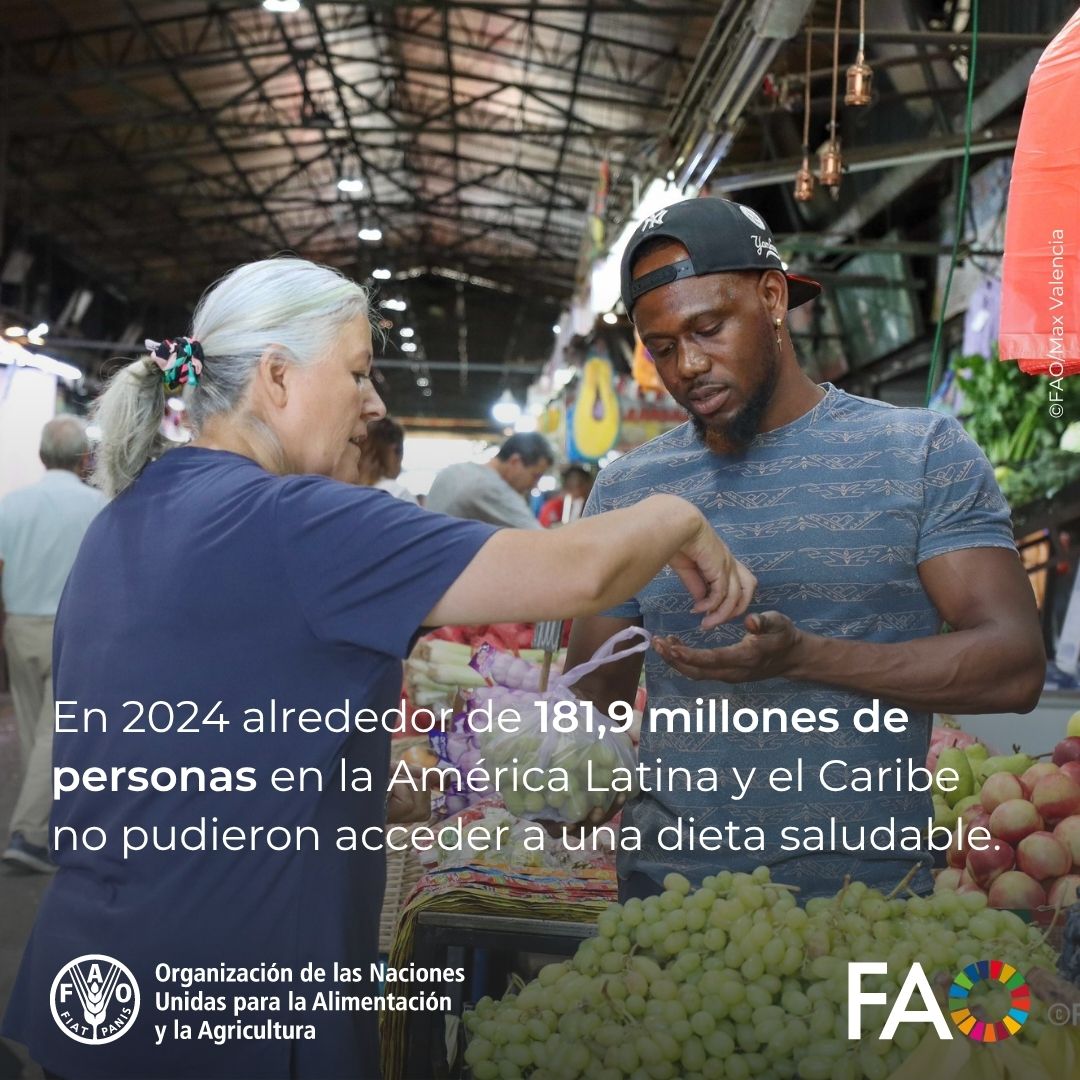
💸¿Por qué comer saludable sigue siendo un desafío para América Latina y el Caribe? 🥦
Aunque el hambre ha disminuido en los últimos años en la región, millones de personas aún no pueden acceder a una dieta saludable.
Descubre cuál es la causa👇
https://t.co/e5VsnNMTRL
Fertilizer supply disruptions linked to the Middle East conflict are pushing countries to make fertilizer security a strategic priority, @FAO analysis shows. The challenge is to manage shortages while building resilience through targeted, temporary measures and innovation.
The Gulf is not only an energy hub. It's also a major remittance hub. In 2024, remittances to developing countries reached $685 billion, supporting nearly one billion people. Prolonged instability could weaken these flows, with consequences for food security and livelihoods.
The Strait of Hormuz crisis echoes 2007-08, when overlapping shocks combined with biofuel mandates amplified food price inflation. Today, with fertilizer markets under pressure, protecting food production must come first. https://t.co/EbH54jQAvA
Food security still depends on fossil fuels. Millions of farmers rely on diesel irrigation, and fertilizer production depends on natural gas. Clean energy investments can help build more resilient agrifood systems.
https://t.co/C2kkIUZd2R
The Strait of Hormuz crisis is the latest reminder that as shocks become the norm, countries must build resilience rather than respond to each crisis in isolation. My latest in @wef: https://t.co/MeRExTHGmq
"Nos estamos encaminando hacia una crisis alimentaria para fines de este año y el próximo” @MaximoTorero
Hoy en el @elcomercio_peru
Lee la entrevista aquí: https://t.co/TsboEwtPtg
Our agrifood systems produce enough calories but not enough nutrition. Unhealthy foods are cheap b/c their real costs are not included; healthy foods remain under-supported. This episode explains how @FAO helps make healthy foods accessible for everyone.
https://t.co/V5RYA06YU4
[Opinion] #IranWar: The #Hormuz crisis is not Covid. #Europe must avoid blanket subsidies. Subsidising the shock and waiting for it to pass will not answer a crisis whose full impact still is not visible. By @MaximoTorero | Euractiv
https://t.co/bjvHOyGyZ1
We are 6-12 months away from a potential food crisis, and the decisions being made now will determine how severe it becomes. Watch our full policy recommendations to prevent a food crisis: https://t.co/eJFmPirP2m
Farmers are already making decisions based on higher energy and fertilizer costs, which means lower future food supply and higher prices. I spoke with @npratc about how #StraitOfHormuz blockade is setting the stage for a food crisis within 6-12 months.
https://t.co/Qbz0DSWOof
Infrastructure is not only about growth. Recent crises have shown it also determines resilience. Diversified ports, stronger logistics, and cleaner rural energy are not only investments in development but keep agrifood systems functioning when shocks hit. https://t.co/iFJ7YS8CBc