✍️ Architecture Decisions.
Today we're researching some new design decisions, and plan out a path forward for the Cantor upgrade.
Cantor will bring monitoring and some incentivized testnet set features.
Following on from my previous post about AI security risks across both crypto and Web2, the recent discussion around $ZEC vulnerabilities has also brought my attention back to quantum-resistant blockchains.
As advances in AI and quantum computing continue to accelerate, the long-term security assumptions underpinning many existing blockchain networks will inevitably come under greater scrutiny. That conversation will be huge over the next couple of years and eyes will drift towards projects building with post-quantum security in mind from day one.
One such project I’ve mentioned plenty of times is @Asentum ($ASE), which is developing a quantum-resistant Layer 1 designed to address the emerging threats posed by future quantum capabilities, rather than attempting to retrofit solutions later…
Front run the meta.
https://t.co/JuzsPIJ8vl
Asentum Operator just updated to v0.5.10 today which included some hotfixes on the previous version release ⚡️
Every validator that comes online accelerates what we're building. No datacenter. No technical background. Just download and sync.
👉 https://t.co/JdGJqRNV9l
Today marked the beginning 🪜
$ASE launched, the community rallied, and the network held. Everything we've built to this point was to get here.
Now we build what comes next.
We change the game and bring DeFi back. We front run the entire industry. Join us 👇
Ethereum just got a glimpse of its future.
$ASE Is LIVE.
And this doesn’t feel like the usual “new L1 hype cycle” everyone scrolls past anymore
@Asentum is going after something most chains are not even ready to think about yet:
Quantum computing security.
While most networks will need heavy upgrades later, Asentum was built from genesis with post quantum architecture already in place.
That alone changes the conversation.
Then you add JavaScript smart contracts
And validators that can run on consumer-grade hardware
It starts to feel less like “another chain” and more like a different direction for blockchain entirely.
Lower barrier for builders. Lower barrier for validators. Higher barrier for failure.
$ASE TGE went live today at 5PM UTC.
This is one of those ones you either catch early or you end up explaining later why you didn’t, I’m not fading this one.
CA: 0x041Ff0E49F6F774E7DC7bD10Ee4A14c00B1D80B2
$ASE is officially live on Ethereum 🚀
Quantum-safe from block zero. Original code. Real validators. Real network.
⏬ Official Contract information ⏬
https://t.co/cUUfYYWO16
The wait is over, join the blockchain built to last. Direct links below 👇
5 hours until $ASE is live on Uniswap ⚡️
Have your Web3 wallet ready. Presale holders — your tokens are claimable at https://t.co/Abe5bhT2aK
Contract is public and CertiK audited. No surprises.
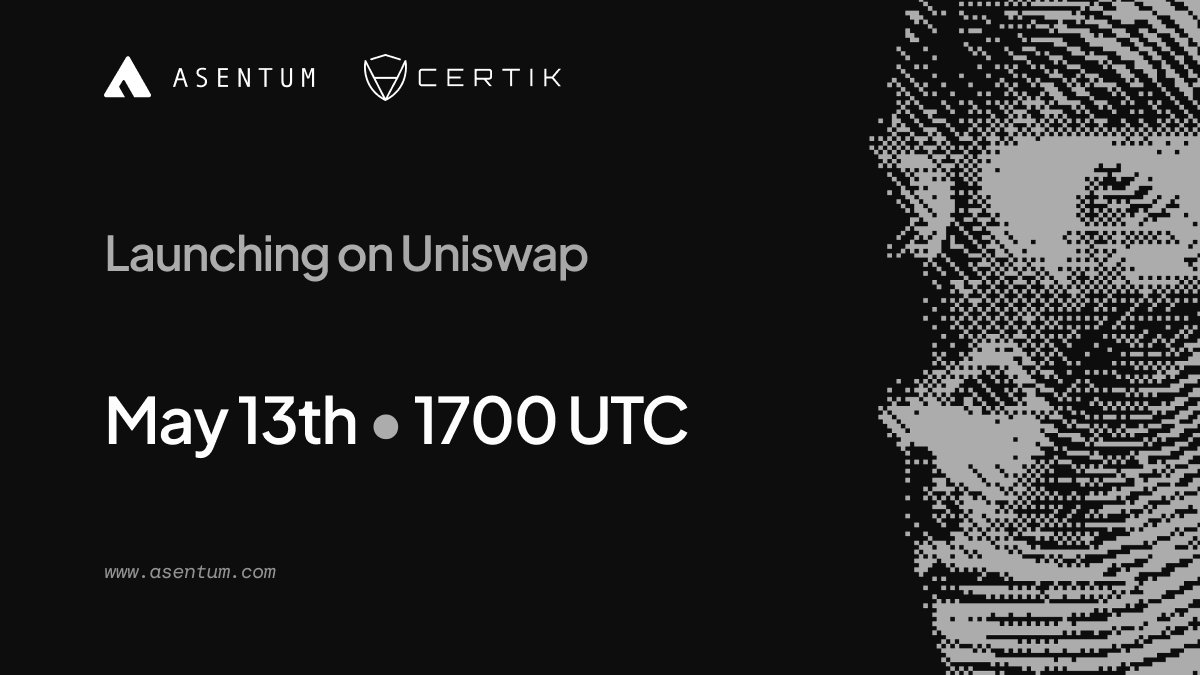
17:00 UTC today 👉 https://t.co/ZA0ALcGN21
Excited to see #Asentum launch today a new L1 blockchain focused on quantum resistance, JavaScript smart contracts, and lightweight validation that can run on a basic laptop.
Why it’s interesting:
- JavaScript smart contracts dramatically lower the barrier for developers. Instead of learning Solidity or Rust, millions of existing web developers could build using a language they already know.
- Quantum resistance creates a compelling long-term narrative as advances in quantum computing continue to raise concerns around current cryptographic standards.
- Laptop-based validation pushes accessibility and decentralization further, allowing far more users to participate in securing the network without specialized hardware. For instance to become a validator on $SOL you would need around $5000 minimum worth of hardware.
The broader thesis is familiar: the biggest winners in crypto are often the projects that make onboarding developers and users materially easier.
Most new L1s struggle to gain meaningful traction but the few that successfully simplify adoption can become major outliers and surge into the billions.
@Asentum $ASE
If you're just finding Asentum - welcome 👋
Get into our Telegram, meet the community, and mark your calendar.
📅 $ASE launches May 13th · 17:00 UTC
💬 https://t.co/nY8F0dJcKK
Solidity has ~25,000 developers
Rust has ~2M developers
JavaScript has 26 million ++
Asentum speaks their language.
Here's how we expand the blockchain developer pool by 1000x 👇
https://t.co/wxkEWRT4AZ
Let's talk about how the Asentum validator network actually works.
~100 validators. BFT consensus. 5s blocks. No reorgs. Ever.
Two tiers: top 50 by stake get a guaranteed slot, the other 50 rotate in randomly every 4 hours. All on-chain. Nobody controls it.
Every chain will need to go quantum-safe eventually.
Asentum already is... from block 0.
🔐 Post-quantum L1 | Live testnet | JS Smart Contracts
🚫 No KYC | 100 ETH hard cap
$ASE presale closing soon 👉 https://t.co/jYDB72O2d2
@davidgokhshtein Discipline hits different when you’re actually positioned right. $AMPS keeps you exposed with amplification so you’re in those moves while you focus elsewhere.