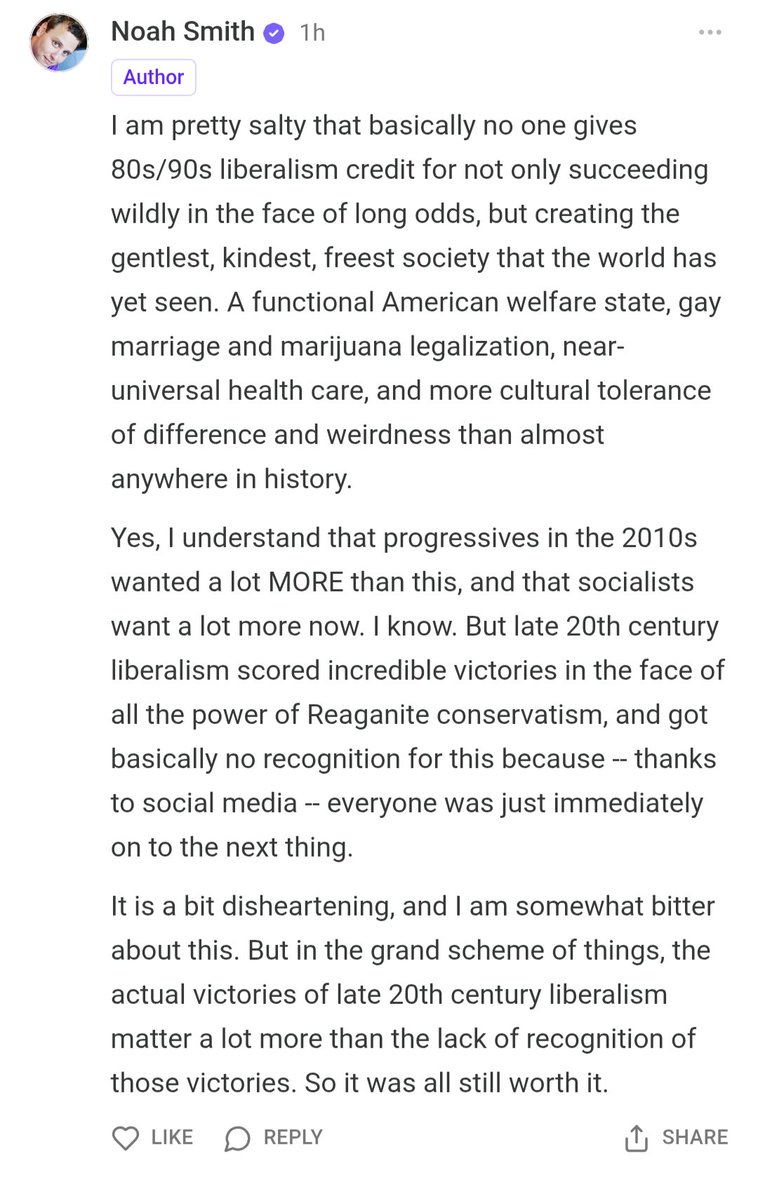
Are national wealth taxes worthy of debate and consideration in a hypothetical country with America's levels of deficit and inequality? Yes.
Are they legal under the US Constitution without an amendment? I do not think so.
So if you're legislative agenda is "I want to do the following 20 things and bank on a national wealth tax to pay for it," I'm worried that your actual plan is to spend several trillion dollars, have your entire tax plan wiped out by the Supreme Court in 18 months, and wind up with WWII-era deficits during a growth period with elevated interest rates, which is going to increase the cost of money and make everything even less affordable.
And that is ... not an affordability agenda.
@mattyglesias Ever since the 2000s era Bush tax cuts, feel like politicians have started treating taxes as a tool to punish people we don't like rather than a necessary social contract for the services we want.
I think a lot of ambitious young people would be shocked how far ahead of your peers you can get just by doing the reading.
Remember how much we talked about Project 2025? How many people do you think *actually read it*. Like six? Maybe seven?
All you'd have to do is just sit down and commit to reading a long, boring document and you would have instantly become one of the ten most qualified experts in the country on Project 2025. There was literally nothing standing in your way.
AFAIK this is how @ezraklein got started, reading boring reports from the CBO or whoever that no other wonks would bother to read - and thus becoming smarter than 98% of the chattering class by default.
Guy who was hoping for a factory revival that didn’t use any water or electricity or involve the construction of anything unsightly or that makes noise.
Taiwan solved tax evasion in 1951 with a trick so cheap it should embarrass every tax authority on the planet.
The problem was an all-cash economy full of small shops. A merchant pockets the cash, skips the receipt, and the sale never existed. Auditors can't catch what was never recorded, and hiring enough of them to watch every noodle stand costs more than the missing tax.
So finance chief Ren Xianqun flipped the incentive. Print a lottery number on every receipt. Draw winners every two months on live TV. Top prize today: NT$10 million, about $310K.
Suddenly the customer and the shopkeeper want opposite things. The merchant wants the sale off the books. The customer wants the ticket. And there are millions more customers than merchants. Every transaction now carries a built-in witness demanding the paper trail.
Year one, reported tax revenue jumped 75%, from NT$29 million to NT$51 million. Seventy-five years later, roughly 70% of Taiwanese still play. Convenience stores redeem the smallest NT$200 prizes at the register, so even a coffee receipt feels like a scratch card.
The elegant part is what the audit force costs. The prize pool runs about NT$7 billion a year, roughly $20 million. In exchange, the government gets 23 million unpaid auditors working every checkout line in the country, forever. No inspector general on earth delivers that coverage at that price.
Greece, Italy, Portugal, and Slovakia all copied it. The most effective compliance tool ever built looks like a game, and that's exactly why it works.
@aakashgupta Sure, but shoudn’t we be able to afford the bars increase out of the TV decrease? Baumol is an incredible economist and had this amazing observation but I think Henry George found the real culprit here (at least in the Anglosphere).
Land value tax would fix this.
I’ve always found people who bristle at “American exceptionalism” kind of… weird. Not because I lack self-awareness — I’ve spent my career cataloging every way this country fails to live up to its own rules. But that’s exactly why I love it so damn much. We built a system designed to be shamed by its own founding documents, and it still delivered one of the most spectacular, world-altering runs in human history. A genuine force for human flourishing.
I also found the argument against American exceptionalism to be historically illiterate. Here’s a sample of what we were first at:
• The first large-scale democratic republic in human history — not a city-state, not a monarchy with a parliament bolted on, but a bold continental experiment in self-rule, popular sovereignty, and ordered liberty.
• A written Constitution (1789) with separation of powers and checks & balances — still the oldest national constitution in force anywhere.
• The Bill of Rights (1791): the first time a nation wrote “the government cannot touch these” into supreme law and actually meant it. A dare the world copied — from later rights charters to the Universal Declaration of Human Rights.
• Public land-grant universities and mass higher education (Morrill Act), opening college to ordinary people no aristocracy would have let near the gates. (but don’t get me started about what happened after we started. Massively federally funding it.)
• Kitty Hawk, 1903 — first controlled powered flight.
• The Moon, 1969 — still the only ones who’ve been there.
• The world’s largest economy since ~1890, powering unprecedented prosperity through grit and genius.
• The assembly line, skyscraper, transistor, personal computer, ARPANET — the backbone of the modern world.
• Telephone, phonograph, GPS — connecting and powering daily life.
• Surgical anesthesia, polio vaccine — saving and transforming millions of lives.
• Jazz, blues, rock ‘n’ roll — brand new American art forms that conquered the globe.
• Hollywood’s dreams, blue jeans, bourbon, and a culture so open a kid like me could devour sushi, burritos, stuffed cabbage, and tabouli in the same week and rightfully think of it all as American.
That’s the part that fills me with genuine love and pride: not just the power or the wins, but the appetite for freedom, creativity, and reinvention. The audacity to say “We the People” and keep trying to live up to it.
What do you love most about this truly exceptional country? 🇺🇸
This 3-minute @smerconish about America might be the best “feel good” clip you’ll watch this 4th of July.
Over a million foreign World Cup fans arrived expecting the tense, angry, divided America their screens had shown them.
Then they met us and found the friendly, generous, welcoming country we were promised growing up.
The polls measure Washington. The visitors measured us. The gap between the two might be the most American story of all. Happy 250th, America. 🇺🇸
We dropped a nuclear bomb on Japan, twice, and 80 years later they light up their cities in our colors as a show of how much they love us.
Meanwhile, we bailed half of Europe out, twice, and their governments take every last opportunity to signal how much they despise us.
Obama:
It is possible for me to be a great admirer of George Washington and also acknowledge he was a slaveholder. And that does not negate his greatness.
That simply acknowledges that there is a profound, deep flaw in these Founding Fathers, who were also geniuses and gave us these tools.
Which is true of all of us, right? It's true of every president. We're this mixed bag.
We've got contradictions and embody the country's contradictions.
Source: MS NOW
Been living in London for 3 years and every time I come back to the US, I have to recalibrate.
When you're overseas, you tend to forget what real abundance feels like, so much so, I just stood there in the granola aisle, mouth open, brain completely short-circuited as I stared at a ridiculous wall of infinite choice.
Bajillions of brands, flavors, and innovations - chocolate peanut butter banana crunch, maple pecan espresso, keto, paleo, collagen-packed, probiotic, gluten-free, protein-loaded, you name it. I was straight-up paralyzed by options.
The French call it “embarras de choix” - embarrassment of choice. That overwhelming feeling when there are simply too many great things to pick from. It’s usually used positively or neutrally (the options are desirable), but the “embarrassment” highlights the mild frustration, guilt and indecision it causes.
But Americans don’t get embarrassed by it. At all.
Because they don't feel guilt about having MORE.
It is the Land of Plenty for a reason. It’s easy to start a food company here, it's easy to build brands, and it's easy to just employ / fire people.
That freedom unleashes relentless innovation and variety, feeding an unstoppable demand for better, tastier, healthier, crazier options.
No wonder Europeans lose their minds the first time they step into a Costco.
American abundance is a policy and cultural choice.
i don't know how much of a larger trend this is, but anecdotally i feel like starting with Hillary Clinton the center left candidates in the Democratic Party have engaged in a series of short term plays where they try to beat challengers to their left by outlefting them, over and over, without much thought put into what does over the long run to the party as a whole
I think the path forward is to recognize that the battle was already lost some time in the 2016-2021 period, become less invested in propping up an "establishment" that no longer knows how to stand up for old-fashioned common sense values, and work on building the next thing.
Random observations from a European in America:
- AC is man’s greatest creation
- You can get pretty much anything you need on Amazon and have it delivered in a day or 2
- Biscuits and gravy is definitely not what you think (but it’s good af)
- Trucks are everywhere and they are MASSIVE
- Hotdogs are made of beef here
- Pharmaceutical ads are weird
- All their snacks have ‘flamin hot’ varieties for some reason (they’re all bad)
- People in general seem happier and more positive here
- Bar tabs are dangerous and we can’t be trusted with them 😂
@PaulSkallas Isn’t this just a problem of high rent? Doesn’t most of it go away if you do zoning and land value tax? I’m from Houston and the city/metro area is more populated than SF, Chicago, DC, etc except NYC and LA. And people buy homes, start families, build businesses, make art, etc