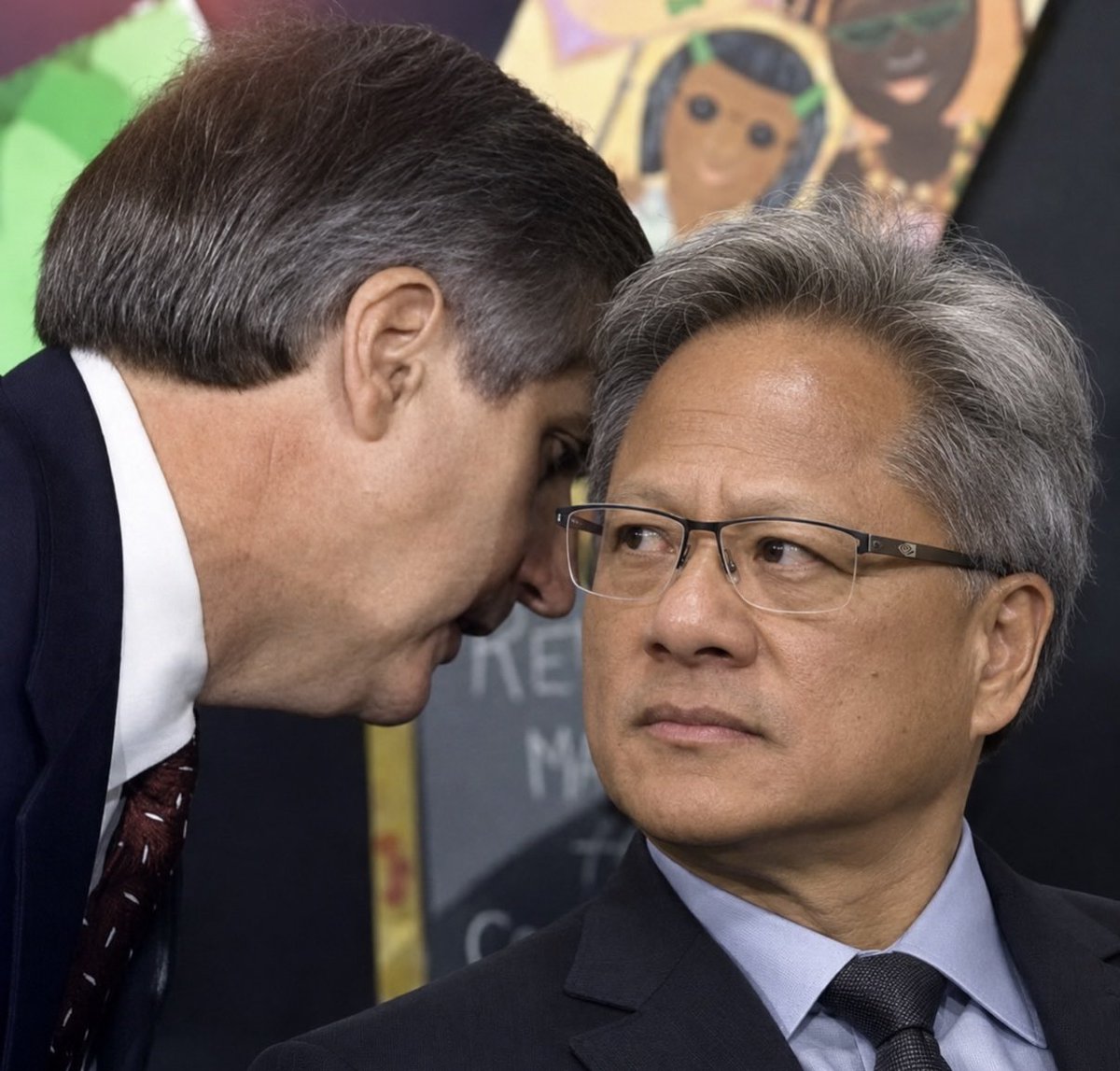
Our message to Nvidia's board:
Do not fire Jensen Huang.
There is no clear replacement for Jensen Huang. We are confident that his departure would ultimately be a net negative for Nvidia, its shareholders, and the AI Revolution.
First, take a look at the data. History also suggests that removing a successful CEO will come with a significant cost.
A study of 187 forced CEO departures from S&P 1500 companies found that removing outperforming CEOs resulted in negative long-term stock returns. This case would be no different, in our view.
Jensen Huang is the definition of an outperforming CEO. Nvidia's board must not make a decision in the heat of the moment.
The board should take the time to conduct a thorough investigation and consult with shareholders, with a strong emphasis on the latter.
Quite literally, Nvidia's board should convene a special shareholder meeting and hold an advisory vote on this decision. This is the most consequential CEO controversy in world history. Shareholders deserve a say.
In addition, Nvidia's stock, $NVDA, is now down -35% in 26 trading days, nearly half of which is a result of the recent scandal.
We believe Jensen Huang's potential removal as CEO is now ~80% priced in.
Why take an action with massive downside potential when the market has already priced in much of that risk?
The downside of retaining Huang may be limited, while the potential upside is tremendous.
Lastly, history shows that retaining Jensen Huang could still lead to a favorable outcome. In 2019, Amazon retained Jeff Bezos as CEO after his extramarital affair became public, and the company's stock subsequently surged +108% by 2021.
Personal misconduct should not be ignored, but it must also be distinguished from corporate wrongdoing and weighed against the consequences of removing an executive who is instrumental to the company's success.
We believe Jensen Huang is an irreplaceable part of Nvidia and the AI Revolution more broadly.
Once the dust settles, firing Jensen Huang would prove to be a costly mistake.
It is time to pause and consult your shareholders.
Breaking: the New York Times reports Jensen Huang had a relationship with an NVIDIA executive who reported to him, separate from the investigation already underway.
$NVDA is giving back today's 3% bounce after hours.
@zerohedge Per Axios that's the third time Trump's signed off on it this year and Commerce still hasn't moved. Funny part for $NVDA is the official guide already assumes zero China data center sales.
Everyone's selling $NVDA over the CEO headlines. Here's what they're selling: a company that just grew revenue 106% to $96.2B, beat its own forecast five quarters running, and trades around 14x forward earnings.
Reuters puts the hit at about $430 billion in market value over two sessions. NVIDIA's board says it has opened an independent investigation and has no reason to believe national security or company secrets were compromised.
Now look at what the business reported. In the quarter that ended July 26, revenue was $96.2B, up 106% from a year earlier, with a 75% gross margin. NVIDIA had guided $91.0B. The four quarters before that also came in above its own forecast.
For the quarter it reports next week, NVIDIA guided $108B, plus or minus 2%, and said that number assumes no data center compute revenue from China.
As of Nov 11 on https://t.co/lnzMa8t7p0, NVIDIA trades at roughly 14x forward earnings. Broadcom and TSMC are near 20x, and AMD is around 37x. I'm bullish, and that gap is a big part of why.
I don't think the headline is the biggest risk to the numbers, though. Three things NVIDIA has disclosed itself matter more to me.
First, NVIDIA is now backing a customer's financing. In August it agreed to guarantee leases at an Ohio data center campus that OpenAI will use, with its obligation capped at $105B (8-K, Aug 17). The guarantees phase in as sites are ready, starting in fiscal 2029, and OpenAI has agreed to reimburse NVIDIA for anything it pays. Still, that's a chip company standing behind its customer's leases.
Second, cash isn't keeping up with sales. Operating cash flow fell to $24.1B in the July quarter from $50.3B the quarter before, even as revenue rose 18%. NVIDIA pointed to working capital and cash taxes. Customers now take about 60 days to pay, up from 45, after it gave some big buyers longer payment terms (CFO commentary, Aug 26).
Third, margins are set to dip. Memory prices have risen faster than NVIDIA expected. On the August call, management guided gross margin to about 74% for the quarter it reports next week and said it expects margins to bottom at 71% to 72% in the quarter after, before settling at 72% to 73% next fiscal year.
None of that says the business is broken. It does say growth is getting more expensive to fund.
What I'm watching on Nov 17 after the close: whether revenue clears the $108B guide, whether the 71% to 72% margin outlook holds, and whether cash flow starts catching up with receivables.
Not investment advice.
@testingcatalog Funny if Google's AI super app turns out to be the coding IDE. Most people who want browser use aren't opening an IDE to get it, so I'd bet the Gemini desktop app sticks around
@StockMKTNewz Siri's already supposed to be running on Gemini anyway. This just puts the Gemini app next to it on the dash. Unless it gets its own wake word, Siri still hears you first.
@iamfabian Not surprised the legacy names want in. Staera's slide has 0.2 pJ/bit vs 5 for co-packaged optics, a 25x power gap if it holds at volume. Who are you hearing pivot, display/LED guys or the optics houses?
@KobeissiLetter 97.5% of Opus quality for a tenth of the cost is a great trade, right up until the missing 2.5% lands on step 14 of an agent run. Routers live or die on knowing when not to save money.
@pequityresearch $19.3B x 4 is the $77B, so that's a Q4 run rate, not a December exit rate.
The catch for the $ANT roadshow: a sequential dip from $81B a week before pricing. Does Barclays expect January to snap back above $81B?
@hhhypergrowth Price hikes of 25% in July and 10% in Q3 compound to ~37.5% before the Q4 one even lands.
The catch: pricing that steep is exactly what pushes hyperscalers to build their own. How long do you think the 10x demand gap lasts?