All ML/AI metrics of the past are scalars. Scalars are garbage.
Focus on vectors.
A scalar is a projection that throws away the geometry. It answers “how much?” while erasing “in which direction?” and “along which axes of failure?”. Once you compress to a single number you can no longer distinguish two systems that fail differently, only that they fail by the same magnitude.
@0xCodez Bro don't mix concepts.
Agentic knowledge graphs use AI agents to build and maintain graphs dynamically, while graph engineering is the broader practice of designing and optimizing graph structures and databases.
The course is by Neo4j, don't confuse readers for engagement.
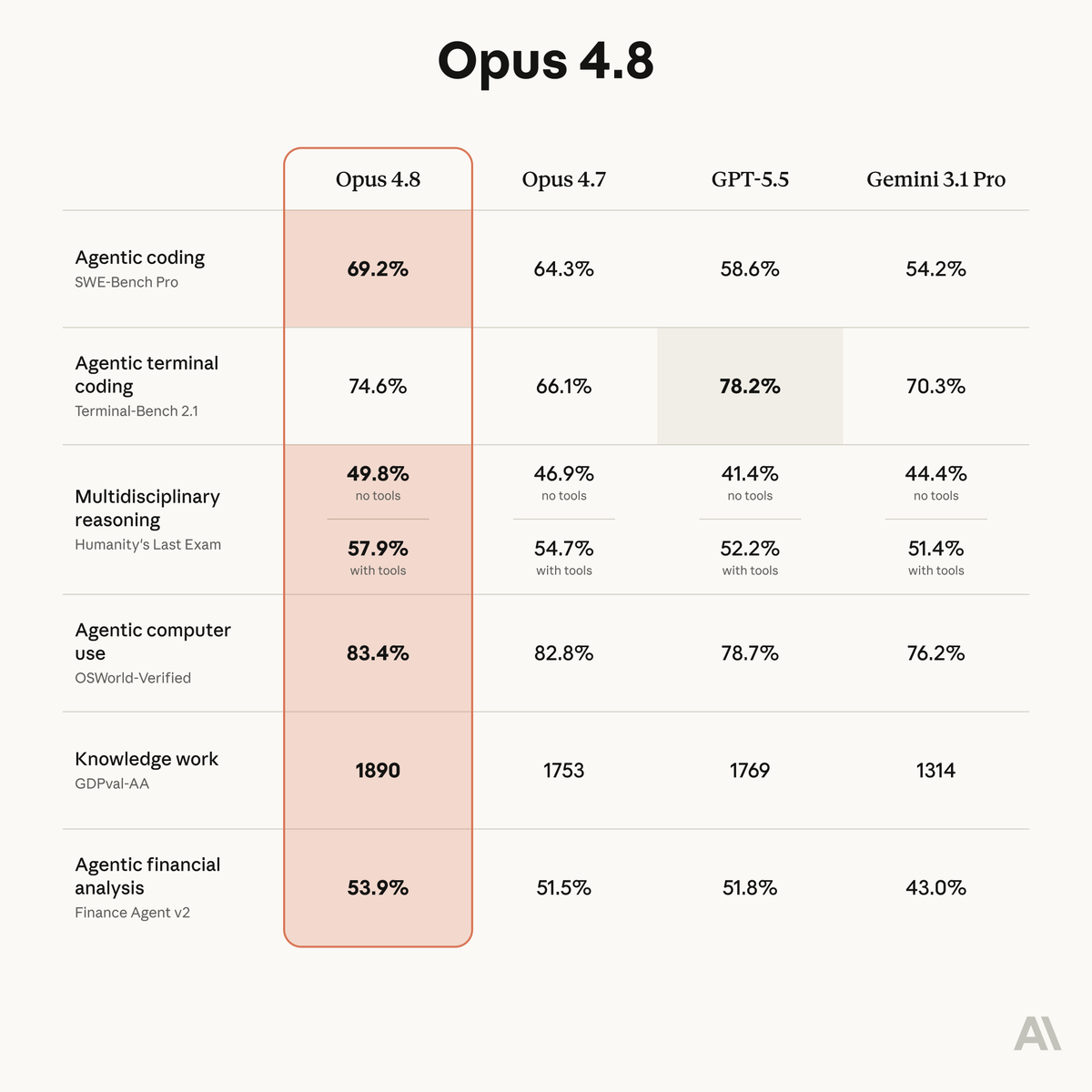
Introducing Claude Opus 4.8: it builds on Opus 4.7 with sharper judgment, more honesty about its own progress, and the ability to work independently for longer than its predecessors.
Available today at the same price.
The funniest thing about X is how quickly people prompt an AI model once or twice, get mediocre results, and immediately form a harsh, almost abusive opinion about it.
Most never bother to actually learn how to use it. It’s exactly like working with a human; give them proper context, onboard them thoughtfully, and then collaborate effectively.
There’s no single magical tool. Understand the limitations first, then build things that actually create high value.
Grok foundation model V9-Medium (1.5T) has finished training. Evals look good. A lot of Cursor data was added in supplementary training and there is more to come.
Fine-tuning is underway and reinforcement learning begins in a few days. 2 to 3 weeks to public release.
This will be a major improvement over the 0.5T v8-small that currently serves all Grok production traffic, especially for difficult coding tasks.
The bitter lesson in 26 words:
Don’t be distracted by human knowledge, as AI has been historically.
Instead focus on methods for creating knowledge that scale with computation, like search and learning.
Context engineering and orchestration are beating blind scaling in production agent stacks.
What routing or context patterns have you found actually reliable in real agentic workflows?
Context quality and orchestration beat blind scaling.
In 2026 agentic systems, you don’t need frontier models for most extraction and execution steps.
Small models are precise, fast, and reliable here, especially when quantized and running on modest hardware.
Model intelligence is smooth enough now that naive rules and hard rejects often do more harm than good.
They fight the model’s capability rather than working with it.
Right context + smart routing lets smaller models handle significantly more than crude filters allow.