I get irritated whenever I hear proud Kolkatans referring to their city as the "City of Joy", after the title of Dominique Lapierre's book. This happens all the time.
I doubt whether Lapierre was referring to Kolkata when he named his book. The name is a straight translation of Anand Nagar, a hellhole of a slum where the story is set.
Lapierre came to Kolkata (then Calcutta) in the early 1980s, impressed by the worldwide (free) publicity campaign by Mother Teresa and her little cult that Calcutta was the most f**ked-up city on the planet. Then he looked for really f**ked-up slums there and settled on Anand Nagar.
There was enormous media coverage, extraordinary levels of genuflecting gratitude, and Lapierre was made an honorary Calcuttan because he told the world what a f**ked-up life we led in this city.
The Anand Nagar slum wasn't even in Calcutta. It was in Pilkhana in Howrah. But Bengalis took Lapierre's title and applied it to Calcutta and rejoiced.
Bengalis had felt proud when Mother Teresa told the world how dreadful Calcutta was (Yay! We are the most dreadful city in the world according to Time magazine!) and ran her multimillion-dollar Vatican racket. This book was further international validation. We are the top-seeded Indians in the race to the bottom! That white-skinned author (French! Truffaut! Sartre!) chose us, not Marathis or Tamizhians!
And even today, we continue to greet visitors at the airport with "Welcome to the City of Joy" signs.
It's pathetic.
ORBIT ACHIEVED. 🚀
Vikram-1 Test Flight-1 has reached orbit. India's first privately developed orbital rocket has completed its final burn and injected its payloads into a ~450 km orbit, making India the third country in the world with private orbital launch capability.
History is made. 🇮🇳
#Vikram1 #JourneyToOrbit #SkyrootAerospace
POKER-X, an innovation by Prakash Urs. With Poker-X, you can easily pour milk or oil into a container.
It eliminates the need to cut the corners of milk/oil packets, keeping the sachet more intact and making recycling easier.
Better recycling means less plastic ends up in the environment, where it can eventually break down into microplastics.
🚨 The most sacred relic in Christianity might have been woven 4,000 miles from Jerusalem.
New genetic analysis of the Shroud of Turin reveals DNA signatures that trace back to the Indian subcontinent. Pollen grains embedded in the fabric match species native to the Kashmir region. The linen itself carries molecular markers consistent with flax grown in areas spanning modern day Pakistan and northern India.
Every Christian scholar who built their career defending the Shroud’s authenticity as the burial cloth of Christ is now staring at evidence that completely reshapes the narrative.
But the implications run deeper than authentication debates.
What we’re looking at could be the smoking gun for first century trade networks that medieval historians claimed didn’t exist yet. The idea that fine Indian textiles reached Palestine 2,000 years ago contradicted everything we thought we knew about early commerce patterns. The Silk Road wasn’t supposed to be fully operational. Maritime trade between India and the Mediterranean was considered marginal.
The DNA evidence suggests otherwise.
If the Shroud originated in India, it means luxury textile production and long distance commerce were far more sophisticated in the first century than any textbook admits. Indian weavers were already creating fabrics so extraordinary that they traveled thousands of miles to reach the most important burial sites in the ancient world.
Think about what that required. Quality control systems to maintain fabric integrity across months of transport. Financial instruments sophisticated enough to handle payments across multiple currencies and kingdoms. Cultural exchange networks deep enough that Indian craftsmen understood and catered to specific burial customs in distant lands.
The genetic markers tell a story of globalization that predates our supposed “global” era by two millennia.
Archaeological orthodoxy just took a massive hit.
The traditional timeline puts sophisticated Indian Ocean commerce centuries later. The standard model claims the Roman Empire was insular, dependent on local production with minimal eastern trade. Economic historians built entire theories around the idea that complex international supply chains were modern inventions.
DNA doesn’t lie about geography.
Those pollen grains traveled from Kashmir valleys to a tomb in Jerusalem through human networks that were supposed to be impossible in 30 AD. Either the dating is wrong, or our entire understanding of ancient economic systems is incomplete.
The religious angle creates its own earthquake.
If the Shroud is authentic but Indian, it means the burial cloths of Christ were luxury imports, not local Palestinian linen. The man Christians worship was laid to rest in fabric that cost the equivalent of a house, shipped from craftsmen who never heard his name but whose work became the most venerated textile in human history.
That detail rewrites crucifixion accounts. Someone with access to international luxury goods provided the burial materials. The narrative of Christ dying poor and abandoned doesn’t align with being wrapped in premium Indian textiles.
The forensic anthropology adds another layer.
DNA analysis also found genetic material from individuals with South Asian ancestry who handled the cloth. Multiple handlers across centuries left traces. But the original genetic signatures point toward the Indian subcontinent as the fabric’s birthplace, not just its journey.
What emerges is a picture of the first century world that’s far more connected, sophisticated, and globally integrated than academic consensus admits.
The Shroud might force a complete revision of ancient trade histories, early Christian economics, and our assumptions about technological capabilities in the Roman world.
DNA evidence rarely lies.
But it frequently demolishes the stories we built around artifacts we thought we understood.
Brilliant read on @SwarajyaMag:
'A country that flinches from telling itself heroic stories does not thereby become more honest. It becomes more vulnerable—to the mythologies of others, to the paralysis of perpetual self-doubt, to the corrosive belief that agency is something that happens to other nations'
'Myths, as every civilisation since the Greeks has understood, are the stories a people tell themselves about who they are and who they wish to become. A nation that does not mythologise its own stories cedes that space to others. And every civilisation that has ever projected influence—hard or soft—has understood that the easiest way to shape a national psyche is through a story people choose to watch on a Saturday night.' https://t.co/ueEe9NES4X
Sigmund Freud believed a father must be a “threat,” not a friend, or the son never fully becomes a man.
A boy is born into the world of the mother, warmth, forgiveness, safety. But maturity begins only when the father introduces limits, hierarchy, and resistance.
Freud called this the “Law of the Father”. not violence, but authority that doesn’t collapse under emotion.
When a father becomes a buddy too early, the boy never exits childhood. Historically, initiation meant separation from the mother, fear, discipline, even pain. The father was the guide into danger, responsibility, and competition.
Today that role is diluted into reassurance and endless empathy. The result is visible everywhere: grown men addicted to comfort, terrified of criticism, avoiding risk, seeking approval.
Friendship with father is possible, but only after strength is proven, not before. Until then, firmness is not cruelty. It is preparation. The world will not negotiate. A father existed to make sure his son could survive that fact.
Wigs, hallmark of fashion and status of British empire, were actually started by French. Louis XIII, King of France in 17th century, started wearing it to cover his baldness. Later it was adopted by British too. It helped with lice, and covering bald patches due to syphilis. In extremely unhygienic conditions during that time, this symbol of aristocracy was perfumed to mask the stench from individuals who had not bathed for days, and sometimes weeks.
हावड़ा से मुंबई के बीच चलने वाली 12262 दूरंतो भारत देश की सबसे बर्बाद ट्रेन है. इसीलिए नहीं कि वो धीरे चलती है,,बल्कि उसे बर्बाद कर दिया गया है.
समय सारणी में चेंज कीजिए,,अगर सही से उसे मालगाड़ियों से आगे नहीं रख सकते तो.
यात्रियों ��े प्रीमियम ट्रेन के नाम पर इतना मोटा अमाउंट लिया जाता है और सर्विस के नाम पर मेमू जैसी सुविधा.
ये ट्रेन टाटानगर 28 मिनट लेट आई थी,और उसके बाद ये बिलासपुर पहुंचते पहुंचते कम से कम 4 घंटे डिले होगी। और ये डेली का हो गया है.
इस्पात एक्सप्रेस,बड़बिल जनशताब्दी जैसी ट्रेनों का हाल तो पूछिए हीं मत.
इसका तोड़ ढूंढिए,हांथ पे हाथ धर के न रहिए .
@CkpDrm @HemantSorenJMM @KHURAPATT @RailMinIndia @Srdomckp @DRMBilaspur @AshwiniVaishnaw @KHURAPATT @khurpenchh @JharkhandRail @mpbidyutmahato @ZeeBiharNews
#LateDivisionCKP #latezoneSER
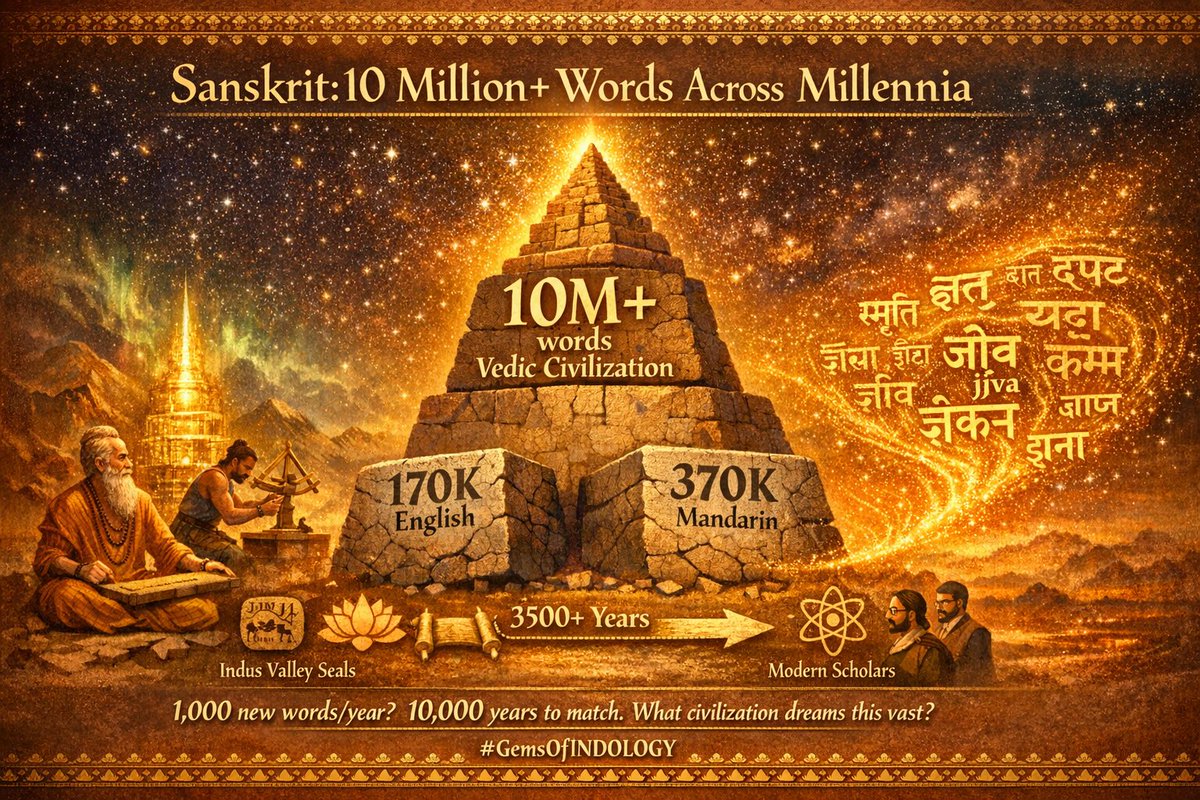
The DEAD language Sanskrit has 10 million words by conservative estimates.
If you coined 1,000 new words every year, you'd need 10,000 years to match it. English? 170,000 words. Mandarin? Around 370,000.
A linguistic architecture built across millennia, encoding knowledge systems we're only beginning to rediscover.
What civilization builds a language this vast?
1/2
@ARanganathan72 Murders masked as suicide due to whatever reasons. This is Bengal for you. People don't realise it but WB today is the equivalent of 90s Jungle-raaj. Sane people living in the state would acknowledge. Rest would continue to live in their dream-bong-land