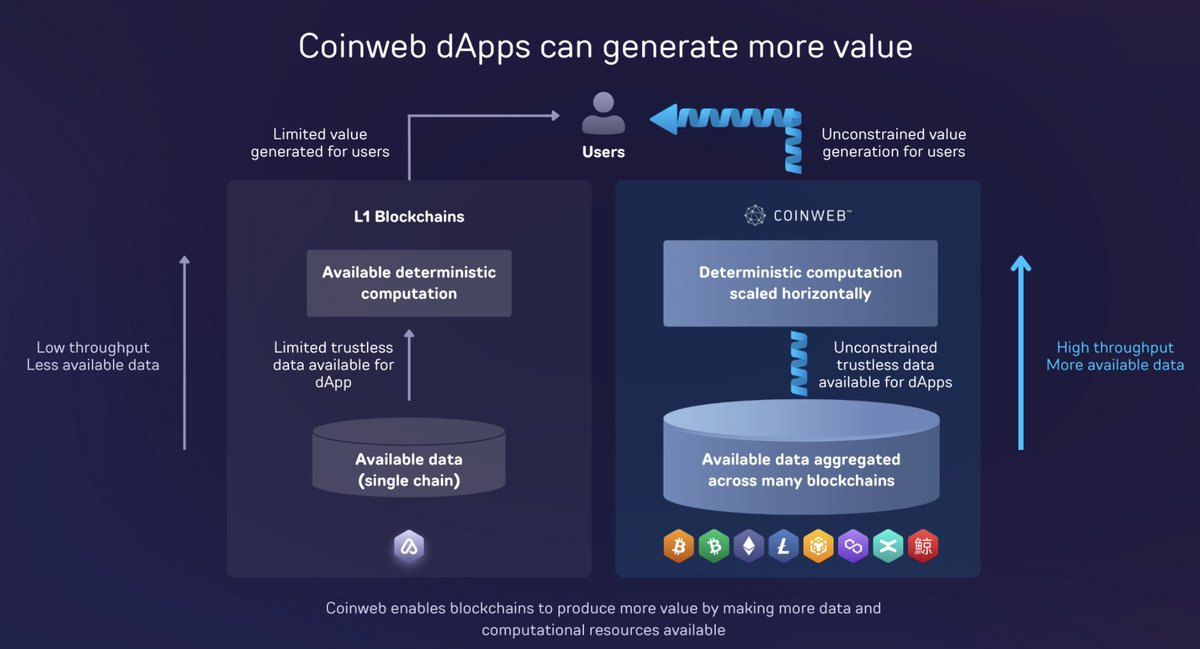
Coinweb is an L2 dApp platform. Coinweb is a trust-minimized cross-chain computation platform. Coinweb does horizontally scalable deterministic computations on top of multiple blockchains, including Bitcoin and Ethereum.
Let's break this down:
Meet Kimi K2.6: Advancing Open-Source Coding
🔹Open-source SOTA on HLE w/ tools (54.0), SWE-Bench Pro (58.6), SWE-bench Multilingual (76.7), BrowseComp (83.2), Toolathlon (50.0), Charxiv w/ python(86.7), Math Vision w/ python (93.2)
What's new:
🔹Long-horizon coding - 4,000+ tool calls, over 12 hours of continuous execution, with generalization across languages (Rust, Go, Python) and tasks (frontend, devops, perf optimization).
🔹Motion-rich frontend - Videos in hero sections, WebGL shaders, GSAP + Framer Motion, Three.js 3D.
🔹Agent Swarms, elevated - 300 parallel sub-agents × 4,000 steps per run (up from K2.5's 100 / 1,500). One prompt, 100+ files.
🔹Proactive Agents - K2.6 model powers OpenClaw, Hermes Agent, etc for 24/7 autonomous ops.
🔹Claw Groups (research preview) - bring your own agents, command your friends', bots & humans in the loop.
-
K2.6 is now live on https://t.co/YutVbwktG0 in chat mode and agent mode.
For production-grade coding, pair K2.6 with Kimi Code: https://t.co/uvoSJKyGCY
-
🔗 API: https://t.co/EOZkbOwCN4
🔗 Tech blog: https://t.co/9wWvgIQSS3
🔗 Weights & code: https://t.co/Be0hjs2RTP
Today he's going to jail. The incarceration of privacy developers, the heroes standing up to government terror, continues. If you want to make a difference, download a privacy tool today to protect yourself, your family, and the future of our world.
https://t.co/MepJ7umSNc
📣 Now live on PACT
@0xPolygon has been a hub for scaling and innovation.
Pact takes it further by stitching Polygon directly into a cross-chain DEX with Bitcoin, Ethereum, Doge and more.
Liquidity flows natively, without validators or added trust assumptions.
The future of DeFi is composable, and leaders like @sandeepnailwal know it.
1/2
Open weights ftw! This looks amazing, and this model is immediately available at Groq at 200 tok/s.
It looks like between the hardware companies (Groq and Cerebras) and open source / open weights models, there is a symbiosis that the closed companies have problems matching.
Coinweb has now parsed 10,000,000,000 L1 transactions.
Every block. Every tx. Every event. All read across chains and made available to dApps in real time.
Best part? Coinweb smart contracts can autonomously react to any type of L1 events.
That’s full data availability + autonomous reactiveness at scale.
The foundation for cross-chain apps that actually work.
Funny how people say “you just got lucky making money”...🤦♂️
They don’t see the 15-hour days digging through projects, filtering hidden gems out of the endless crypto BS, or when I lived off noodles and couldn't afford rent so I had to borrow money off my mum because I didn't want to take any money out of crypto..
✅ - I caught Luna at $0.20 after watching a random podcast with 78 views.
✅ - I caught Solana at $0.80 after seeing an interview with barely 400 views.
✅ -Now I’ve positioned into @CoinwebOfficial, @HeyAnonai, and @AbstractChain at what I believe is the perfect time.
I don't say this to brag and TBH compared to the world I basically have $0.. lol
No one knows for sure which projects will dominate… but these are the teams I’m backing.🤝
Things you didn’t know about full cross-chain data:
Most devs think “more chains” means more endpoints.
On Coinweb, it means one unified data layer your contracts can read from directly.
Full data availability means your dApp can access confirmed state from every connected L1 and L2 inside a single execution environment.
Balances, events, prices, governance states, you name it.
Pair that with deterministic computation and your logic stays predictable. Same inputs, same outputs, even when they come from different chains.
And with Reactive Smart Contracts, your app can watch multiple chains 24/7 and trigger itself when conditions hit. No prompts, no keepers.
Examples of what you can build with it:
> Cross-chain risk engines that net exposures in real time
> Prediction markets that settle from many on-chain feeds at once
> Credit markets using collateral baskets across chains, with auto-rebalancing
> Compliance and monitoring layers with on-chain attestations
> AI agents acting on composite multi-chain signals
Why it matters:
– True composability across ecosystems
– One place to reason about state, not ten
– Route around outages and fees with always-on contracts
– Fee abstraction with $CWEB for clean UX
Build with all the data, not just a slice of it.
Make the dApp you couldn’t make anywhere else.
Build on Coinweb.
Pact-swap is the cheapest solution I have seen to do cross-chain swaps between Native Bitcoin and other chains.
I have joined the team to help them with GTM strategy. There is a limited time role waiting for you in the project Discord👇
What Coinweb needs is just a sequential order of blocks, which is the blue chain in Kaspa.
Coinweb nodes as a whole monitor the state of all the L1 blockchains connected to Coinweb, and then the Coinweb state is defined by what is found in the underlying L1 blockchains.
Because Coinweb uses refereed delegation of computation (rdoc) instead of consensus, only a single honest node is required to observe each L1 blockchain.
Consequently not all nodes must process all data from all L1 nodes, but in the case where a dishonest nodes push false information about the state of, say Kaspa, then other nodes need the ability to evaluate fraud proofs. Thus Coinweb nodes should have access to Kaspa, but not necessarily process all of it.
In addition to that optimization which is a consequence of rdoc being a trust-minimized validation mechanism, the interface between reactive smart contracts on Coinweb and a given L1 is often designed such that it is efficient to query the L1's RPC APIs whether a given event has been emitted for a set of blocks or not.
We do not do this for slow blockchains like Bitcoin, but for high speed ones, the design of the indexing or archival APIs for the L1s can affect what the Coinweb smart contracts should see from the L1.
An example of such capabilities at the RPC layer are the bloom filters supported by Bitcoin nodes where it is possible to query for whether a range of bitcoin addresses have received coins for a range of blocks. Another example is the ability to query Ethereum nodes for events for a given smart contract across multiple blocks.
So data that is indexed well by the L1 blockchain is a good fit for what is exposed to the reactive smart contracts in Coinweb, but at the end this is decided on a case by case basis based on the specific L1 designs.
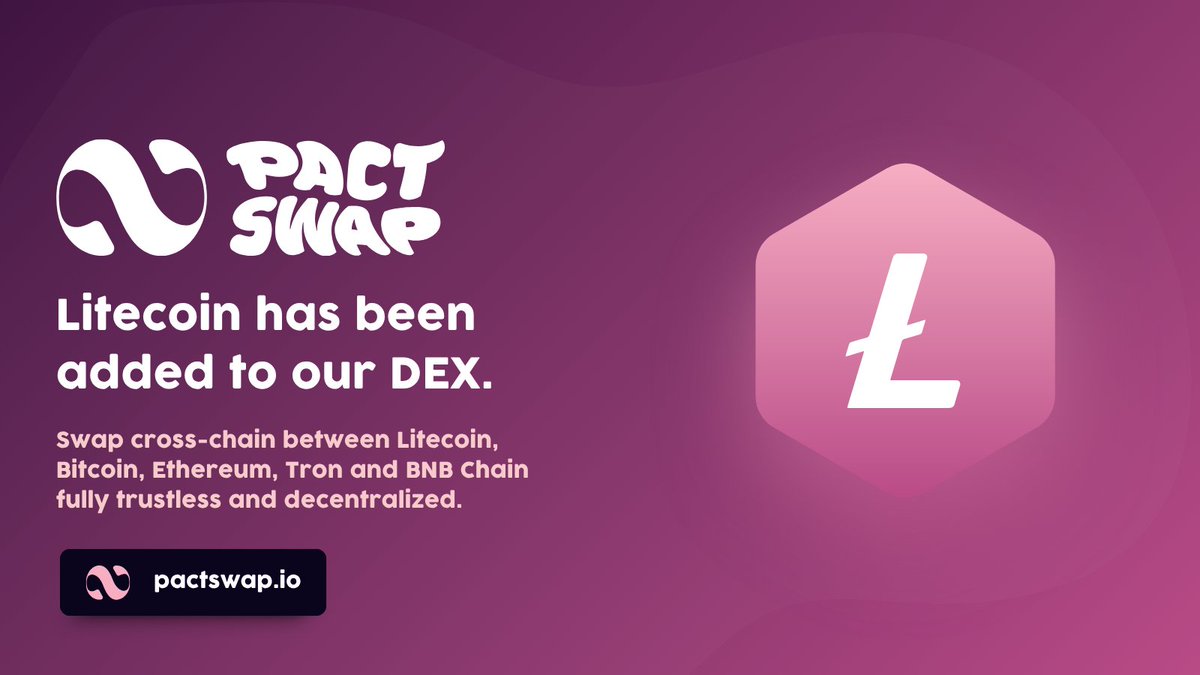
We’ve added @litecoin to our cross-chain DEX!
Want to buy $LTC with $USDT, $USDC, or $USD1? Or swap it directly with native $BTC? At CEX-level fees?
You can - live now on @PACT_SWAP.
No bridges.
No wrappers.
Trustless. Fast. Composable.
Powered by the PACT framework from @CoinwebOfficial.
Let’s hear it for the devs behind the scenes. 🛠️
LFB! ≈ Litecoin F***ing Builds!
Small update:
We just deployed upgrades to our broadcasters.
Transacting native $CWEB on Coinweb using @BNBCHAIN as anchor?
Now 11x cheaper. Yes, eleven times cheaper.
Efficiency matters.
Every upgrade we ship makes the noise easier to ignore.