We are looking forward to closing the gap between blockchain and the traditional world. 🤝
Find out what Coinweb is capable of 🌏
$CWEB #Coinweb#Interoperability
Why does moving $100 across chains require locking 8-9 figures somewhere? Genuinely asking. We already fixed it, we just want to know why everyone else is still doing it.
The real cost of a cross-chain transaction isn't gas. It's the collateral sitting idle because your bridge can't prove your funds are safe without locking multiples of their value.
Provable finality changes that math entirely.
Every dollar of excess collateral locked in a bridge exists for one reason: the system has no way to verify what happened on the other chain, so it substitutes capital for certainty.
Fix the verification problem and the capital requirement collapses with it. That's the entire thesis behind the PACT Framework.
Here are 5 things about the PACT Framework everyone should know:
Cross-chain settlement? We fixed the trust problem.
🔹 No trusted third party.
🔹 No extra synchrony needed.
🔹 Bonded collateral enforces it.
Bridges get exploited. PACT gets bonded.
🔹 Overlay layers watch, don't guess.
🔹 Only acts on final state.
🔹 No reorg surprises.
One other party doesn't deliver? You're covered.
🔹 Stable party safeguarded by collateral.
🔹 Unstable party pays compensation.
🔹 No arbiter required.
Timing matters. PACT makes it explicit.
🔹 Staggered leader/follower timeouts.
🔹 Confirmations always arrive first.
🔹 No silent race conditions.
Delayed finality? Built in.
🔹 Actions wait for stability.
🔹 Queues respect chain delays.
🔹 Settlement you can prove.
This is the PACT Framework. Bonded settlement for cross-chain, without the trust.
Small progress update.
MultiversX halted their network shortly after the Supernova upgrade, and Coinweb kept running smart contract deployments the entire time without interruption. This is the benefit of building on top of many chains instead of betting everything on one: no single chain's heartbeat can stop the system.
We've also started exploring private swaps built using the PACT Framework, albeit very very very early stage.
New price oracles are in testing now, including ARB-USD and SOL-USD, and Solana smart contract event gathering has been introduced at the core level.
On the infra side: our testing SDK and core simulation got a serious upgrade, cutting some test runs from minutes down to seconds. The new Contract Kit is being hardened ahead of migrating existing contract code, and early improvements have already cut some contract-flow execution times by around 50%.
Steady progress across the board.
It's finally official: we're live on @Arbitrum, bringing the total to 12 supported chains.
Arbitrum assets are already available for trading on @Pact_Swap, with more pairs and integrations to follow.
We're on a mission to build the ultimate interoperability machine: connecting new chains, providing full data availability, and making it effortless to build, deploy, and supercharge cross-chain dApps.
This week we're attending Litecoin Summit by @LTCFoundation. In light of that, we thought it would be good to explain a bit what Coinweb brings to the table for the broader $LTC community.
Litecoin does not need to become Ethereum to support more advanced applications.
With Coinweb, developers can deploy dApps that use @litecoin as an underlying base layer while executing application logic through Coinweb’s Reactive Smart Contracts.
That means a dApp can observe Litecoin transactions, react to verified Litecoin data, and coordinate logic across other chains and VMs.
This opens the door to more than just LTC swaps.
Examples of what developers can build:
• Payment apps using native LTC settlement
• Cross-chain DEXs and liquidity products
• Merchant infrastructure
• DeFi applications triggered by Litecoin activity
• Multi-chain dApps where LTC is part of the core logic
And any type of dApp requiring smart contracts that reacts to data on the Litcoin network.
Litecoin remains Litecoin. Coinweb adds the application layer around it.
Coinweb’s Reactive Smart Contracts are like smart robots for blockchains.
They run on their own, can react autonomously to events, and work across all connected chains.
One gas token ( $CWEB ), self-managed fuel, no middlemen.
Perfect for cross-chain swaps: no validator sets, no idle capital, no 1000x collateral. Just-enough, just-in-time collateral management.
More trustless. Faster. Cheaper. Smarter.
Most dApps today are still confined to the blockchain they were built on.
Their data lives there.
Their logic executes there.
Their users are limited by it.
Coinweb changes that.
Instead of relying on its own consensus system to “agree” on what happened on another chain, Coinweb continuously parses and reacts to canonical L1 blockchain data directly from the source chains themselves, deterministically.
To date, we have parsed over 40,000,000,000 L1 transactions.
This gives developers building on Coinweb direct access to blockchain data across every connected ecosystem.
Directly from the underlying chains themselves.
That means developers can build dApps that react to real multi chain activity in deterministic ways.
A transaction either happened on the blockchain or it didn’t.
No subjective validator voting.
No probabilistic bridge consensus.
No federated trust assumptions.
This becomes especially powerful for emerging categories like autonomous AI agents.
An AI application built on Coinweb could monitor activity across multiple chains simultaneously and execute deterministic actions based on verifiable blockchain events:
• Rebalance treasury positions across ecosystems
• Execute cross chain liquidity strategies
• React to payment settlement events
• Coordinate multi chain gaming economies
• Trigger automated workflows based on real blockchain activity
All from a unified application layer with direct access to canonical L1 data.
Reactive Smart Contracts execute based on verifiable blockchain events, allowing applications to coordinate logic across ecosystems with predictable outcomes and reduced complexity.
This is a fundamentally different model for building multi chain applications.
We will have @AntonCoinweb representing Coinweb and contributing to this year’s Litecoin Summit in Amsterdam!
Looking forward to connect with the LTC community!
Thrilled to welcome @AntonCoinweb, the Chief Marketing Officer of @CoinwebOfficial & Contributor to @Pact_Swap, to the Litecoin Summit this year!
Join us, June 22-23, 2026 at the Tobacco Theater in Amsterdam to kick off Dutch Blockchain Week! 🇳🇱
⏩ https://t.co/QbHM0OEH0M ���
This is exactly the direction we’ve been building towards.
@CryptoRubic integrating @Pact_Swap means the PACT Framework will now be powering cross-chain execution inside major aggregator flows.
Higher capital-efficency → better quotes → higher conversion → more volume.
Distribution unlocked.
It’s always great to pay less, right?
@Pact_Swap gets it, offering fees from just 0.35%, up to 95% more cost-efficient than similar solutions.
And soon, Pact Swap will be integrated into Rubic for cross-chain swaps across @BNBCHAIN, @0xPolygon, @ethereum, @trondao and @Bitcoin.
10B was just the start.
Now 21B+ and accelerating ⚡
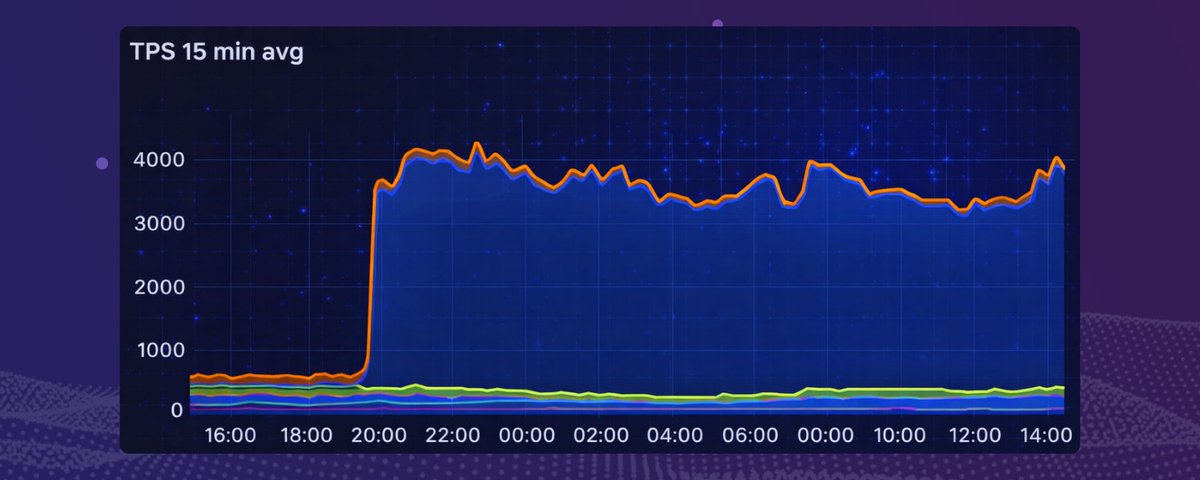
Solana integration injected serious throughput into the system, increasing the volume of data flowing through Coinweb and strengthening real time reactivity. This ultimately enables better applications and drives stronger network effects.
Coinweb has now parsed 10,000,000,000 L1 transactions.
Every block. Every tx. Every event. All read across chains and made available to dApps in real time.
Best part? Coinweb smart contracts can autonomously react to any type of L1 events.
That’s full data availability + autonomous reactiveness at scale.
The foundation for cross-chain apps that actually work.
Solana is now live in production on Coinweb and visible in the explorer.
It is the leader of all chains in adjusted stablecoin volume. That momentum makes it an important network for the broader ecosystem.
With @solana connected, developers building on Coinweb can now access Solana’s on-chain data and infrastructure directly through our execution layer.
The next phase is enabling interoperability between Solana and other connected chains. We will soon support cross chain swaps between $SOL and SPL tokens with native Bitcoin, BNB Chain and additional networks in the ecosystem.
As more chains connect, applications built on Coinweb gain broader reach without needing separate deployments or additional integration layers.
One deployment. Multiple blockchains.
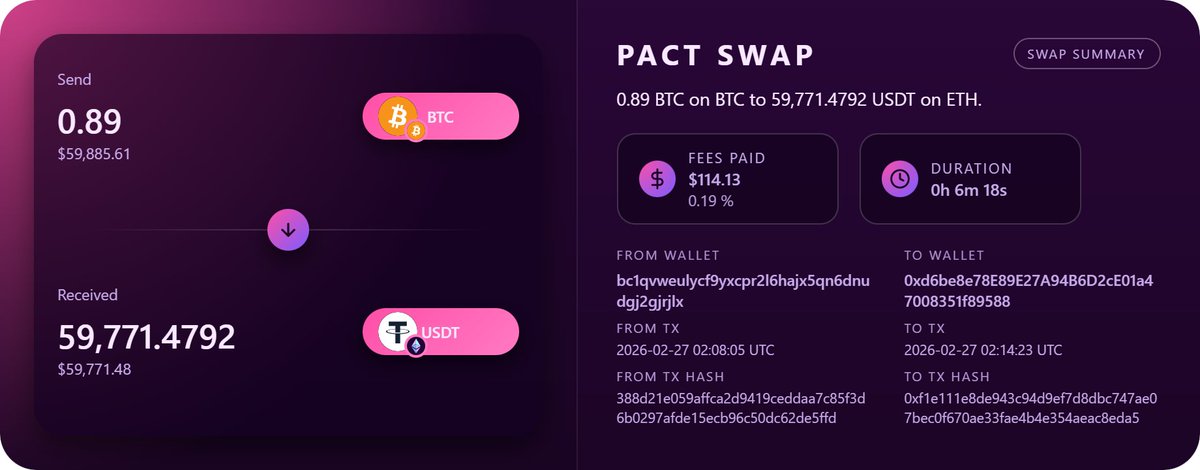
0.19% fees for a cross-chain BTC → USDT on ETH swap.
On @Pact_Swap someone swapped 0.89 BTC to 59,771.4792 USDT on ETH.
Fees paid: $114.13 (0.19%). 👀
Who said cross-chain has to be expensive?
#Defi done right!
People use the term “multi-chain” the wrong way.
Today, multi-chain usually means deploying the same dApp separately on different blockchains. Different contracts. Different liquidity pools. Different user bases. And very often, those deployments cannot even communicate with each other.
That is not unity. That is fragmentation.
Coinweb changes what multi-chain actually means.
Instead of deploying multiple isolated instances, you deploy once on Coinweb’s execution layer. From there, your application gains access to every blockchain we connect to, with shared logic and cross-chain awareness built in.
Your dApp can read events from multiple L1s, trigger actions across them, and route activity where it makes the most sense, all without splitting users or duplicating infrastructure.
That is true multi-chain.
One deployment.
Multiple blockchains.
No fragmentation.