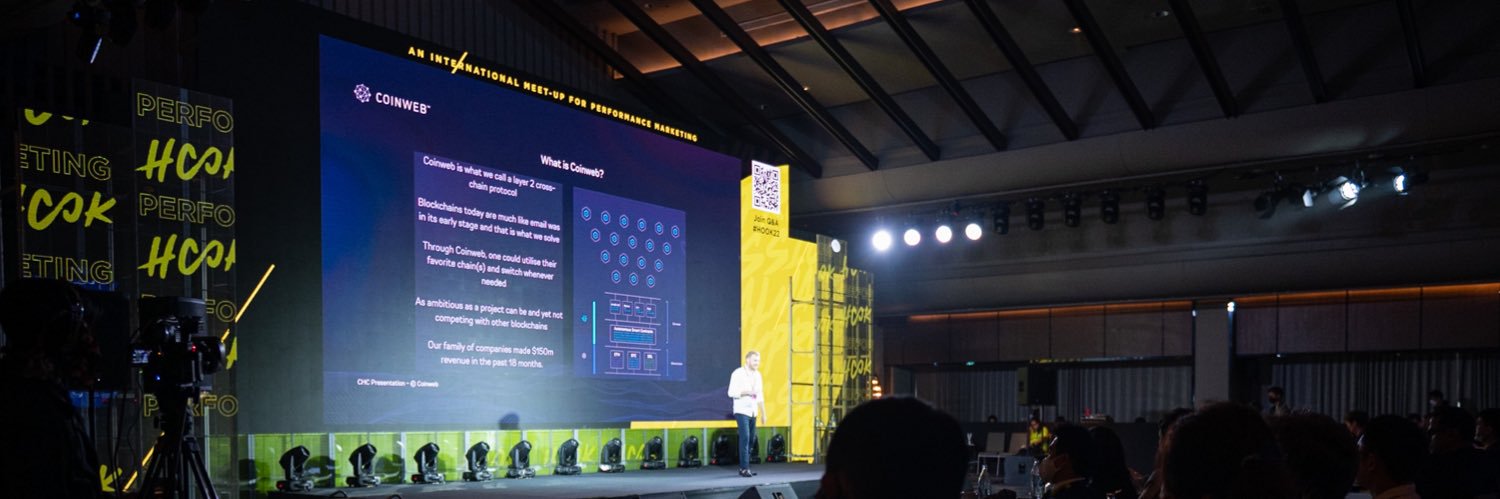
We will have @AntonCoinweb representing Coinweb and contributing to this year’s Litecoin Summit in Amsterdam!
Looking forward to connect with the LTC community!
5+ hours down
people realize how much they rely on exchanges during volatility
WTF going on coinbase?
hours of watching your chart move and not being able to do anything about it is actually insane !!!💀
Nothing reminds people about “not your keys, not your coins” faster than an exchange outage
Maybe decentralization is not as real as they pretend
What happened to those who had trades open?
Classic Coinbase.....Just another day in crypto paradise
Coinbase servers fighting for their life every time the market gets interesting
"Non-technical teams are now shipping production code and many of our workflows are being automated."
HAHAHAHA PLEASE STOP
Cannot make this shit up
This is exactly the direction we’ve been building towards.
@CryptoRubic integrating @Pact_Swap means the PACT Framework will now be powering cross-chain execution inside major aggregator flows.
Higher capital-efficency → better quotes → higher conversion → more volume.
Distribution unlocked.
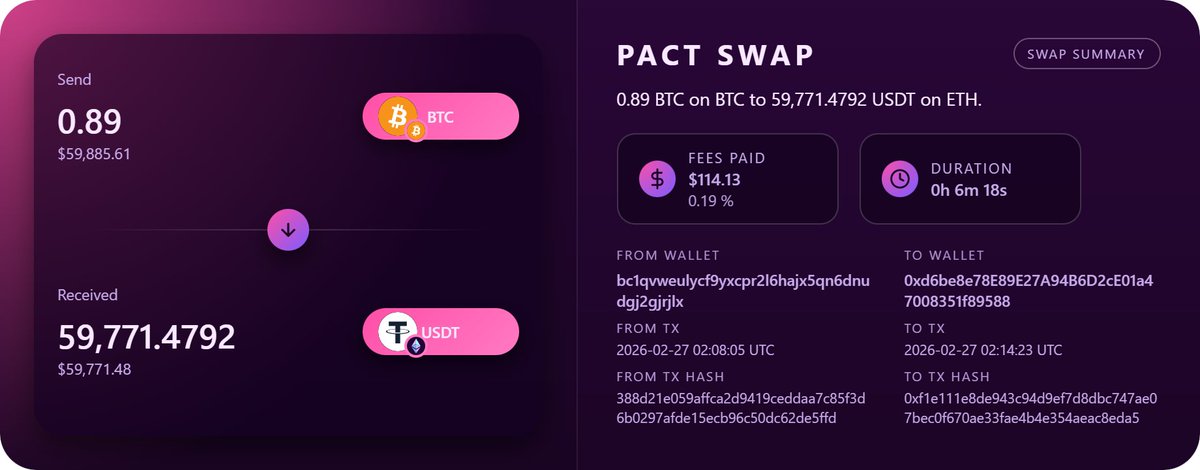
0.19% fees for a cross-chain BTC → USDT on ETH swap.
On @Pact_Swap someone swapped 0.89 BTC to 59,771.4792 USDT on ETH.
Fees paid: $114.13 (0.19%). 👀
Who said cross-chain has to be expensive?
#Defi done right!
👓 Quick look at what Fortris Swaps can do.
🔄 Convert BTC, stablecoins and other cryptocurrencies directly in the platform: no external exchanges, no delays.
⚙️ Every swap is secured, auditable and governed by your existing controls.
Learn more: https://t.co/XUXeIFosO7
Quick introduction to Multi Asset Order Types on Pact Swap:
One of the biggest problems in cross chain trading today is liquidity fragmentation. Liquidity is split across chains, pairs, and venues, which makes pricing worse and capital usage inefficient.
Pact Swap solves this with Multi Asset Order Types.
Instead of liquidity being tied to a single pair or a single chain, a single order can be reused across multiple assets and trading paths. This allows the same liquidity to serve many different swaps without needing to be duplicated.
In practice, this means a liquidity provider does not need to post separate liquidity for LTC to ETH, LTC to BTC, LTC to USDT, and so on. One order can dynamically settle against whichever asset the liquidity provider wants, as long as the conditions of the order are met.
This dramatically reduces liquidity fragmentation and improves pricing across the entire system.
Multi Asset Order Types work because Pact Swap is not an AMM and does not rely on pools. Trades are settled autonomously, and each settlement is enforced by collateral posted by the liquidity provider for that specific trade.
The liquidity provider commits to an outcome.
Reactive Smart Contracts observe what happens on each underlying chain.
If the trade settles correctly, the collateral is released back. If it does not, the collateral is reassigned to incentivise another LP and if no one settles, it gets entitled to the user.
Because collateral is posted per trade and not permanently locked, the same capital can be reused many times across different assets and chains. This is one of the key reasons Pact Swap can offer such low fees without sacrificing security.
Multi Asset Order Types are only possible because the protocol is built on @CoinwebOfficial.
Coinweb turns independent blockchains into a single coherent compute environment. This allows Pact Swap to observe, reason about, and react to events across all connected chains deterministically, without relying on external coordination or compatibility between chains.
This is also why Multi Asset Order Types are fundamentally different from atomic swaps. Atomic swaps require strict compatibility and direct coordination between users. Pact Swap does not. Orders are enforced by code, not by user interaction or timing assumptions.
The result is a system where liquidity becomes more flexible, more efficient, and more scalable as more assets and chains are added.
This is the same composability that made Uniswap so powerful, but applied across chains and across assets instead of being confined to a single ecosystem.
Multi Asset Order Types are not a minor feature.
They are a core reason Pact Swap will be able to scale liquidity better than any other cross-chain DEX out there.
$BTC $ETH $BNB $LTC
Quick introduction to Multi Asset Order Types on Pact Swap:
One of the biggest problems in cross chain trading today is liquidity fragmentation. Liquidity is split across chains, pairs, and venues, which makes pricing worse and capital usage inefficient.
Pact Swap solves this with Multi Asset Order Types.
Instead of liquidity being tied to a single pair or a single chain, a single order can be reused across multiple assets and trading paths. This allows the same liquidity to serve many different swaps without needing to be duplicated.
In practice, this means a liquidity provider does not need to post separate liquidity for LTC to ETH, LTC to BTC, LTC to USDT, and so on. One order can dynamically settle against whichever asset the liquidity provider wants, as long as the conditions of the order are met.
This dramatically reduces liquidity fragmentation and improves pricing across the entire system.
Multi Asset Order Types work because Pact Swap is not an AMM and does not rely on pools. Trades are settled autonomously, and each settlement is enforced by collateral posted by the liquidity provider for that specific trade.
The liquidity provider commits to an outcome.
Reactive Smart Contracts observe what happens on each underlying chain.
If the trade settles correctly, the collateral is released back. If it does not, the collateral is reassigned to incentivise another LP and if no one settles, it gets entitled to the user.
Because collateral is posted per trade and not permanently locked, the same capital can be reused many times across different assets and chains. This is one of the key reasons Pact Swap can offer such low fees without sacrificing security.
Multi Asset Order Types are only possible because the protocol is built on @CoinwebOfficial.
Coinweb turns independent blockchains into a single coherent compute environment. This allows Pact Swap to observe, reason about, and react to events across all connected chains deterministically, without relying on external coordination or compatibility between chains.
This is also why Multi Asset Order Types are fundamentally different from atomic swaps. Atomic swaps require strict compatibility and direct coordination between users. Pact Swap does not. Orders are enforced by code, not by user interaction or timing assumptions.
The result is a system where liquidity becomes more flexible, more efficient, and more scalable as more assets and chains are added.
This is the same composability that made Uniswap so powerful, but applied across chains and across assets instead of being confined to a single ecosystem.
Multi Asset Order Types are not a minor feature.
They are a core reason Pact Swap will be able to scale liquidity better than any other cross-chain DEX out there.
$BTC $ETH $BNB $LTC
Why is our interop framework called PACT?
Because it is a promise, a guarantee, a pact between the user and the system.
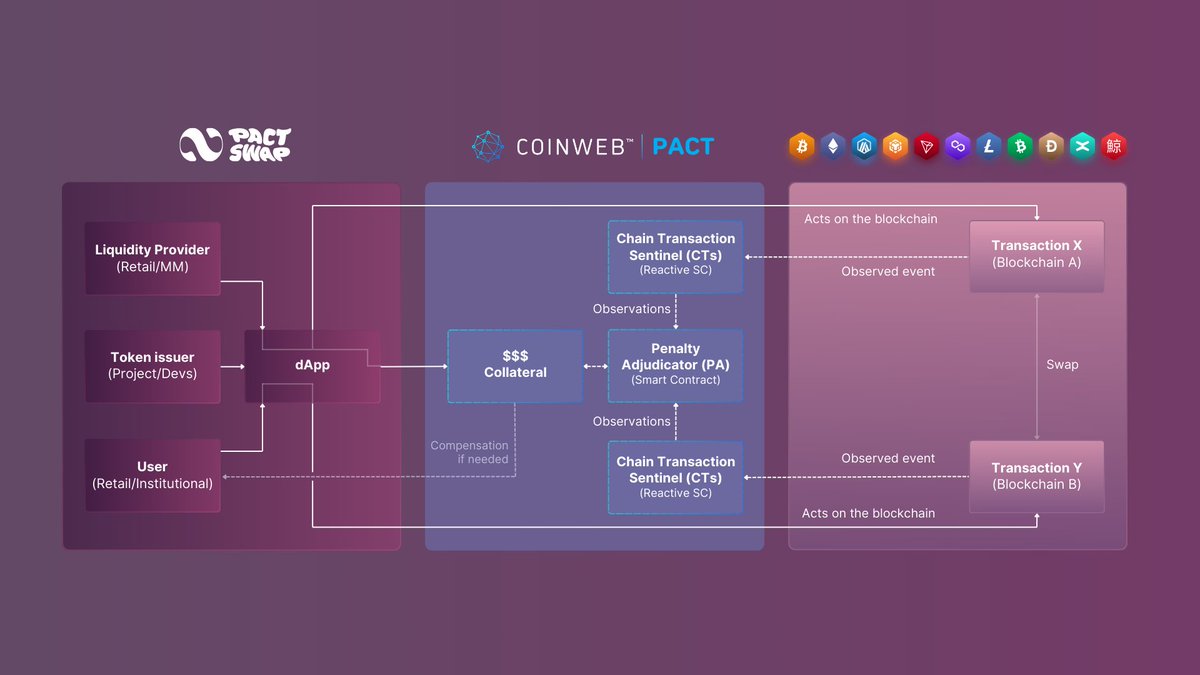
This is how a PACT works:
> Liquidity Provider posts collateral.
> Liquidity Provider places an order in the book.
> A user takes the order.
> Liquidity Provider sends the funds to the user.
> The PACT checks that the LP followed the rules.
>> The PACT releases the collateral back to the LP (minus fee to fee pool).
> If the PACT was not followed, the collateral is used to incentivise other LPs to finalise the trade, if this fails, the collateral is used to compensate user.
Try it today on @Pact_Swap
Why is our interop framework called PACT?
Because it is a promise, a guarantee, a pact between the user and the system.
This is how a PACT works:
> Liquidity Provider posts collateral.
> Liquidity Provider places an order in the book.
> A user takes the order.
> Liquidity Provider sends the funds to the user.
> The PACT checks that the LP followed the rules.
>> The PACT releases the collateral back to the LP (minus fee to fee pool).
> If the PACT was not followed, the collateral is used to incentivise other LPs to finalise the trade, if this fails, the collateral is used to compensate user.
Try it today on @Pact_Swap
@sam_battenally@andyyy Imagine:
> Order book
> Cross-chain
> Native BTC support
> Permissionless listings
> CEX-level fees
> Totally trustless
Now check out > @Pact_Swap
As the self-appointed Technologia Overlord of @Pact_Swap and @CoinwebOfficial, here’s a highly valuable secret on how to optimise the cost of your cross-chain protocol through your validators.
A 🧵
As the self-appointed Technologia Overlord of @Pact_Swap and @CoinwebOfficial, here’s a highly valuable secret on how to optimise the cost of your cross-chain protocol through your validators.
A 🧵