@ol_onX@wildlabs3 Got it. Are you looking for a tool to manage the campaign workflow end-to-end, or specifically to automate tasks like creator outreach, campaign tracking and reporting? We could explore a solution around your actual workflow.
@cyrilXBT The real learning curve begins when AI moves beyond generating responses and starts interacting with tools and business systems. Understanding tool permissions, error handling and evaluation is essential to making those agents dependable.
@WillConaway1 Automation needs to account for failure, not just the ideal workflow. Observability, fallback paths and clear recovery procedures are essential when multiple systems depend on one another. Reliability should be designed in from the start.
@BamoBuilds A workflow should be understood before it's automated. Generic templates can speed up a demo, but real business processes have exceptions, approvals and hand-offs. Designing around those realities is what makes automation useful beyond the prototype.
@kavya_hazarika Starting with one real customer problem is often the smarter approach. A focused feature reveals the actual data, integrations and failure points needed. Build around proven requirements, then expand the architecture as the product grows.
@panditdhamdhere An agent's ability to take action makes permissions and evaluation essential, not optional. Every tool call should have clear boundaries, and every important action should have a way to measure whether it achieved the intended outcome.
@ignatdesigner This highlights an important opportunity for SaaS teams. Making pricing, security and integration details easy to discover helps both human buyers and AI agents evaluate a product. Better structured information can reduce friction throughout the buying journey.
@JustinasRoland0@Netlify Building fast is becoming easier, but production readiness is a different challenge. Reliability, monitoring, error handling and user experience are what turn an impressive AI prototype into a product people can depend on.
@AndrewRoss00 The agent itself is often the smallest part of the implementation. Clean data, clear decision logic and the right business context determine whether automation actually works in production. That's where the real engineering effort belongs.
@Islaladrones Not every decision in an agent loop needs a frontier model. Combining deterministic rules for predictable checks with LLM reasoning for complex decisions can improve cost, speed and reliability. The challenge is knowing where to draw that boundary.
@shawnchauhan1 Agent sprawl is an interesting challenge. As teams deploy more agents, ownership, shared context and clear boundaries become just as important as the models themselves. Without those controls, automation can create more complexity than it removes.
Most businesses don't need more people to manage repetitive tasks. They need better systems.
AI automation can reduce manual work, streamline workflows and give teams more time to focus on growth.
What's one task you'd automate first?
#AI#Automation
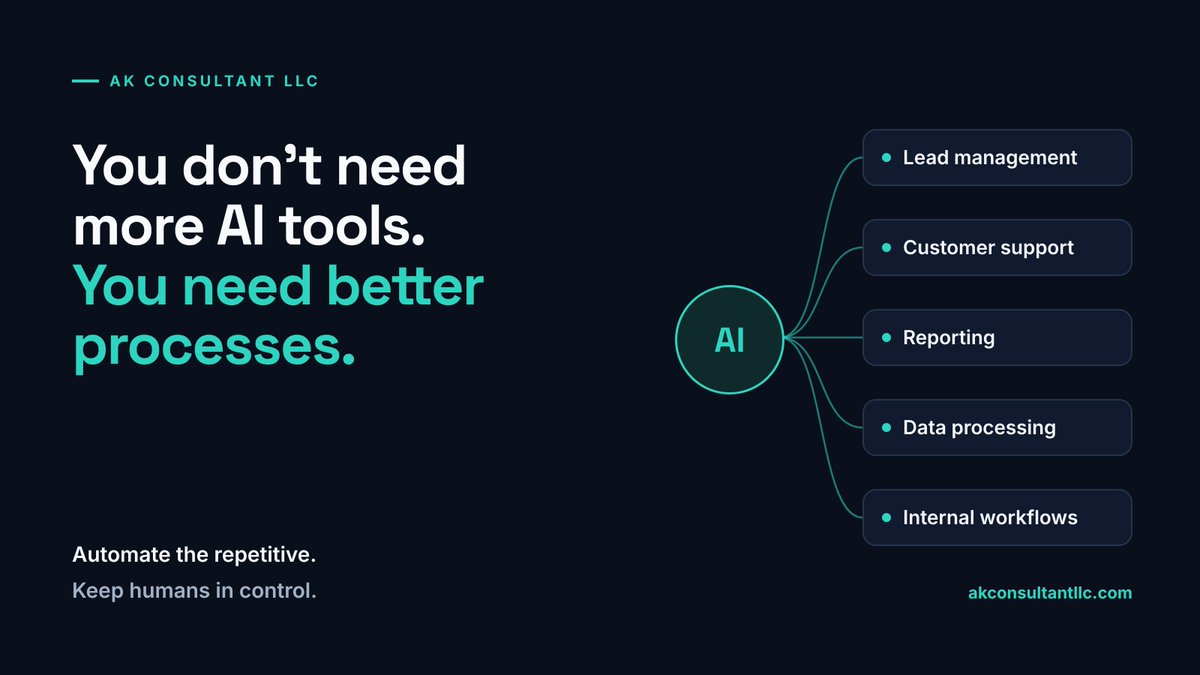
AI automation isn't about using more tools.
It's about reducing manual work.
From lead management to customer support, smarter workflows help businesses save time and scale.
Automate smarter. Grow faster.
#AIAutomation
@NickRestivo_@JPSkonieczny Hi, I've been following what you're building around sports media and the creator economy. I'm involved in AK Consultant LLC, where we work on AI-powered applications, automation and custom software. Always interested in connecting with founders building in the technology space.
@MonicaStankova1 Interesting concept! We build custom AI agents and software at AK Consultant LLC. Could you connect us with the founder to discuss the MVP?
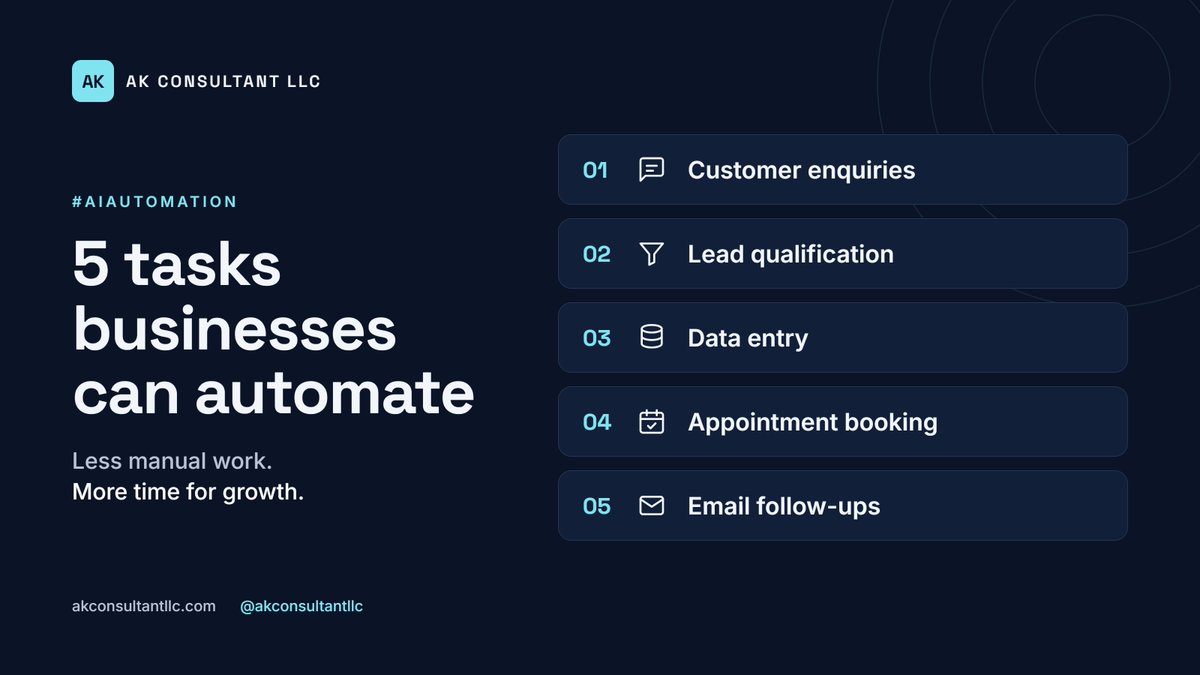
5 tasks businesses can automate:
Customer enquiries
Lead qualification
Data entry
Appointment booking
Email follow-ups
Less manual work. More time for growth.
#AIAutomation