Inna lillahi wa inna ilaihi raji'un. Condolences to Tun Dr Mahathir and family on the passing of Tun Dr Siti Hasmah. Memories of Dr. Sitti Hasmah as an exceptionally gentle and intelligent personality, when she visited the Maldives with you, sir, will remain with us. May Allaah Almighty grant her jannathul firdhous. Aameen
Indeed a man of honour, integrity and vision. My classmate from the Class of 1972, a good friend, and much respected colleague in public service. May Allaah grant him Jannathul Firdhous. Aameen
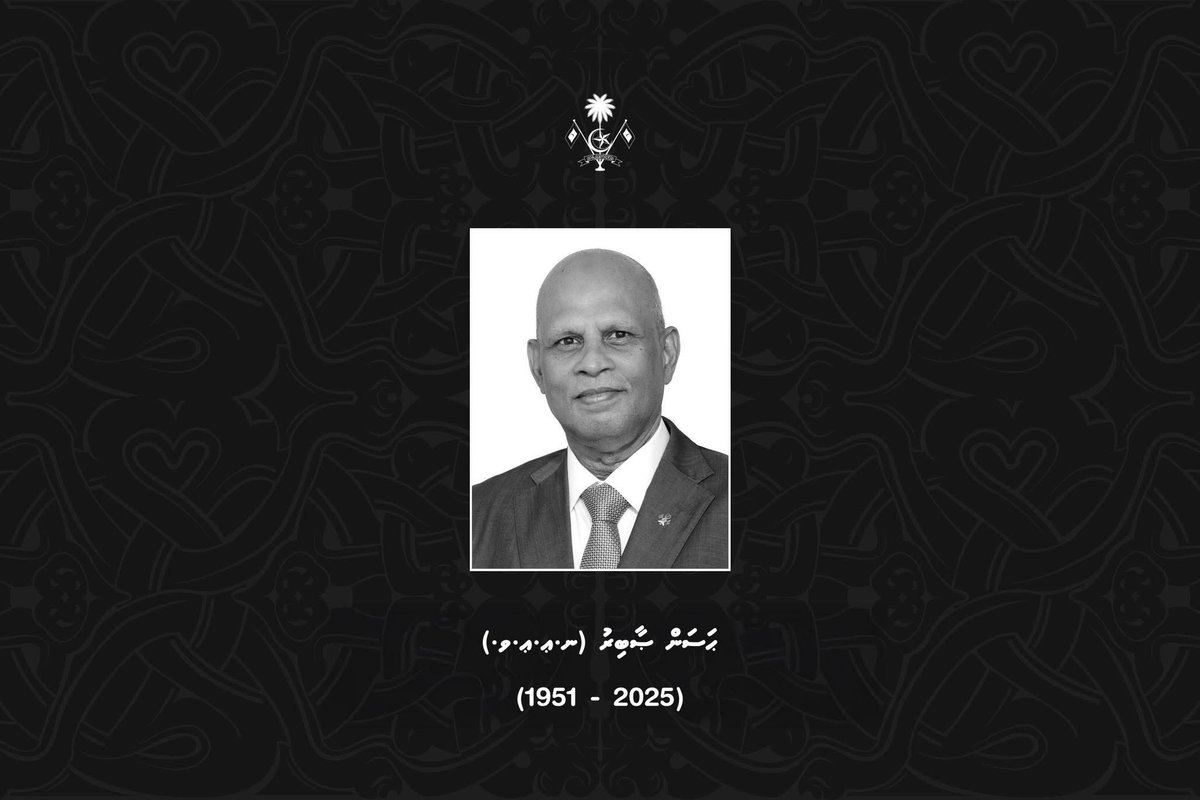
One year ago today, at 07:31 in the hospital of Malé, we lost His Excellency Hassan Sobir, my dear friend, my mentor, and one of the most important people in my life.
On 27 July 2025, the day before he passed, he was awarded the Order of Izzuddin, the highest honour of the Maldives. Because his health had declined, his daughter accepted the award for him. Knowing he received this recognition at the very end of his life makes it even more meaningful, a final tribute to the man he was: dedicated, principled, and deeply respected.
My family and I send our deepest condolences to his loved ones. We stay close, and we pray that God grants him eternal peace and grants you strength as we remember him today.
His memory lives on, always
إنا لله وإنا إليه راجعون
Francis Fukuyama recently shared a compelling piece titled “The Myth of Authoritarian Efficiency” by political scientists Jørgen Møller and Svend-Erik Skaaning (Aarhus University / V-Dem project).
The article dismantles the popular notion that authoritarian regimes—particularly China—are simply better at “getting things done.” Drawing on historical data and comparative evidence, the authors argue that democracies consistently outperform autocracies over the long term across critical domains:
• Military effectiveness: Democracies have won more than 80% of wars since 1815. Greater legitimacy enables citizens to make greater sacrifices, and democratic alliances prove more durable.
• Economic performance: While autocracies can drive catch-up growth to middle-income levels, they struggle to transition to innovation-driven, knowledge economies that require rule of law, intellectual property protection, and open debate. High-quality democracies show a modest but robust long-run growth advantage.
• Avoiding catastrophe: Autocracies periodically produce large-scale man-made disasters (Mao’s Great Leap Forward, Soviet collectivization). Institutional checks and public scrutiny in democracies make comparable failures rare.
• Crisis management & environment: Transparency, independent science, and accountability lead to better outcomes on pandemics, climate policy, and environmental indicators. China’s zero-COVID flip-flop and overstated economic statistics illustrate the risks of centralized, unaccountable decision-making.
The authors acknowledge democracies can be slow and messy, but emphasize that self-correction mechanisms ultimately make them more resilient and effective than systems that concentrate power without feedback loops.
Francis Fukuyama, author of the landmark book The End of History and the Last Man, continues to spark important conversations about the enduring strengths of liberal democracy in an era of renewed authoritarian confidence.
Full article (highly recommended):
https://t.co/rdLYptPLnY
What’s your take—do you see evidence of this “myth” playing out in emerging markets or great-power competition today?
#Democracy #Geopolitics #China #EmergingMarkets #InternationalRelations #PoliticalEconomy
Famous American woman Jennifer Grout, who embraced Islam, recited the Holy Qur’an in her beautiful voice on the Al Jazeera channel. Watch how beautifully she is reciting the verses of the Holy Qur’an!
https://t.co/Rt96xz9YDl
Rising oil prices will hit all, more so Maldives, making our exports more expensive.
Economic uncertainty & rising living costs will deter holiday travel affecting our tourism industry.
We have to prepare as a nation, as companies & at the personal level
#DhivehiArchives
This is D. Ahmed Didi. He founded Ahmadhiyya International School in Machchangolhi Ward, which opened on 21 February 1982. It was one of the four schools established in each of Malé's four wards at the beginning of President Maumoon Abdul Gayoom's presidency.
The school building was originally started by the people of Machchangolhi Avah (Avah), but the project was not carried out for various reasons and stalled. D. Ahmed Didi later took over the school, completed it at his own expense, and ran it entirely at his own expense in the initial stage.
It opened on 21 February 1982 as "Madrasath al-Ahmadhiyya," named after the founder himself, unlike the other ward schools, which were named after their respective wards.
D. Ahmed Didi introduced many different business innovations to the Maldives. This included designing the bazaar shops in a modern way. From the junction of Chaandhanee Magu and Fareedhee Magu to the north, up to Orchid Magu, the shops were modernized under his initiative. The area was then called the "Singapore Bazaar."
He was the person to open the first modern standard style air-conditioned restaurant in Malé in the 1970s. He also brought trained chefs and waiters from Sri Lanka. The name was "Camillo Restaurant."
He was at the forefront of importing goods from Singapore. The first circus was brought to the Maldives by D. Ahmed Didi. He also held shows with foreign musicians.
He was a very kind man who helped many people with medical assistance and other things.
These details are taken from a Facebook post by Mohamed Muizz Adnan.
The original black-and-white photo of him was published in a 1992 issue of the Haveeru newspaper. The colorized version was colorized with AI.