Akekathed Sanglub, Ph.D.
Interested in AR, Digital Twins, Imagineering Education, Digital Storytelling, Active Learning, Digital Competence, Digital Literacy.
AI Agents = LLMs + orchestration 🚀
Here are the main types of LLMs powering them 👇
🧠 General-purpose (GPT, Claude)
⚙️ Domain-specific (Legal, Finance, etc.)
📚 RAG-based (real-time knowledge)
🤖 Tool-augmented (API actions)
🧩 Open-source (LLaMA, Mistral)
The game is no longer the model.
It’s how you combine them. 🔥
#AI #LLM #AIAgents #GenAI
AI tools aren’t competing — they’re completing. ⚡
Pick the right brain for the right job: ChatGPT for creativity ✍️
Perplexity for research 🔍
Grok for trends 📊
Gemini for productivity ⚙️
Work smarter, not harder. 🚀
RAG has three generations. Most teams are still on the first one. 🧠
Classic RAG → Retrieves
Fast, simple, single-hop. Perfect for FAQs and policy lookups.
Graph RAG → Connects
Entity-rich and relational. Shines when the answer lives *between* documents, not inside them.
Agentic RAG → Reasons
Adaptive, multi-step, self-correcting. The agent chooses its own tools and checks its own work.
The upgrade path isn’t about complexity for its own sake — it’s about matching retrieval to the shape of the question.
Classic RAG handles “what.” Graph RAG handles “how are these related.” Agentic RAG handles “figure it out.”
Save this for your next architecture review. 📌
Which generation is your team building on right now? 👇
Credit: codewithbrij
#RAG #AIEngineering #LLM #AgenticAI #generativeai
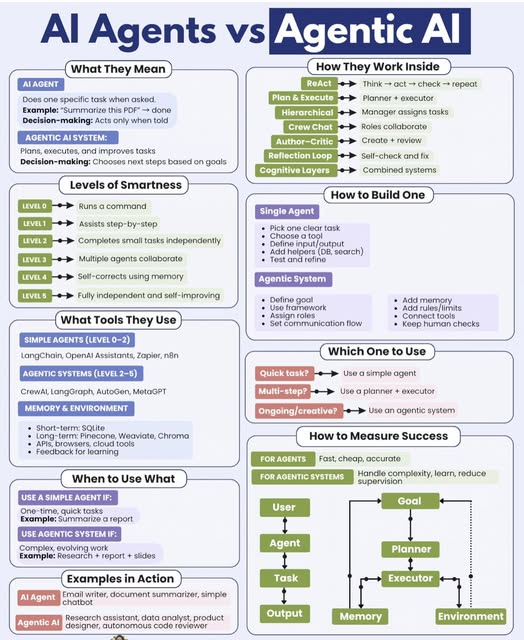
𝐀𝐈 𝐀𝐠𝐞𝐧𝐭𝐬 𝐯𝐬 𝐀𝐠𝐞𝐧𝐭𝐢𝐜 𝐀𝐈 𝐢𝐬 𝐰𝐡𝐞𝐫𝐞 𝐚 𝐥𝐨𝐭 𝐨𝐟 𝐩𝐞𝐨𝐩𝐥𝐞 𝐠𝐞𝐭 𝐜𝐨𝐧𝐟𝐮𝐬𝐞𝐝 𝐫𝐢𝐠𝐡𝐭 𝐧𝐨𝐰.
And that confusion is costing teams time, money, and clarity.
An AI agent is simple.
You give it a task. It gives you an output.
It doesn’t think ahead. It doesn’t plan. It just responds.
𝐄𝐱𝐚𝐦𝐩𝐥𝐞
↳ Summarize a document
↳ Write an email
↳ Generate code snippet
That’s useful. But limited.
Agentic AI is a different game.
↳ It doesn’t just respond.
↳ It decides what to do next.
It can plan → execute → review → improve
Sometimes with multiple agents working together
𝐓𝐡𝐢𝐧𝐤 𝐨𝐟 𝐢𝐭 𝐥𝐢𝐤𝐞 𝐭𝐡𝐢𝐬:
↳ Agent = Intern who does what you ask
↳ Agentic AI = Team that understands the goal and figures things out
This is why people struggle while building with AI.
They try to solve complex workflows using simple agents.
And then say
“AI doesn’t work”
It does. You’re just using the wrong layer.
If your use case is:
• One-time tasks → use a simple agent
• Multi-step workflows → use planner + executor
• Ongoing, evolving work → build an agentic system
The real shift is not tools.
It’s thinking in systems instead of prompts.
The people who understand this early will build faster
Automate better
And need less manual effort over time
The rest will keep writing better prompts for problems that need better architecture
If you’re building in AI right now
Start asking this before anything else:
Am I solving this with a tool or designing a system?
#LLM #AIEngineering #AgenticAI #RAG
Azure Cloud Mindmap: A Practical Guide for Azure Engineers
1⃣ Compute & Containers:
→ VM & App Service: Deploy virtual servers or managed web apps quickly.
→ AKS & ACI: Orchestrate Kubernetes clusters or run serverless containers.
→ Functions: Execute event-driven serverless code at scale.
2⃣ Networking & Content Delivery:
→ VNet & Subnets: Create isolated private networks for your resources.
→ Front Door & ExpressRoute: Optimize global routing and establish private cloud connections.
→ Load Balancer & DNS: Distribute traffic and manage domain records efficiently.
3⃣ Storage & Databases:
→ Blob & Disk Storage: Scalable object and block storage for any workload.
→ SQL Database & Cosmos DB: Managed relational and globally distributed NoSQL databases.
→ Redis Cache: High-performance data caching for faster application response.
4⃣ Security & Identity:
→ Entra ID & Key Vault: Manage identities and secure your cryptographic keys.
→ Microsoft Defender & Sentinel: Advanced threat protection and SIEM/SOAR capabilities.
→ Azure Policy: Enforce organizational standards and assess compliance.
5⃣ DevOps, IaC & Integration:
→ Azure DevOps & Terraform: Manage your full CI/CD lifecycle and infrastructure as code.
→ Bicep & ARM Templates: Native Azure tools for resource provisioning.
→ Service Bus & Event Grid: Build reliable, decoupled, and event-driven architectures.
6⃣ Big Data & Analytics:
→ Data Lake & Databricks: Store massive datasets and perform high-speed processing.
→ Synapse Analytics: Unified analytics service for data warehousing and big data.
→ Data Factory: Orchestrate data movement and transformation at scale.
7⃣ Monitoring & Management:
→ Azure Monitor & Log Analytics: Track system health and collect diagnostic logs.
→ Application Insights: Deep observability for monitoring live application performance.
Are you focusing on the Azure ecosystem this year? ☁️
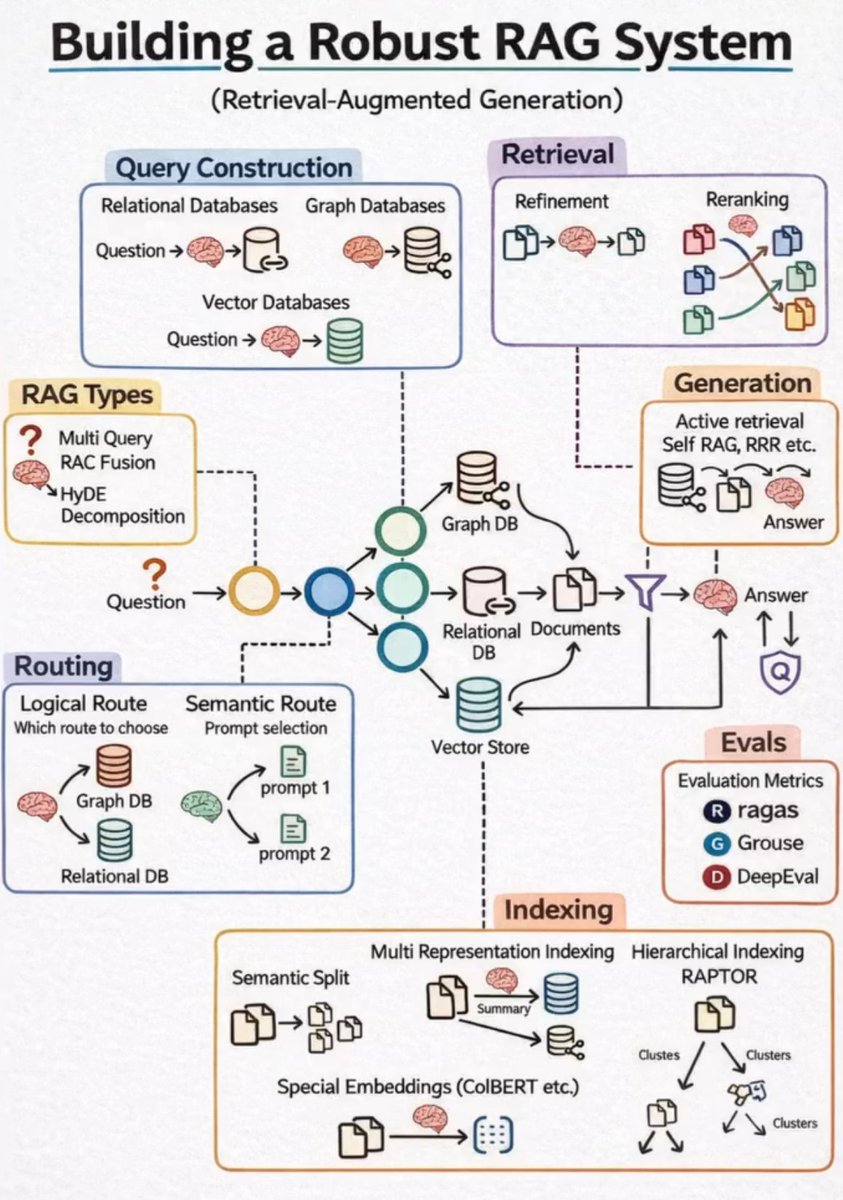
Building a Robust RAG System isn’t just about plugging in a vector database — it’s about designing an intelligent pipeline that balances retrieval accuracy, routing logic and evaluation rigor.
A well-designed RAG architecture includes:
• Advanced Query Construction using relational, graph and vector databases for contextual understanding
• Intelligent Routing (logical + semantic) for optimized prompt selection and system efficiency
• Multi-stage Retrieval with refinement and reranking to improve relevance and reduce hallucination
• Flexible Generation strategies like Self-RAG, RRR and active retrieval loops
• Robust Indexing pipelines including semantic chunking, hierarchical clustering (RAPTOR) and specialized embeddings (ColBERT)
• Continuous Evaluation using frameworks like RAGAS, Grouse and DeepEval for measurable performance
Modern AI systems demand more than just LLMs — they require strong data pipelines, retrieval precision and evaluation discipline.
If you're building scalable AI products, your RAG system architecture is your competitive advantage.
#RAG #GenerativeAI #AIArchitecture #MachineLearning #LLM #DataEngineering #AIEngineering