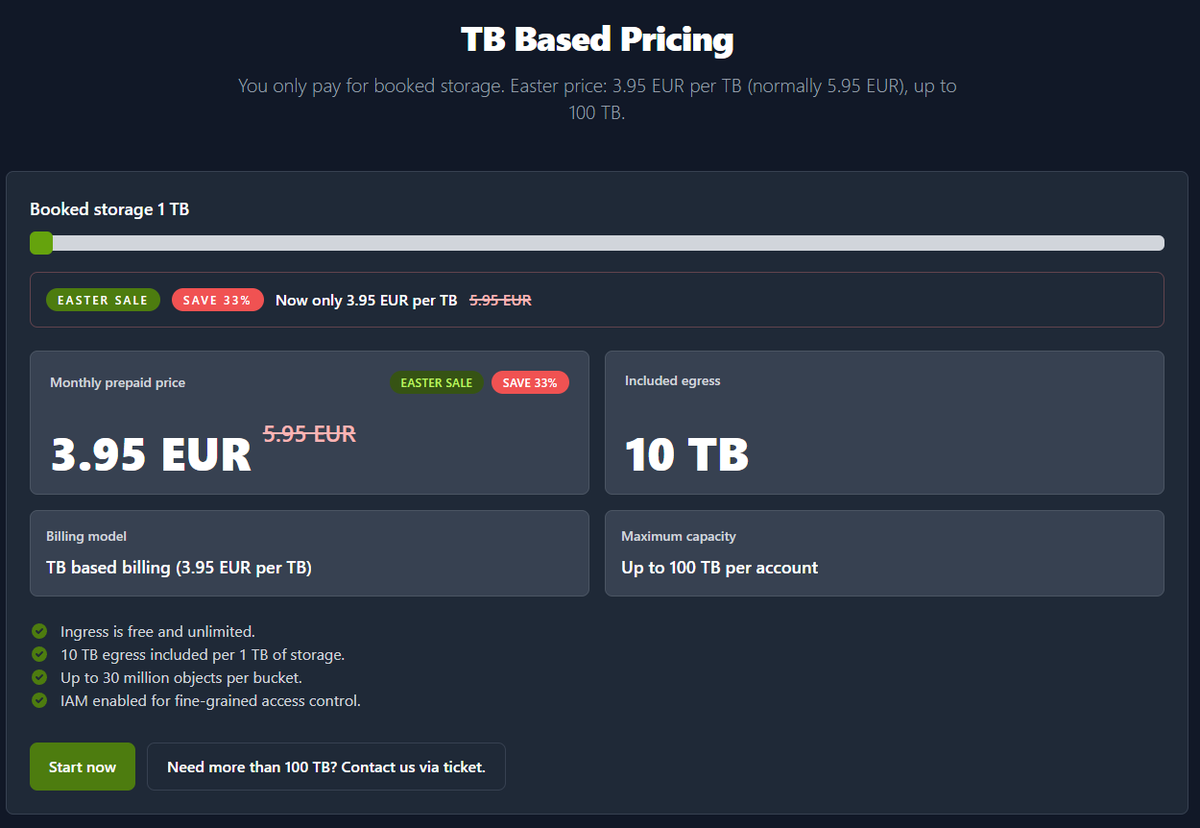
I definitely suggest anyone to tryout @DatalixDE object storage (S3 compatible) for their cheapest offering in the market. I'm sharing napkin figures against popular and 2nd cheapest.
Against popular AWS S3 at 19.73 eur it is 5x cheaper.
Against 2nd cheapest Blackblaze at 5.15 eur it is 1.3x cheaper and also offers free 3x outgoing traffic.
🐰 Looking for affordable S3 compatible Object Storage? Our Easter Sale is live ✅
- Just 3.95€ / TB (33% off!)
- 10 TB Egress included per TB & Free Ingress
- Easy integration, IAM enabled
- Built for backups, media, app data & more
Get yours now at:
https://t.co/Hkv0vfhpgn
To all those very clever people pointing out that nothing should be running <10% efficiency:
"even if the choice of C were to do *nothing* but keep the C++ programmers out, that in itself would be a huge reason to use C"
I kept hitting the same wall.
Maps for India scattered, no clear provenance, formats gatekept, no easy way to share your own.
So I built bharatlas. The wiki for India's maps.
View, slice, download. Drop your own to publish. Open data, open code.
→ https://t.co/oNGTxymmPy
SpaceX has almost finished writing V1.0 of an in-house AI training stack in C that exact-maps to 220k GB300s with 800G NICs, making heavy use of pipeline parallelism and getting as close to bare metal as possible.
The potential speed improvement vs JAX for large training runs is over an order of magnitude.
Andrew is relentlessly building the world’s most powerful systems programming language (and toolchain).
He has my full support and trust (and frankly, sheer gratitude for holding firm on quality).
Props to @jetbrains for putting together a terrific interview.
https://t.co/4rFgmyTrCz
This video clears up a lot of philosophical dilemmas in choosing Rust or Zig.
As likely said by Zach in the video, LLMs over-engineer solutions and are susceptible to memory footguns. Rust would be the right language for LLM code generation but comes at the cost of readability.
Zig, on the other hand, helps express thoughts in simple code with less cognitive load.
He also explains why code readability wins in the long run and why he favours zig over rust
My new article, "System Calls", is the second piece in my Linux kernel series, and it picks up right where the boot article left off.
When the kernel handed control to `/sbin/init` at the end of boot, it didn't give up power - it just changed mode. Userspace is sandboxed by hardware. `bash` can't print to the terminal, `cat` can't read a file, `curl` can't send a packet. Everything has to go through the kernel via system calls.
One thing that you need to know is syscalls are NOT a function calls. It's a full hardware privilege transition. The `syscall` instruction itself does surprisingly little - saves two registers and jumps to a fixed address. The kernel has to do the hard work in hand-written assembly before any C code is allowed to run the real syscalls' specific handlers.
Read it here: https://t.co/bgF752IAVE
#Linux #Kernel
Grok foundation model V9-Medium (1.5T) has finished training. Evals look good. A lot of Cursor data was added in supplementary training and there is more to come.
Fine-tuning is underway and reinforcement learning begins in a few days. 2 to 3 weeks to public release.
This will be a major improvement over the 0.5T v8-small that currently serves all Grok production traffic, especially for difficult coding tasks.
So software built with @zml_ai runs transparently at max speed on:
- CPU
- NVIDIA GPUs
- AMD GPUs
- Google TPUs
- AWS Trainium
- Intel GPUs
- Tenstorrent NPUs
- Apple GPUs (very experimental)
And more to come.
“Japanese economy doesn’t work on performance based pay”
An interesting read on Japanese employee working for a single company until retirement, generalists over specialists, no lay offs during tough times.