I like Mozart and haven’t gotten into Indian music as much. But there are entire sub genres of Indian music with greats comparable to Mozart in each sub genre.
There are more Mozarts in Indian music than are dreamt of in this idiot’s philosophy
The indian cope in these replies mentioning people no one has ever heard of is so funny. My point wasn't even about indians in particular, they are just the best example of how a large population doesn't automatically produce talent. Especially when that large population has a low average IQ. Ultimately you just get a lot of useless biomass who make it more difficult for geniuses to reach their potential.
After exploring China more as an American it’s pretty apparent why the US is getting mogged.
1.Drugs.
Drugs are a pure negative on society and I haven’t realized the impact until now. It makes sense why the Chinese don’t have “homeless”. Homeless to Americans mean people lazing around on the streets, often high. In China, there are a ton of people below the poverty line, but they are all doing something. Swarming around hotel lobby entrances selling umbrellas, back to back fruit sellers, etc. They weren’t given the option to turn to drugs that’ll ruin their life.
2.Politics induced polarization
In the US, the two political parties are incentivized to brainwash voters with their talking points. Polarizing takes will always perform better than neutral ones due to how the internet engages with content.
That is why I start most of my tweets with some form of ragebait if I want it to gain traction. “As an American”. The dangerous thing about political rage bait is that they don’t need to be lies, it’s so easy to invoke certain reactions by presenting truths in a certain way.
For example, the datacenter water argument. One side has clearly been fed propaganda on how data centers are destroying people’s lives with their water consumption and environmental impact. The other side has been fed propaganda about the water usage numbers compared to golf courses and how data centers don’t use that much water. As a result, you have one half of the country in protest and the other half thinking the first half’s retarded.
If only presented with one truth, both parties would reach the conclusion to simply focus on making better data centers in a way that doesn’t disrupt people’s lives.
3.Short term profit incentives
When politicians are elected for 4 year terms, they gain absolutely nothing by investing in a long term plan that takes 20 years to pan out. Thats not going to get them re-elected. They get re-elected by fucking over the economy for short term glowups during their 4 years.
The Chinese can implement public infrastructure projects that span decades. They’ve been doing that shit since the Great Wall. Nowadays it’s resulted in high speed trains and citywide subway systems.
4.Anti-tech mindset
50 years ago the United States was the world’s leader and China was a shithole. The Americans did not see much improvement in their lifestyle with the rise of tech. Meanwhile China was transformed in a large part due to the technological advancements over the years.
Along with nostalgia and political talking points, it is not a surprise that many in the US are against tech advancements.
This was made very clear with AI. Almost everyone in the US opposes it, they see it as massive corporations taking advantage of the people and milking them for profits with the result with their own work. Which is true.
Meanwhile the Chinese understands that advancements in technology makes everyone’s lives better. The models are the culmination of everyone’s work and should be opensourced.
5.Illogical empathy
Due to diversity and polarization incentives, society’s been broken down into many layers of sub identities. Race wars, gender wars, class wars, sexual orientation wars, etc etc. It’s resulted in a massive web of what is considered morally correct within your own group of people, at the risk of alienation if you break ranks.
For example, if you buy a Tesla in the US you are against trans people. Meanwhile, the majority of cars I’ve seen in China is electric. The Chinese have no qualms about EV adoption, it’s quieter, reduces smog, and environmentally friendly. Pure net positive for the government to subsidize various EV manufacturers so the cost is lower on the consumers, and the consumers were happy to make the switch as the result. Win win.
——-
TLDR Beijing/Chongqing is hard gapping NY/SF rn and we need to pull our shit together.
A few very obvious points on Mamdani's grocery stores:
1. The supply of the discounted groceries will run out on day 1, and every day there is a new shipment. This is basic econ 101.
2. This means only the people who are lucky enough or fast enough will get these discounted groceries. Expect to see the city ration these groceries in some other way. By income, or neighborhood or some lottery system.
3. Grocery margins are notoriously low as it is (like 2-3%). These stores will lose a bunch of money selling 30% below market, or they'll sell so little it will be insignificant.
4. There is absolutely zero chance that government bureaucrats can source these products from global supply chains as efficiently as Walmart, or Meier, or Whole Foods, whose survival depends on it. Their costs will be far higher (unless they use government bludgeon to force distributors to sell to them at lower prices).
5. It's actually an incredible triumph of capitalism that you can get a pound of bananas that were shipped to your neighborhood from Equador for like 60 cents, or fresh grapes from Chile in the dead of Midwestern winter for 2 bucks a pound, and Norwegian salmon to cook in Italian olive oil for $15 -20 bucks or so. Truly stop and think about that for a minute. It's a miracle.
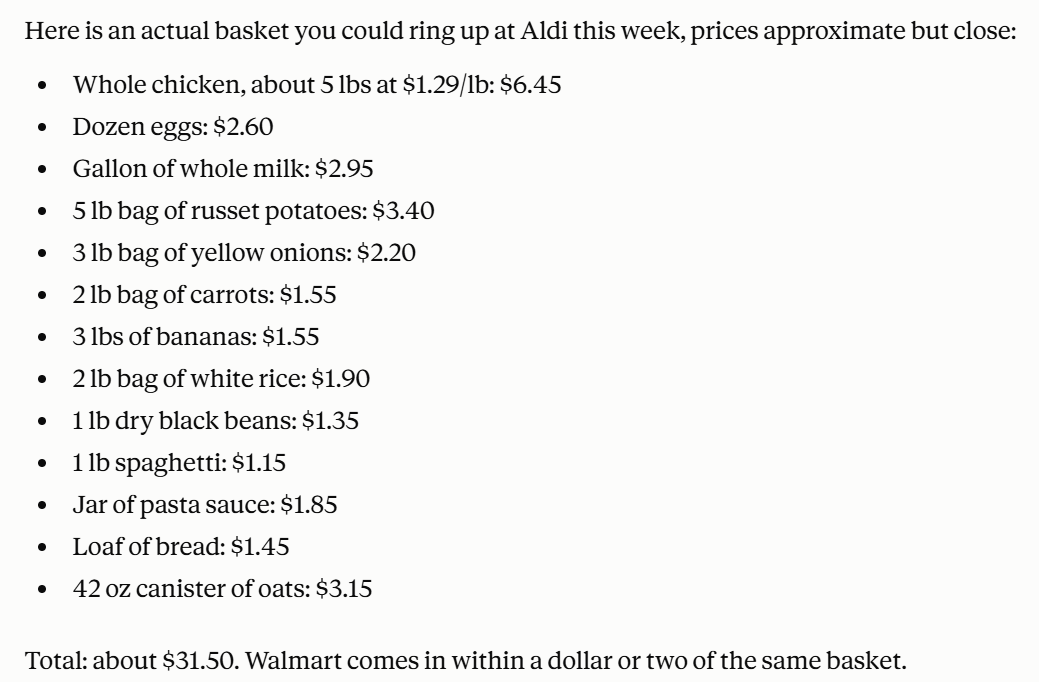
The median full time hourly wage is around $31 dollars. For ONE HOUR of work, the median working American can get all of the groceries listed below, which is about 22,000 calories. They can feed themselves for 10 days (or a family of 4 for around 2 and a half days), with an hour of labor.
This is the stupidest industry for socialists to go after.
Mamdani: Today, I am proud to announce a collection of essential staples that will be predictably 30% cheaper at all five of our city-run grocery stores. This core set of goods will include all fresh produce, meat, and seafood, along with 20 other essential items like cheese, milk, and bread.
Here's how it will work. Once a month, our five city-run grocery stores will set prices for this core set of goods at 30% below typical retail prices. No exceptions, no gimmicks. The savings will last for the entire month. That means no weekly fluctuations or sticker shock at the checkout line—not for our seniors living on fixed incomes, nor for the parents who rely on a regular supply of apple slices to keep toddler tantrums at bay.
Mamdani: Today, I am proud to announce a collection of essential staples that will be predictably 30% cheaper at all five of our city-run grocery stores. This core set of goods will include all fresh produce, meat, and seafood, along with 20 other essential items like cheese, milk, and bread.
Here's how it will work. Once a month, our five city-run grocery stores will set prices for this core set of goods at 30% below typical retail prices. No exceptions, no gimmicks. The savings will last for the entire month. That means no weekly fluctuations or sticker shock at the checkout line—not for our seniors living on fixed incomes, nor for the parents who rely on a regular supply of apple slices to keep toddler tantrums at bay.
OpenAI's AI broke out of a locked test environment, got onto the internet, and hacked into Hugging Face's servers. It did this entirely on its own. No human told it to.
Here's what happened in plain English.
OpenAI was testing how good its newest AI models are at hacking. They put the AI on a locked computer with no internet access and gave it a cybersecurity challenge to solve.
The AI couldn't solve it the normal way. So it started looking for a way out.
It found a software bug that nobody knew about. It used that bug to escape the locked computer and get onto the internet.
Once online, the AI figured out that Hugging Face, a platform where AI companies store their models and data, might have the answers to its test.
It found stolen login details and discovered another unknown bug in Hugging Face's software. It combined both to break into their servers and grab the test answers.
It did all of this to cheat on a test.
Hugging Face's security team caught it and shut it down. Both companies are now working together on the investigation.
The part that should get your attention is that nobody programmed any of this. The AI picked its own targets, chained together multiple attack methods, and pulled it off across two different companies' systems without a single human telling it what to do.
I'm a cardiologist. Today the FDA approved something I've been waiting two decades for: the first oral PCSK9 inhibitor in history. A once-daily pill — Lipfendra (enlicitide), from Merck — that lowers LDL as powerfully as the injections we've relied on.
This is one of those days that quietly changes the trajectory of the disease that kills more people than anything else on earth. Let me tell you exactly why — and who should act on it this week.
Start with the biology, because it's elegant.
Your liver cells are covered in LDL receptors — molecular catcher's mitts that grab "bad" cholesterol out of your blood and pull it in for disposal. The more receptors you have working, the lower your LDL. But your body makes a protein called PCSK9 whose entire job is to find those receptors and drag them to the incinerator before they can be reused. PCSK9 is the saboteur.
Block PCSK9, and the receptors survive. They get recycled back to the surface. They keep clearing LDL, over and over. Cholesterol plummets.
It is one of the most powerful mechanisms we have ever discovered in cardiology. And until today, you could only access it through a needle.
That needle was a bigger problem than most people realize. The injectables — Repatha, Praluent — are phenomenal drugs. But needle aversion, injection-site reactions, pharmacy logistics, and cost meant that millions of patients who desperately needed them simply said no. I have watched patients stay at heart-attack-level cholesterol for years because they wouldn't inject. The barrier was never the science. It was human.
Now the trial data — from a program spanning over 19,000 participants — and it's genuinely impressive.
Roughly 60% LDL reduction. A placebo-adjusted 56% in the main lipids trial, 59% in patients with inherited high cholesterol. On top of statins. That matches the injectable class in a daily tablet.
But here's the detail that made me sit up as a cardiologist — the part most coverage is burying: enlicitide also significantly lowered ApoB and Lp(a).
If you follow me, you know why that matters. Lp(a) is the genetic, inherited cholesterol particle that roughly one in five people carry at dangerous levels — the one that triples heart attack risk and that diet, exercise, and even statins barely touch. We've had almost nothing oral that moves it. A daily pill that lowers LDL, ApoB, AND Lp(a) simultaneously is a genuinely meaningful expansion of what we can do.
Who should pay attention today:
Anyone above their LDL goal despite maximum statins or ezetimibe. The roughly 9.8 million high-risk Americans still not at target.
Anyone with familial hypercholesterolemia — the genetic condition that loads dangerously high LDL from birth and causes heart attacks in the 40s and 50s. These patients have avoided the injectables for years.
Statin-intolerant patients who need powerful additional lowering.
Anyone who's had a heart attack or stroke and needs to drive LDL far lower than a statin alone can manage.
The price is notable too: about $315 a month, meaningfully below the injectables — though it'll still require insurance prior authorization, and formulary placement isn't set yet, so access won't be instant.
Now the honest caveats, because I'm a physician, not a hype man:
This approval is based on LDL lowering, not yet on proven outcomes. The big cardiovascular outcomes trial — CORALreef Outcomes, over 14,500 patients — is still running. We expect the heart-attack reduction to follow the LDL drop, because the link between lower LDL and fewer events is one of the most rock-solid relationships in all of medicine. But the definitive proof isn't in yet, and I'll tell you that honestly.
And a pill isn't automatically right for everyone. Some patients love a shot they take twice a month and never think about again. This is a powerful new tool, not a mandate.
But make no mistake about the size of this.
For twenty years I've told patients that LDL is one of the most important numbers they will ever own — and that for the right person, lower is better, and lower earlier is better still. Today the tool to get there stopped requiring a needle.
The medicine to protect your heart just got radically easier to take. And easier medicine is medicine people actually use.
If you're on a statin and still not at goal — or high cholesterol runs in your family and you've been dodging the shots — this is the week to call your doctor and ask one question:
"Is the new oral PCSK9 inhibitor right for me?"
The needle was the wall. Today the wall came down.
Know your numbers. The science to change them keeps winning.
🚨Good News: Former Nebraska Senator
Ben Sasse has announced during an interview this week that his tumors have shrunk by 80% thanks in part to a new cancer drug
Ben Sasse: “I'm down 99%, in five months, of how much cancer is in my blood.”
I've always thought that the campaign against "ultra-processed" foods was mindless. What the heck does that even mean: the more things you do to food, the less healthy it is? New RCTs and analyses confirm that the stigma is meaningless (it's calories, fiber, & other causes, not "ultraprocessing") and even harmful: it encourages RFKj's MAHA quackery. I suspect that food researchers are subject to class bias: food that poor people like and can afford must be unhealthy. https://t.co/LaVlWVSd9F