Geotechnical Engineer | Educator | Mentor. Sharing practical lessons from engineering, teaching and research to help you learn, grow and make informed decisions
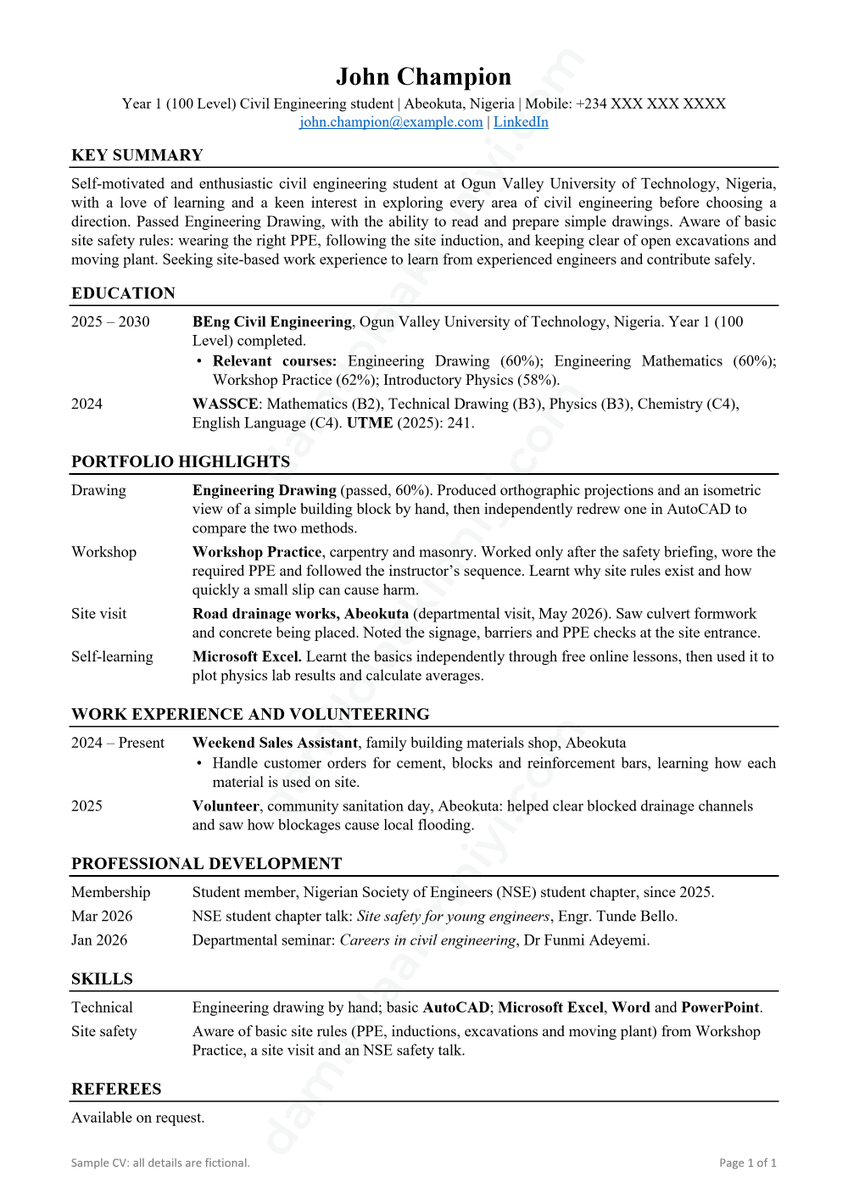
This is a sample CV for a Year 1 civil engineering student. Average grades. No design project yet.
Still, an employer can already see who he is: curious, careful on site and willing to learn on his own.
That isn’t luck. It’s a mindset, and it can be built from the first year.
The free first-year checklist and portfolio templates are here:
https://t.co/6ogqLHyrjI
Please share this with a student or graduate who would find it useful.
This is a sample CV for a Year 1 civil engineering student. Average grades. No design project yet.
Still, an employer can already see who he is: curious, careful on site and willing to learn on his own.
That isn’t luck. It’s a mindset, and it can be built from the first year.
I mentor engineering students, graduates and early career professionals worldwide.
Applications for the current programme have closed; the next starts in February 2027. It isn’t free, but it’s affordable.
Register your interest:
https://t.co/Q3GuM7sLYV
Do practice problems by hand before you use software.
If you can't estimate the answer, you can't tell when the computer is wrong.
Strong fundamentals are what make you an engineer, not just someone who clicks buttons in software.
Software changes every few years.
Engineering fundamentals don’t.
If you only master one thing at uni, make it the core theory of your field.
Here’s how 🧵
Test yourself: explain each topic out loud with no notes, as if you're teaching a younger student.
Where you get stuck is what you don't really understand yet.
Go back and fix it.
I’ve reviewed CVs from many international graduates in the UK who are struggling to get interviews.
So I built a 2-page sample CV for a graduate civil engineering role.
It’s a template to learn from, and here’s how to read an advert so your CV does the same.👇
No placement? A part-time job in a care home shows you can balance work with study, follow procedures and communicate under pressure.
You have more evidence than you think.
@TheOnly_Lucky 1) Don't specialize too early. Learn broadly.
2) Find an industry mentor. Reach out politely.
3) Use your holidays wisely. Go to any site near you (wearing a PPE), ask the Site Manager for shadowing opportunities.
4) There are lots of opportunities out there for you.
A young engineer was asked to estimate foundation settlement. A hold point was agreed to review key design assumptions.
He returned with the completed design before the hold point meeting.
I was concerned and asked him to explain his calculations.
His reply shocked me.
Using AI wasn't the problem. Not understanding the basics was.
While you're at university or as a recent graduate, don't outsource your understanding to AI.
Ask questions, read and learn the fundamentals.
Do hand calculations.
Understand the assumptions behind your results.