Omar and Khalil. Murdered by Israel today.
I interviewed Omar about six months ago, at the funeral of his friend, also murdered by Israel. Tomorrow I will be at the funeral of Omar himself.
There is no "circle of violence". Only a systematic massacre of the Palestinian people.
Mass funeral of 112 people in Gaza
This picture alongside millions will be a testament to the apathy, inaction, inhumanity of our brutal world.
We could’ve stopped it. You definitely could have. May it haunt the whole world.
@MayadeenEnglish The civilization you have today started from Saudi and Arab world and they you putting it down shows how arrogant you are. You and your proxies will soon be eliminated together with the bigger sheydan of Zionist
Absolutely incredible.
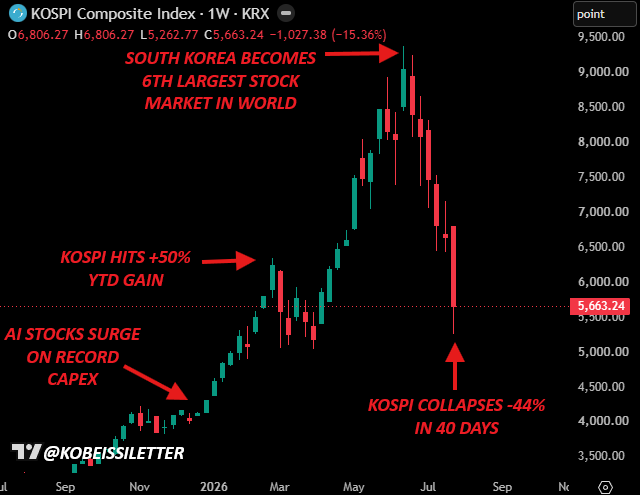
In an unprecedented move, South Korea's stock market just collapsed -44% in 40 days, erasing -$2 trillion in market cap.
Now, South Korea's finance ministry has announced plans to "stabilize" the market.
What is happening? Let us explain.
(a thread)
🚨 Palestinian man Sheikh Farouk Ramadan, whom Israel labeled a “terrorist” after he defended himself during a confrontation with armed settlers in the occupied West Bank village of Tel on Friday, was shot dead while unarmed, an analysis of four videos by +972 Magazine and Local Call found.
The footage undercuts the army’s claim that it “neutralized the terrorist who carried out the shooting attack,” as previously shared in a post by @ireallyhateyou account on X (see reply).
Reconstructing the incident from the footage, the outlets lay out the following sequence:
🔸 Armed settlers from the nearby Havat Gilad outpost entered the Palestinian village, and one struck Ramadan with his rifle. Residents came out to repel them and a scuffle broke out.
🔸 Ramadan wrestled that rifle away and fired it during the melee. This is the moment Israel calls a “terror attack,” but the weapon was a settler’s, seized on the spot.
🔸 He was then filmed walking slowly toward soldiers, unarmed, with nothing in either hand, before dropping to the ground. He was shot dead there, possibly by a settler, minutes after the gun had left his hands.
The outlets note the army only located the weapon in a search after the incident, confirming Ramadan was not holding it when he was killed.
Two Israelis and four Palestinians, including three of Ramadan’s relatives, were killed; Israeli media have reported the dead soldier (the second Israeli) was likely killed by friendly fire.
Goldman's base case for oil is $80 by year end, with $120 next year only if Hormuz stays shut.
JPMorgan is at ~$75 and calls a protracted disruption unlikely.
Neither are pricing for a regional war. They are arguing about how long a negotiation takes.
On Thursday oil crossed $100 a barrel for the first time since May, and gold fell 2.4% the same day.
It fell on the very day the war gained a second chokepoint at the red sea, and the US threatened its biggest attack yet.
The dollar hasn't moved.
So the stress lives basically only where the physical disruption lives; where tanker insurance is at 7.5% to 10% of a ship's value per Hormuz run.
Nothing has changed.
Capital has quarantined this 'war' inside the oil market, and it has kept it there through 5 months, 2 ceasefires and every escalation headline since February.
Every economy in this war is running out of road at its own speed.
Iran's currency is near 1.9 million to the dollar, inflation is near 89%, its oil license is cancelled, and China, the only customer left, cut purchases roughly in half rather than fight US banking sanctions.
The American president is at 36% approval with petrol near $4 a gallon and a House that just voted to end the war.
Saudi Arabia has a decade of investment plans that need quiet seas, which is why its first strikes on Yemen spared the port Yemen's economy depends on.
The one leader whose position genuinely improves with a bigger war is Netanyahu, facing an October election he is currently losing, and Trump is intentionally keeping him out of this for precisely that reason.
When every major player's dominant strategy points at settlement, the strikes are about the terms.
These terms have a date.
The June deal gave ships 60 days of free passage through Hormuz, that window ends around August 17, when a transit fee becomes the default after day 60 unless both sides agree otherwise.
Iran rejected two ceasefire offers this week because a truce that reopens the strait before that date would surrender its main bargaining position weeks before it matures, and with its economic options gone, the strait is the position.
Both sides kept negotiating through mediators the entire time they were firing. The strikes are how the final terms are being argued.
The militia network Iran spent 40 years building around Israel is gone.
Hezbollah silent through the entire war, Hamas 'finished' as a fighting force, Syria's weapons corridor closed, Iraq's militias reduced to background noise.
The Houthis blockade is aimed narrowly at Saudi shipping, justified by a purely Yemeni grievance, not Gaza, not Iran or Israel.
So the remnants of the war machine are generating the price that the peace-seekers will collect.
When the deal lands, the Houthis will stand down in exchange for Yemen's ports reopening, and the network exits this war one piece smaller than it entered.
There's going to be a deal around August 17-24. Maybe earlier.
Both straits reopen, the transit fee survives but is run by Oman under a scheme co-designed with Iran.
Al Jazeera Ends Contracts of 24 Gaza Journalists After Job-Security Assurances
Exclusive | Gaza24Live
GAZA — Al Jazeera has ended the contracts of 24 journalists and media workers in the Gaza Strip, according to members of the team, despite earlier assurances that they would be offered greater job security and future opportunities within the network.
The affected journalists said Al Jazeera director Asef Hamidi had reassured them in an email that they would not be abandoned and pledged to support their professional development and provide suitable positions across the network.
Instead, they said, their salaries were stopped and they were referred to a private company identified as “Media,” where they would be paid on a piecework basis without permanent contracts, insurance or clear employment protections.
The decision affected correspondents, camera operators and producers who covered the war in Gaza. Those named by the group include Mohammed Shaheen, Mohammed al-Sharif, Ayman al-Hissi, Hassan al-Zaanin and Ashraf al-Sarraj from northern Gaza, as well as Jamal Adwan, Alaa Salama, Ola Abu Muammar, Moaz al-Amour, Abdullah Abu Kamil and Talal al-Arouqi from southern Gaza.
Many of the journalists had previously worked for local and regional media organisations before Al Jazeera recruited them at the start of the war. They said they joined the network to bring Gaza’s story to a wider international audience and because they believed their relationship with the broadcaster was based on mutual professional commitments.
Some worked with the network for two to three years under bombardment and direct threats. Several were injured or suffered professional and personal losses, while others lost homes or family members but continued reporting.
In social media posts, the journalists accused the network of retreating from what they described as its moral and professional obligations. They said the transfer to an unstable piecework arrangement did not represent a fair alternative to their previous contracts or reflect the risks they had taken.
Some also raised concerns about a potential conflict of interest, alleging ties between officials at the private company and individuals with professional interests involving Al Jazeera. They said the head of a Gaza-based committee concerned with journalists’ protection also manages the company to which they were referred, and called for an independent review of the arrangement.
The journalists urged Al Jazeera to reverse the decision, honour its previous commitments and give them priority for future positions and projects.
They also called on the Palestinian Journalists’ Syndicate, rights groups and international media organisations to review their contracts and correspondence with the network and ensure that they are not compelled to accept work without legal protection, insurance or minimum job security.
The group said it was prepared to pursue legal action before Palestinian and international bodies, stressing that it was seeking fair treatment rather than exceptional privileges.
“We are asking for treatment that reflects the risks and sacrifices we endured during the war and protects our dignity and professional rights,” the journalists said.