Dmitriy is blogging about speeding up #MySQL by putting its code to huge pages. The library implementing that is on Github, and we believe it is more advanced than alternatives.
Our team started blogging about #mysql#performance by describing our work on the simulation model of threadpools in MariaDB and Percona Server. https://t.co/oUWT6tWDm0
For the last year or so I've started a survey of interesting design ideas about B-tree and related stuff. Never though it would be so deep and interesting. Many whitepapers later I've finally managed to put it together (at least partially).
https://t.co/IfoNxw8GT5
I can't believe it!😅
After more than a year of writing, I finally released my first book.🎉
Read it to understand your application's performance on a modern CPU and learn how to improve it.
Available for FREE download (PDF) today!⤵️
https://t.co/oTVC0C6tqW
Please RT!
(1/4)
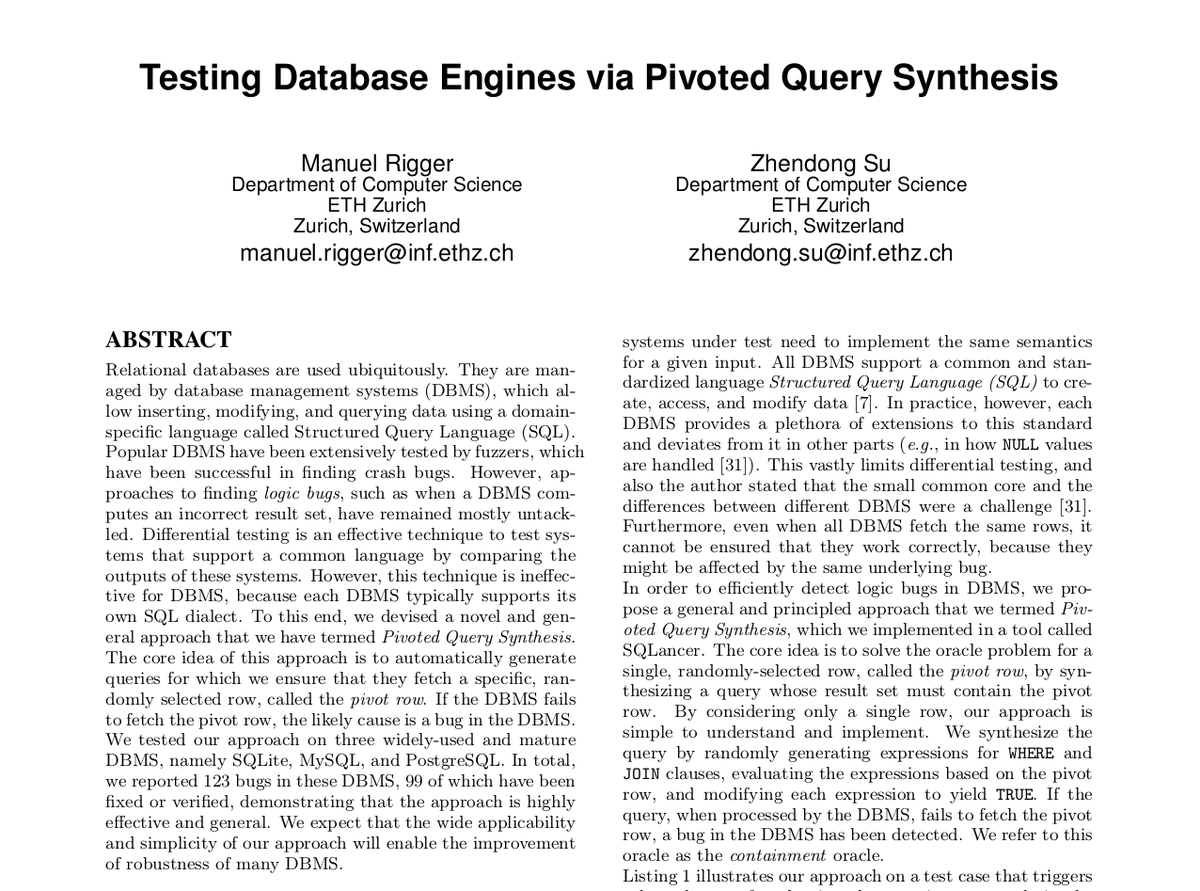
We propose Pivoted Query Synthesis (PQS), a new approach for finding logic bugs in DBMS (see https://t.co/NboQkq969d). Using PQS, we found ~100 previously unknown (and many critical) bugs in widely-used DBMS (e.g., SQLite3, MySQL, and PostgreSQL). Work with @zhendongsu.
We open sourced tcmalloc!
https://t.co/pfpxxd93ll
Includes per-CPU caching mode indispensable for highly-threaded servers&extensive huge page support.
Lots of worthy things for low-level hackers.
I contributed to it a bit incl cache capacity balancing
https://t.co/cLzu6CLpcq
1/2
This looks pretty cool from Google. Analyzing scheduler task migration on machines with lots of CPUs is a pain without visualisation tools.
https://t.co/8uKh9y1Ruy
"Is Parallel Programming Hard, And, If So, What Can You Do About It?" by @paulmckrcu
Free 500-page book/pdf covering hardware,counting,partitioning and design, RCU, data structures, verification, memory ordering and more and of course famous quick quizzes!
https://t.co/6YXoXCC5dp