Of all the concepts, I have tried to learn and implement in my life to make it better, the following 4 have had the deepest impact.
Especially relevant in the high noise, polarized, competitive society high on social media that we live in today
They are given below.. (1/n)
One of the #most expensive #property transactions in India. Essel Group chairman(Zee Group) Subhash Chandra is selling prime bungalow in Lutyens' Delhi for ₹1,260 crore. The property was bought in 2015 for ₹304 crore. This
property's value appreciated by 314.5% over 11 yrs.
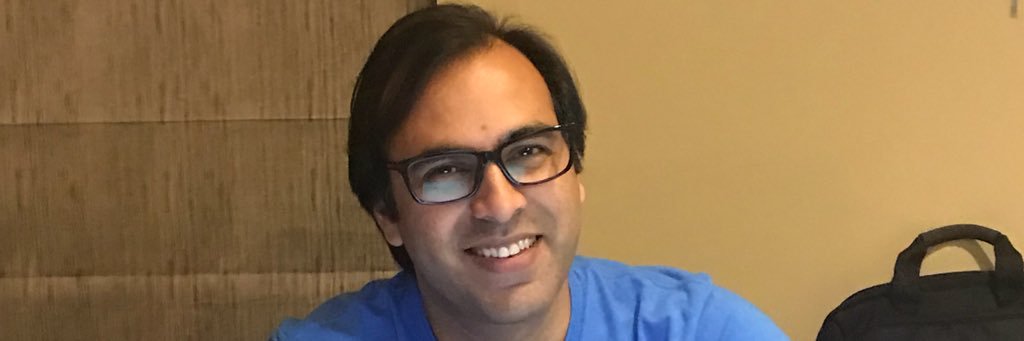
His name is Soumith Chintala.
He grew up in Hyderabad and went to a good school, but he was bad at mathematics. He studied at VIT in Vellore, a college that does not carry the prestige of an IIT.
When he finished his degree and applied to twelve universities in the United States for a master’s programme, every single one rejected him, despite a strong GRE score.
He went to the United States anyway.
He applied again, this time to fifteen universities. All rejected him except two.
In 2010, he joined New York University. There he met a professor named Yann LeCun, who was not yet famous, and began working in his lab on a then unfashionable field called deep learning.
The rejections did not stop.
He applied to DeepMind and was rejected. He applied for jobs across the industry and was rejected.
The only offer he received was for a test engineering role at Amazon.
At one point, a visa technicality nearly forced him to leave the United States. He spent months obtaining a waiver so he could continue his work.
He kept building things in the open and sharing his code freely.
In 2016, while working at Meta, he and a small team released an open-source framework called PyTorch.
It was a tool for building artificial intelligence systems.
Today, PyTorch is one of the foundations of modern AI. A significant share of AI research and products around the world is built using the framework he helped create.
He spent eleven years at Meta before leaving in November 2025 to join a new AI lab.
He was rejected by twelve universities, then fourteen more, then DeepMind, then almost every employer he approached.
The tool he helped build is now used by much of the field that once said no to him.
Follow for stories India deserves to remember.
Saw a post regarding marks difference in Paper 1 and Paper 2 of JEE Advanced. If true, then it is disastrous.
Students scoring negative marks in Paper 1 are getting 100+ in Paper 2. How tf is that even possible?
The brazen celebrations by coaching institutes need to stop. The definition of character and intellect with an exam result, needs to stop. The obstacles to meritorious students not getting desired results need to end. The systemic flaws need to end.
Dear @1mgOfficial using agentic AI calling if someone has medicines in their carts is a poor idea and workflow
Plus it is a very poor agentic ai deployment that you have done!! Can you please stop being so intrusive??
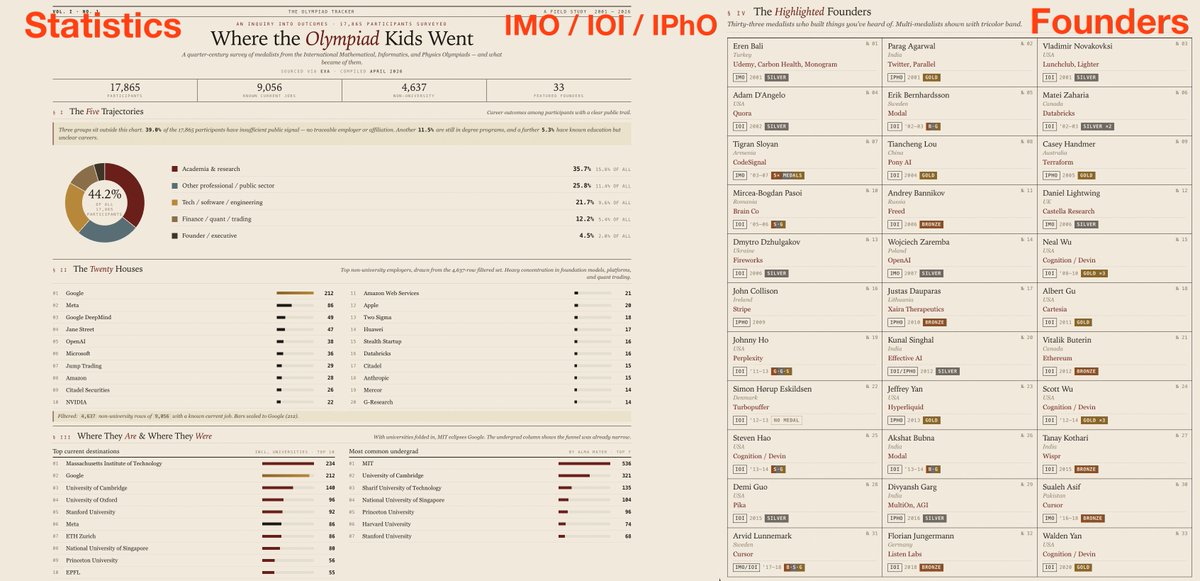
What do the smartest kids in the world do when they grow up?
I did the largest study of ~18,000 International Olympiad medalists (IMO, IOI and IPhO) over the last 25yrs, arguably the sharpest analytical minds of the world in high school, to see where they ended up and traced ~50% of them.
Founders of ~20 unicorns and ~7 decacorns and ~10 billionaires: OpenAI, Cursor, Stripe, Databricks, Perplexity, Ethereum, Cognition, Hyperliquid, Fireworks, Modal, Quora, Parallel, Cartesia, Wispr
Most kids went to MIT, a whopping 12% of them, followed by Cambridge (7%) and Sharif (3%)!
The career paths they chose (of those who graduated) were:
— 36% Academia (professors)
— 26% Other
— 22% in Software / Tech
— 12% in Quant / Finance
— 5% Founders!
The biggest employer was Google, by far, at 6%.
Others interesting tidbits were:
— 47 of them work at Jane Street (#3)
— 38 at OpenAI (#5)
— 15 at Anthropic
— 8 at Cognition
— 6 at Isomorphic Labs
Olympiaders were 1500x more likely to be billionaires and 4000x more likely to be unicorn founders than the average person!
Joy Of Giving Video no. 26
Harakhchand Savla, who left everything behind to serve those fighting life’s toughest battles outside Tata Memorial Hospital. Because true wealth lies not in what we earn, but in the lives we uplift.
#MotilalOswalFoundation#JoyOfGiving#Service #KindnessThatInspires #inspirational
JEE Mains में 99 परसेंटाइल और 25 लाख का खर्च, फिर भी नहीं मिलेगा IIT? ये कैसा सिस्टम जो पेरेंट्स को तोड़ रहा
हर साल लाखों छात्र आईआईटी का सपना देखते हैं, लेकिन क्या 99 परसेंटाइल भी सफलता की गारंटी है? 26 छात्रों का परफेक्ट 100 परसेंटाइल, 30 हजार से ज्यादा टॉपर और 25 लाख तक पहुंच चुका कोचिंग का भारी-भरकम खर्च! क्या देश की सबसे प्रतिष्ठित इंजीनियरिंग परीक्षा अब महज एक 'महंगी लॉटरी' बनकर रह गई है?
समझिए पूरा गणित : https://t.co/p8bdO6yh1X
#JEE #IIT #EducationSystem #Coaching #Students #Competition
Dear @NTA_Exams in the 4S1 JEE main final ans key, the wrong que (ID: 695278261) has been dropped. The gas equation que was correct, while the Brewster’s angle question (ID: 695278270) was incorrect and should be dropped. Please rectify, as this impacts percentiles unfairly.
We're looking for a CEO to lead the Plaksha Incubation Centre (PIC) 🚀
@PlakshaUniv
Not a manager. A builder.
Someone who can turn a deeptech incubator in Northern India into the country's most consequential startup hub.
Here's what we need 👇
I want to see such indian content creators being celebrated, way more than we do.
What an awesome way to remember formulas: Bam Bam Bhole , Sona Chandi Tole 🤩
There's a physicist at Stanford named Safi Bahcall who modeled this exact principle and the math is wild.
He calls it "phase transitions in human networks." When you're stationary, your probability of a lucky event is limited to your existing surface area: the people you already know, the places you already go, the ideas you've already been exposed to. Your opportunity window is fixed.
When you move, your collision rate with new nodes in a network increases nonlinearly. Double your movement (new conversations, new cities, new projects) and your probability of a serendipitous encounter doesn't double. It roughly quadruples. Because each new node connects you to their entire network, not just to them.
Richard Wiseman ran a 10-year study at the University of Hertfordshire tracking self-described "lucky" and "unlucky" people. The single biggest differentiator wasn't IQ, education, or family money. Lucky people scored significantly higher on one trait: openness to experience. They talked to strangers more, varied their routines more, and said yes to invitations at nearly twice the rate.
The "unlucky" group followed the same routes, ate at the same restaurants, and talked to the same 5 people. Their networks were closed loops. No new inputs, no new collisions.
Luck isn't random. Luck is surface area. And surface area is a function of movement.
The lobster emoji is doing more work than most people realize. Lobsters grow by shedding their shell when it gets too tight. The growth requires a period of total vulnerability. No protection, no armor, soft body exposed to the ocean.
That's the cost of movement nobody posts about. You have to be uncomfortable first. The new shell only hardens after you've already moved.