🚨 Anthropic just showed a 27-minute workshop on how to actually do prompts for Claude.
Taught by the people who built it.
Free. No registration. No paywall.
I've seen $300 courses that don't cover what they teach in the first 8 minutes.
Watch it and bookmark it now.
Software Engineers who made grep, cat, cut, find, ls, less, and sed really cooked here.
50 years later and it’s still bread and butter of data analysis.
And it still works better than most of bloated alternatives.
- you are
- a random CS grad with 0 clue how LLMs work
- get tired of people gatekeeping with big words and tiny GPUs
- decide to go full monk mode
- 2 years later i can explain attention mechanisms at parties and ruin them
- here’s the forbidden knowledge map
- top to bottom, how LLMs *actually* work
- start at the beginning
- text → tokens
- tokens → embeddings
- you are now a floating point number in 4D space
- vibe accordingly
- positional embeddings:
- absolute: “i am position 5”
- rotary (RoPE): “i am a sine wave”
- alibi: “i scale attention by distance like a hater”
- attention is all you need
- self-attention: “who am i allowed to pay attention to?”
- multihead: “what if i do that 8 times in parallel?”
- QKV: query, key, value
- sounds like a crypto scam
- actually the core of intelligence
- transformers:
- take your inputs
- smash them through attention layers
- normalize, activate, repeat
- dump the logits
- congratulations, you just inferred a token
- sampling tricks for the final output:
- temperature: how chaotic you want to be
- top-k: only sample from the top K options
- top-p: sample from the smallest group of tokens whose probabilities sum to p
- beam search? never ask about beam search
- kv cache = cheat code
- saves past keys & values
- lets you skip reprocessing old tokens
- turns a 90B model from “help me I’m melting” to “real-time genius”
- long context hacks:
- sliding window: move the attention like a scanner
- infini attention: attend sparsely, like a laser sniper
- memory layers: store thoughts like a diary with read access
- mixture of experts (MoE):
- not all weights matter
- route tokens to different sub-networks
- only activate ~3B params out of 80B
- “only the experts reply” energy
- grouped query attention (GQA):
- fewer keys/values than queries
- improves inference speed
- “i want to be fast without being dumb”
- normalization & activations:
- layernorm, RMSnorm
- gelu, silu, relu
- they all sound like failed Pokémon
- but they make the network stable and smooth
- training goals:
- causal LM: guess the next word
- masked LM: guess the missing word
- span prediction, fill-in-the-middle, etc
- LLMs trained on the art of guessing and got good at it
- tuning flavors:
- finetuning: new weights
- instruction tuning: “please act helpful”
- rlhf: reinforcement from vibes and clickbait prompts
- dpo: direct preference optimization — basically “do what humans upvote”
- scaling laws:
- more data, more parameters, more compute
- loss goes down predictably
- intelligence is now a budget line item
- bonus round:
- quantization:
- post-training quantization (PTQ)
- quant-aware training (QAT)
- models shrink, inference gets cheaper
- gguf, awq, gptq — all just zip files with extra spice
- training vs inference stacks:
- deepspeed, megatron, fschat — for pain
- vllm, tgi, tensorRT-LLM — for speed
- everyone has a repo
- nobody reads the docs
- synthetic data:
- generate your own training set
- model teaches itself
- feedback loop of knowledge and hallucination
- welcome to the ouroboros era
- final boss secret:
- you can learn *all of this* in ~2 years
- no PhD
- no 10x compute
- just relentless curiosity, good bookmarks, and late nights
- the elite don’t want you to know this
- but now that you do
- choose to act
- start now
- build the models
Learning java is so hard.
This note will make it easy to learn Java.
Get the most comprehensive Java guide available, with over 300 pages of chapter-wise notes.
For the next 24 hours, it is FREE.
To get it, just
1. Like.
2. Reply "Java".
3. Follow me for DM
If you are a backend engineer, you have to understand SOLID principle without any exception. I have received multiple dms asking me to explain it in an understandable way. So here we go. Save this, you'll thank me later.
SOLID is a set of five design principles that help developers create software that is easy to maintain, understand, and extend. Think of this like rules for building with lego bricks, and shouldn't fall apart when you add a new piece.
→S - Single Responsibility Principle
A class should have only one job or one reason to change.
How I remember: A screwdriver is designed to drive screws. It's not also a hammer and a saw. If you make it do too many things, it becomes complex and hard to use properly.
→O - Open/Closed Principle
Software should be open for extension, but closed for modification. Means one should be able to add new features without changing the existing, tested code.
How I remember: Your phone is "closed" because you can't change its core operating system. But it's "open" cause one can extend its functionality by installing new apps from the Play/App Store without breaking the phone.
→L - Liskov Substitution Principle
If you have a class A, any class B that inherits from A should be able to replace A without causing any errors. In short, child classes should be perfectly substitutable for their parent classes.
How I remember: If you have a universal remote control designed for a "TV," it should work whether you're pointing it at a Samsung TV or an LG TV. You can substitute one type of TV for another, and the remote still works as expected
→I - Interface Segregation Principle
Clients should not be forced to depend on interfaces or methods they do not use. It's better to have many small, specific interfaces than one large, general-purpose one.
How I remember: When you go to a restaurant, you don't get one giant menu with every food item in the world. You get a breakfast menu, a lunch menu, or a dessert menu. You only see what's relevant to you at that moment
→D - Dependency Inversion Principle
High-level modules (your main business logic) should not depend on low-level modules (like a specific database or a payment gateway). Both should depend on abstractions (like a generic Database interface).
How I remember: You don't wire a lamp directly into your house's electrical system. Instead, the lamp has a standard plug, and your wall has a standard socket. The plug and socket (the abstraction) allow you to switch out the lamp for any other appliance without rewiring your house.
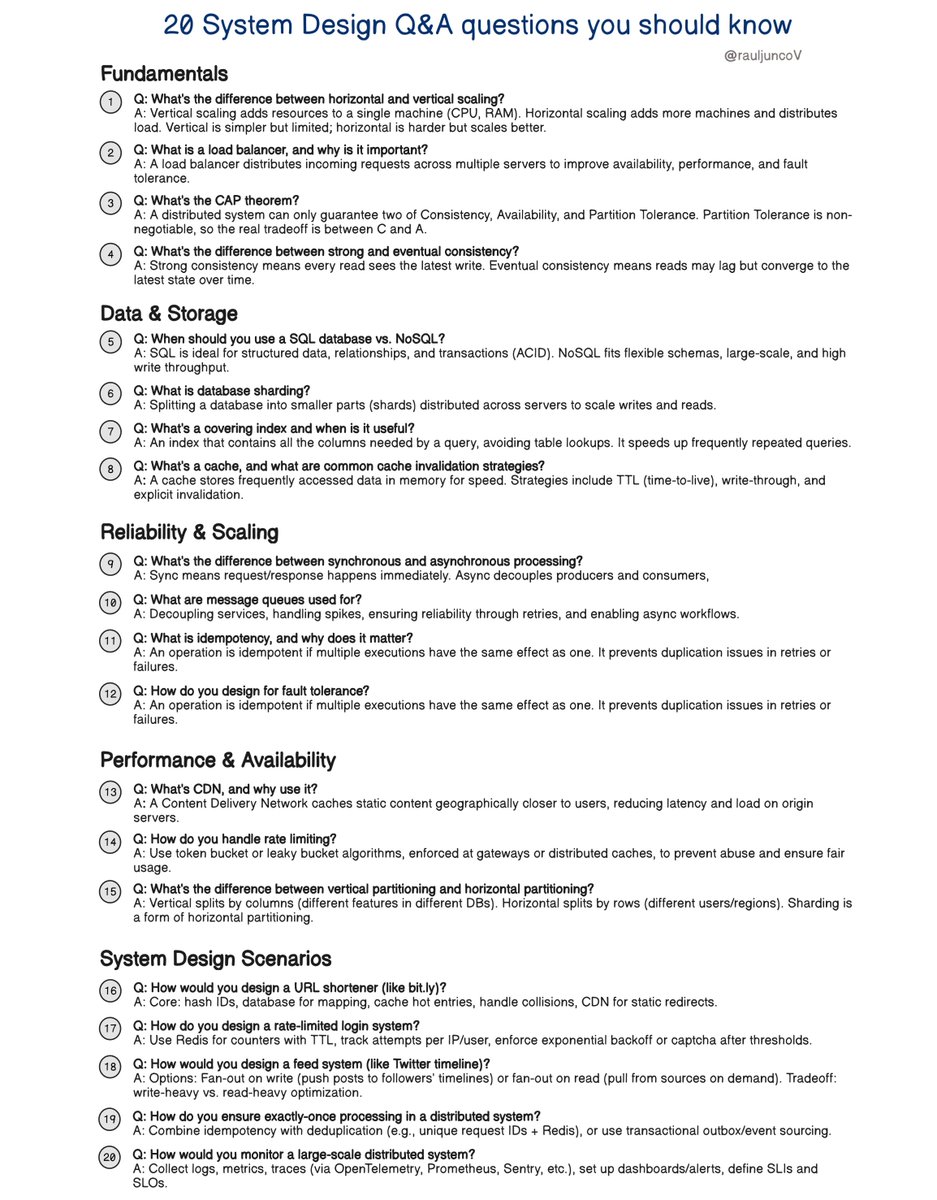
Most engineers stay average because they practice code questions.
Top engineers get ahead because they practice system design questions.
These 20 aren’t trivia.
They’re the ones that reveal if you can actually scale, simplify, and ship.
Read them. Save them. Drill them.
Because the engineer who can design systems…
…owns the room.
Add more to this list.