one agent is good
a team of 100 agents is something else
Ruflo turns Claude Code and Codex into a coordinated AI team
100+ specialized agents for coding, testing, security and docs
shared memory across sessions
agents learn from tasks that worked
a live console to track every agent, token and dollar spent
works with Claude, GPT, Gemini and local models
free and open source, 75,000 stars
one agent is good
a team of 100 agents is something else
Ruflo turns Claude Code and Codex into a coordinated AI team
100+ specialized agents for coding, testing, security and docs
shared memory across sessions
agents learn from tasks that worked
a live console to track every agent, token and dollar spent
works with Claude, GPT, Gemini and local models
free and open source, 75,000 stars
4 free GitHub repos that make Claude Code way more powerful:
1. ai-memory: gives Claude Code long-term memory, and lets you switch to Codex or Cursor mid-task without losing context (5.5K stars)
2. OpenSpec: your AI writes a plan with you before touching any code (71K stars)
3. ai-job-search: turns Claude Code into a job hunting assistant that tailors your CV and cover letters (45K stars)
4. iFixAi: audits your AI agent and grades it from A to F in under 2 minutes (24K stars)
save this for your next project
4 free GitHub repos that make Claude Code way more powerful:
1. ai-memory: gives Claude Code long-term memory, and lets you switch to Codex or Cursor mid-task without losing context (5.5K stars)
2. OpenSpec: your AI writes a plan with you before touching any code (71K stars)
3. ai-job-search: turns Claude Code into a job hunting assistant that tailors your CV and cover letters (45K stars)
4. iFixAi: audits your AI agent and grades it from A to F in under 2 minutes (24K stars)
save this for your next project
4 free GitHub repos that make Claude Code way more powerful:
1. ai-memory: gives Claude Code long-term memory, and lets you switch to Codex or Cursor mid-task without losing context (5.5K stars)
2. OpenSpec: your AI writes a plan with you before touching any code (71K stars)
3. ai-job-search: turns Claude Code into a job hunting assistant that tailors your CV and cover letters (45K stars)
4. iFixAi: audits your AI agent and grades it from A to F in under 2 minutes (24K stars)
save this for your next project
most people pay every month for AI stuff they could run for free on their own computer.
6 open source repos to build your own AI kit:
1. Ollama: run AI models on your own computer, no API bills (147K stars)
2. AnythingLLM: a desktop AI that reads your documents and answers questions about them (64K stars)
3. OpenClaw: your personal AI assistant, local-first, connected to your channels (385K stars)
4. Dify: build AI workflows by dragging blocks, no code (110K stars)
5. OpenHands: an agent that writes code for you (60K stars)
6. AutoGPT: autonomous agents that handle long tasks without you babysitting them (175K stars)
save this before you lose it
most people pay every month for AI stuff they could run for free on their own computer.
6 open source repos to build your own AI kit:
1. Ollama: run AI models on your own computer, no API bills (147K stars)
2. AnythingLLM: a desktop AI that reads your documents and answers questions about them (64K stars)
3. OpenClaw: your personal AI assistant, local-first, connected to your channels (385K stars)
4. Dify: build AI workflows by dragging blocks, no code (110K stars)
5. OpenHands: an agent that writes code for you (60K stars)
6. AutoGPT: autonomous agents that handle long tasks without you babysitting them (175K stars)
save this before you lose it
most people pay every month for AI stuff they could run for free on their own computer.
6 open source repos to build your own AI kit:
1. Ollama: run AI models on your own computer, no API bills (147K stars)
2. AnythingLLM: a desktop AI that reads your documents and answers questions about them (64K stars)
3. OpenClaw: your personal AI assistant, local-first, connected to your channels (385K stars)
4. Dify: build AI workflows by dragging blocks, no code (110K stars)
5. OpenHands: an agent that writes code for you (60K stars)
6. AutoGPT: autonomous agents that handle long tasks without you babysitting them (175K stars)
save this before you lose it
ONE COMMAND, AI ON YOUR LAPTOP
Ollama runs open AI models right on your own machine.
Install it, type "ollama run gemma4" and you're chatting.
It runs DeepSeek, Qwen, Gemma, gpt-oss, Kimi and more.
It works on macOS, Windows and Linux, with 1 install line each.
"ollama launch claude" starts Claude Code through it.
Your other apps can talk to it through a local API on port 11434.
How big a model you can run depends on your hardware.
182.4k stars on GitHub
ONE COMMAND, AI ON YOUR LAPTOP
Ollama runs open AI models right on your own machine.
Install it, type "ollama run gemma4" and you're chatting.
It runs DeepSeek, Qwen, Gemma, gpt-oss, Kimi and more.
It works on macOS, Windows and Linux, with 1 install line each.
"ollama launch claude" starts Claude Code through it.
Your other apps can talk to it through a local API on port 11434.
How big a model you can run depends on your hardware.
182.4k stars on GitHub
Stop letting AI code without a plan
A free plugin on GitHub forces your agent to think first.
It's called Superpowers.
It walks your agent through 7 stages, from brainstorming to a finished branch.
It asks you questions, then shows the design for your approval.
It splits the work into tasks of about 2 to 5 minutes each.
It writes the tests before the code, then reviews the result against the plan.
In Claude Code it installs with 1 command.
Fair warning from the repo: sessions can burn more tokens than you expect.
293k stars on GitHub
Stop letting AI code without a plan
A free plugin on GitHub forces your agent to think first.
It's called Superpowers.
It walks your agent through 7 stages, from brainstorming to a finished branch.
It asks you questions, then shows the design for your approval.
It splits the work into tasks of about 2 to 5 minutes each.
It writes the tests before the code, then reviews the result against the plan.
In Claude Code it installs with 1 command.
Fair warning from the repo: sessions can burn more tokens than you expect.
293k stars on GitHub
Stop letting AI code without a plan
A free plugin on GitHub forces your agent to think first.
It's called Superpowers.
It walks your agent through 7 stages, from brainstorming to a finished branch.
It asks you questions, then shows the design for your approval.
It splits the work into tasks of about 2 to 5 minutes each.
It writes the tests before the code, then reviews the result against the plan.
In Claude Code it installs with 1 command.
Fair warning from the repo: sessions can burn more tokens than you expect.
293k stars on GitHub
Paid budgets are usually set one of two ways: last year’s number plus 10%, or whatever’s left after everything else. Neither one connects to the pipeline the company is being asked to produce.
Build it backwards instead (illustrative):
→ New ARR target: $4,000,000
→ ÷ average deal size $40k = 100 new customers
→ ÷ win rate 22% = 455 SQLs needed
→ × cost per SQL $1,450 = $660k for the year
→ − 35% that comes from non-paid sources = $429k paid, about $36k/month
Three things this does that “last year + 10%” can’t:
It makes the assumptions arguable. If $36k/month is unaffordable, the conversation becomes about win rate, deal size or target — which is the right conversation.
It shows what a win-rate change is worth. 22% → 26% takes 455 SQLs down to 385, and about $100k off the budget.
It gives you a number to defend in Q2 when someone asks why spend is where it is.
Start from the target, not from the spreadsheet row.
Most channel tests don’t fail. They get abandoned halfway, which is a different thing and teaches you nothing.
Four numbers, agreed before the first dollar goes in:
Budget floor. At least 3x your current cost per SQL, per month. Below that you’re buying noise — a handful of clicks and one lead that proves nothing either way.
Duration. Two full sales cycles. A three-week test on a 60-day cycle measures clicks and calls it a verdict.
Success metric. Cost per SQL, not cost per lead. Every new channel looks good on CPL in month one and most of them look very different by the time sales has worked the leads.
Exit criteria. Written down before launch, in the same doc as the other three. “Let’s give it another month” is a feeling, not a decision — and it’s how a $12k test quietly becomes a $40k one.
Do this and the test gives you an answer whichever way it goes: a channel you scale, or a channel you can stop arguing about.
The expensive outcome isn’t a channel that didn’t work. It’s three half-tested channels and no conclusion about any of them.
Run a search for your category today and every ad says the same thing: AI-powered, intelligent, automated, built for modern teams.
The word that used to differentiate is now the price of entry. Five swaps that still work:
Name the job, not the tech. “AI-powered analytics” → “Close the books 4 days faster”
Use a number you can defend. “Smarter workflows” → “Cut invoice approvals from 6 steps to 2”
Say who it’s not for. “For modern teams” → “For finance teams running NetSuite”
Show the before state. “Automate your pipeline” → “Stop rebuilding the same report every Monday”
Make the proof specific. “Trusted by leaders” → a named result from a named customer
The test is simple: if a competitor could run your ad unchanged, it isn’t an ad. It’s a category description you’re paying to distribute.
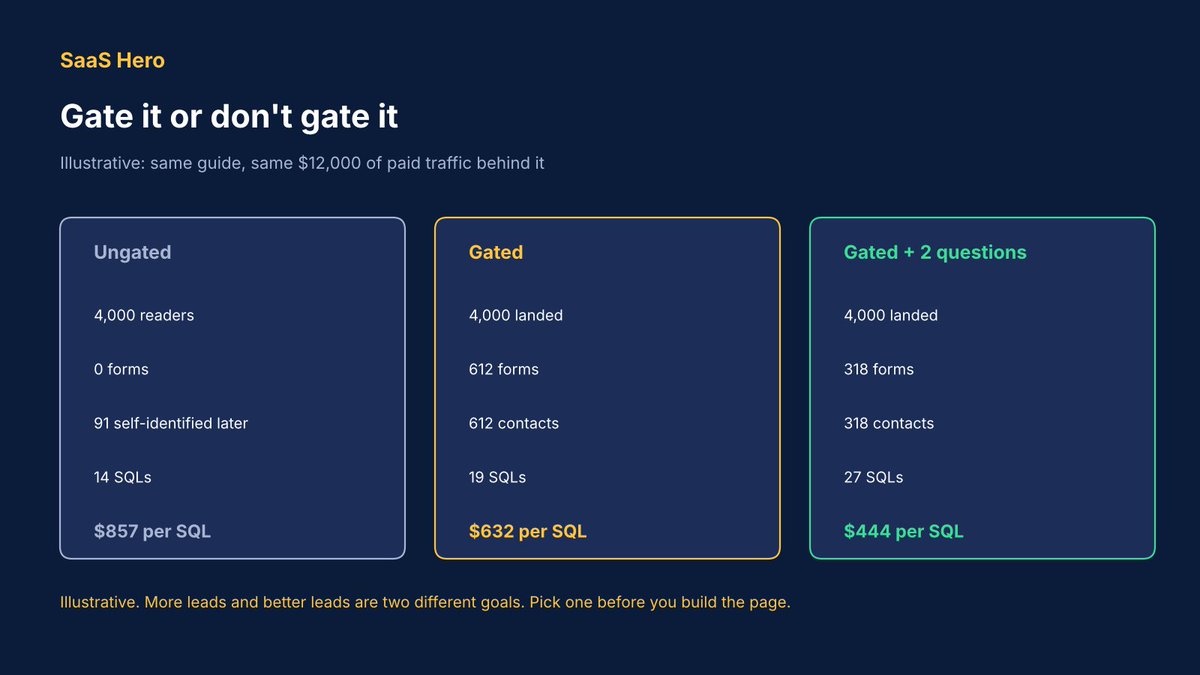
“Should we gate the guide?” is the wrong question. The right one is: what are we buying with this budget — volume or qualification?
Same guide, same $12,000 of paid traffic (illustrative):
Ungated — 4,000 readers, 0 forms. 91 eventually self-identify through other channels. 14 SQLs at $857 each.
Gated — 612 forms, 612 contacts, 19 SQLs at $632.
Gated + 2 qualifying questions (company size, current tooling) — only 318 forms. Half the leads. But 27 SQLs at $444.
The version with the fewest leads produced the most pipeline, because sales stopped working through 600 contacts to find 19.
A gate isn’t about hoarding the PDF. It’s about deciding who you’re willing to spend sales time on — and asking two extra questions is cheaper than finding out on a call.
"Should we bring paid media in-house?" An agency saying "never" would be lying to you. 🏢
Rough guide by monthly spend. Under $20K, one in-house hire can't realistically cover search, social, landing pages, CRO and reporting, so an agency or a specialist contractor usually wins. Between $20K and $80K, a hybrid works best: one in-house owner who holds the strategy, with outside specialists executing. Above $80K, the spend justifies a dedicated team, with specialists brought in for specific channels.
What matters more than the structure: who owns the accounts, the conversion tracking and the historical data. We've inherited plenty of accounts where the previous owner left and took all the context with them.
Whatever you decide, make sure the strategy and the data stay with your company. The execution can move. 🔑
More campaigns feels like more control. Usually it's less performance. 🧩
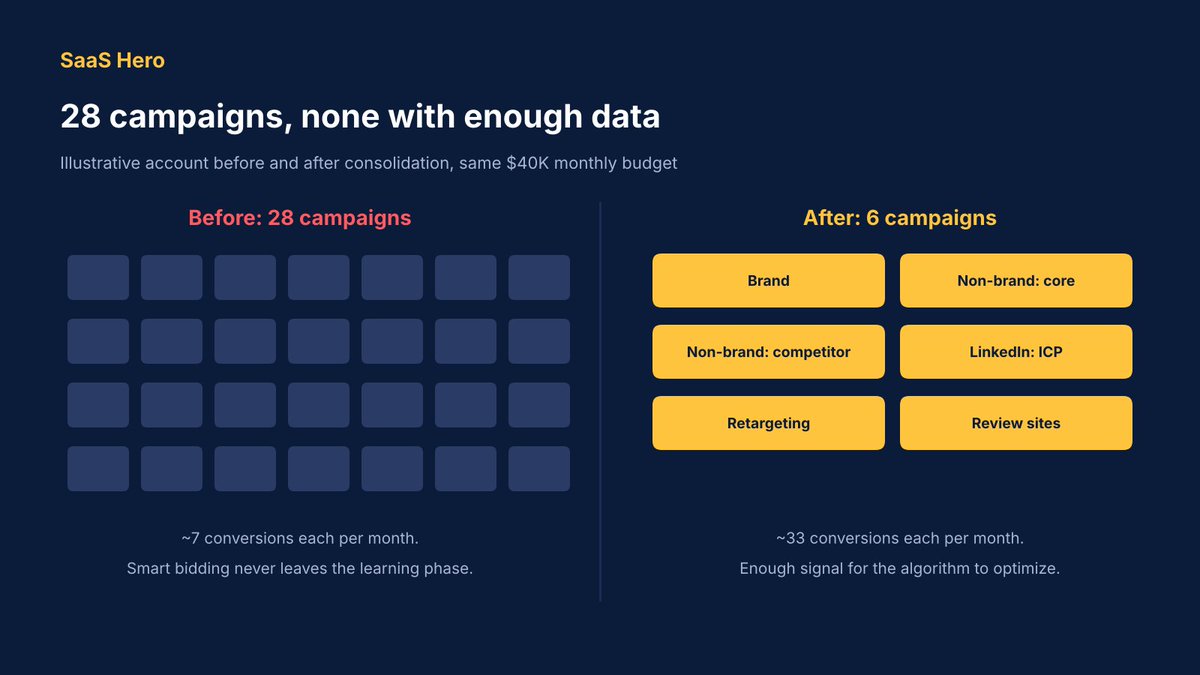
Accounts grow by accumulation: a campaign per product, per persona, per region, per test nobody turned off. Then smart bidding has to learn from a handful of conversions in each one, and it never gets out of the learning phase.
In this illustrative example, a $40K monthly budget produced around 200 conversions, spread across 28 campaigns. That's about 7 each, far below what automated bidding needs. Consolidated into 6 campaigns that match how the business actually buys media, each one gets about 33.
Consolidate where the strategy is the same, and separate only where you need a different budget, a different bid strategy or a genuinely different audience.
Granularity was a strength when you set bids by hand. Now it starves the algorithm. 📉
More campaigns feels like more control. Usually it's less performance. 🧩
Accounts grow by accumulation: a campaign per product, per persona, per region, per test nobody turned off. Then smart bidding has to learn from a handful of conversions in each one, and it never gets out of the learning phase.
In this illustrative example, a $40K monthly budget produced around 200 conversions, spread across 28 campaigns. That's about 7 each, far below what automated bidding needs. Consolidated into 6 campaigns that match how the business actually buys media, each one gets about 33.
Consolidate where the strategy is the same, and separate only where you need a different budget, a different bid strategy or a genuinely different audience.
Granularity was a strength when you set bids by hand. Now it starves the algorithm. 📉
Not everyone searching your category is ready for a demo. Give them something else to click. 🧰
A free tool, calculator or benchmark report captures demand far earlier in the buying process, and it works on keywords where a demo page simply won't convert.
In this illustrative comparison of $10,000 in search spend, a demo request page produced 68 leads at $147 each, 22 of which became SQLs, at $455 per SQL, with opportunities appearing in about 11 days. A free tool page produced 420 leads at $24, 54 SQLs at $185, but opportunities took about 38 days.
Cheaper leads, more of them, slower to convert. That's a trade-off worth making deliberately, with nurture and retargeting built to carry those leads forward, not an accident you discover a quarter later.
Fill the top of the funnel and the bottom. Just measure them separately. 📊
Your cost per lead is down 30%. Your sales team is furious. Both can be true. 🤖
In this illustrative month, 500 demo requests came in from paid campaigns. 95 were bots and spam. 120 were students, job seekers and competitors. 105 were real companies far outside the ICP. That left 180 genuine prospects.
The dashboard reports a great cost per form fill. The real cost per prospect worth calling is nearly three times higher, and reps lose hours sorting through the rest.
What helps: bot protection and honeypot fields on every form, blocking free email domains where it fits your market, enriching each submission with firmographic data before it reaches the CRM, and sending only the qualified ones to sales while the rest go to nurture.
Then optimize campaigns on qualified leads, not form fills. The algorithm learns from whatever you feed it. 🎯
Introducing SaaS Hero ABM. 🎯
For B2B SaaS companies selling to a defined list of target accounts, we now run full account-based marketing programs: building the account list with sales, coordinating LinkedIn, display and search ads for those accounts, personalizing landing pages by industry and tracking engagement and pipeline account by account in your CRM.
Marketing and sales finally work from the same list, and every dollar goes toward accounts that can actually buy.
Learn more at https://t.co/apz63dodLy
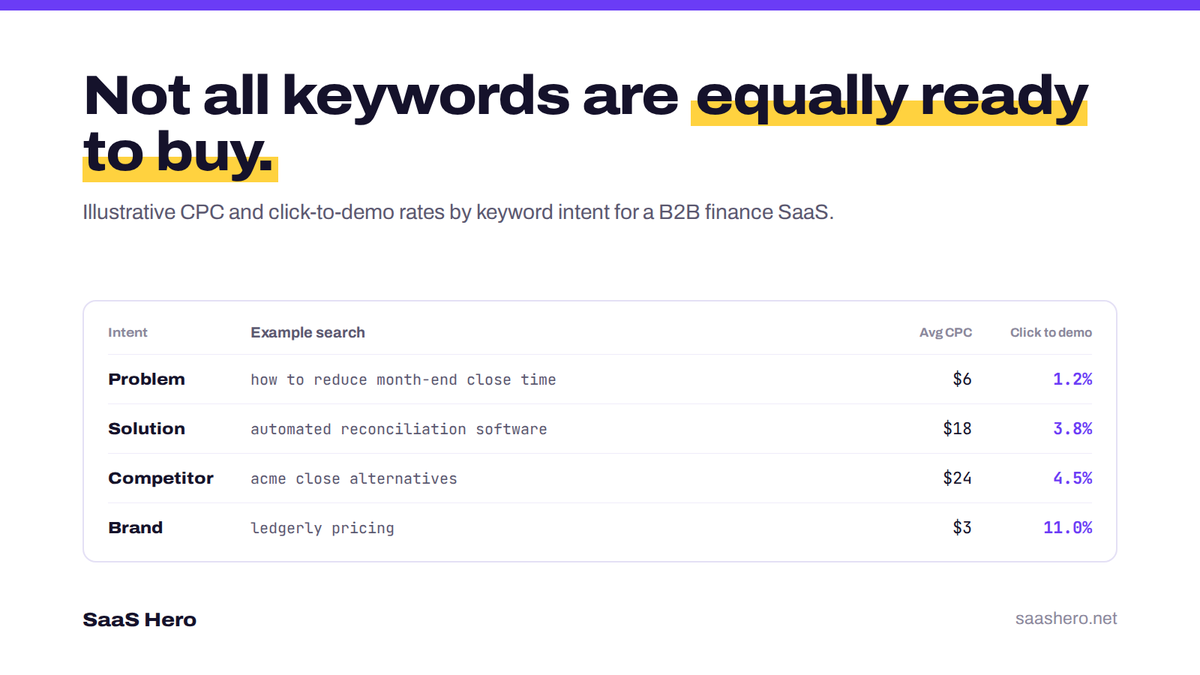
Not all keywords are equally ready to buy.
In this illustrative example for a B2B finance SaaS, a problem search like "how to reduce month-end close time" costs about $6 per click, but only 1.2% of clicks request a demo. A solution search costs $18 and converts at 3.8%. A competitor alternative search costs $24 and converts at 4.5%. A branded pricing search costs $3 and converts at 11%.
Each tier needs a different offer, a different page and a different budget. 🎯
Not all keywords are equally ready to buy.
In this illustrative example for a B2B finance SaaS, a problem search like "how to reduce month-end close time" costs about $6 per click, but only 1.2% of clicks request a demo. A solution search costs $18 and converts at 3.8%. A competitor alternative search costs $24 and converts at 4.5%. A branded pricing search costs $3 and converts at 11%.
Each tier needs a different offer, a different page and a different budget. 🎯
Building a new category? Your buyers aren't searching for your product name yet. 🧭
When a category is new, keyword research has to start with the problem, not the solution. What are people searching when they feel the pain your product solves? What tools are they using today, and what do they search when those tools fail them?
Those problem-based searches often have lower volume and lower intent, so pair them with content that educates, and retarget the people who engage.
You can't capture demand that doesn't exist yet. You can meet people where the problem already is.